Stobo Castle: A Historic Estate and Health Spa


Site at a Glance
- Rating
- 4.7
- Popularity
- Medium
- Country
- United Kingdom
- Primary era
- Modern
- External website
- Open
- Eras represented
- Modern
- Civilizations
- British
- Site type
- Domestic
- Remains
- Castle
On this page7 sections
History
Stobo Castle is a castellated early nineteenth-century castle in Stobo, United Kingdom, built between 1805 and 1811 in the Scottish Borders. It is the seat historically associated with the barony of Stobo, a hereditary territorial lordship created in 1577 whose origins reach back to the twelfth century.
From Church Lands to the Murrays
In the twelfth century, the lands of Stobo were held by the church. After church property was secularized during the Reformation, the estate passed through several families and noble houses, including the Tweedies, the earls of Morton, and the Maitlands. By the early seventeenth century, it had come into the hands of the Murrays.
Stobo was associated with Alexander Murray, 3rd Baronet, whose son David inherited the estate. David Murray took part in the Jacobite uprisings of 1745, attempts to restore the Stuart dynasty to the British throne. After his exile in France, his property claims were forfeited.
The Montgomery Estate
James Montgomery acquired Stobo and its barony in the 1760s. He later became Lord Advocate and Lord Chief Baron of the Scottish Exchequer, and received a baronetcy, a hereditary British dignity, in 1801. His son inherited the estate in 1803 and commissioned the present castle, whose construction was supervised by Archibald and James Elliot from 1805 to 1811.
The Montgomery period also saw the development of the surrounding parkland. In 1650, Stobo Estate and Dawyck House became the first estates in Scotland to introduce the non-native horse chestnut. A covered carriage entrance, or porte-cochère, was added to the castle in 1849. Sir Graham Graham-Montgomery, 3rd Baronet, later commissioned further work on the grounds, including a redesign by John Hay in 1872.
Twentieth-Century Changes
After the Montgomery baronetcy became extinct in the early twentieth century, Stobo Castle was sold to the English cricketer Hylton Philipson. He owned the estate until 1939 and developed its gardens with Japanese-influenced water gardens and terraces, as well as three large lakes.
In 1939, after Philipson’s death, the castle was purchased by Wenefryde Scott, 10th Countess of Dysart. It was rarely occupied during the war years, and the countess later sold parts of the estate. In the post-war period, the property was subdivided, while the contents of the house were auctioned by Sotheby’s in April 1972.
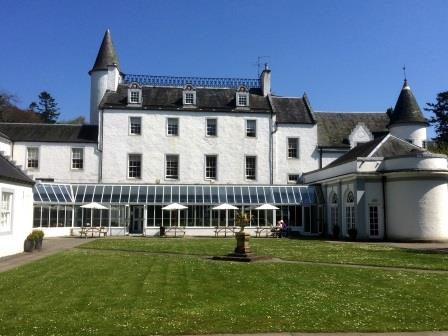
The Winyard family acquired the castle during the 1970s and established a hotel and health resort. A large extension containing additional hotel rooms and a swimming pool opened in 2003, and the property now operates as a health spa. The barony of Stobo is held separately from the castle and the surrounding estate. The 3,884-acre Stobo Estate was offered for sale in late 2020 and was subsequently divided into seven lots.
Stobo Castle is a Category A listed building, the highest level of national architectural or historic importance in Scotland. Its grounds are included in the Inventory of Gardens and Designed Landscapes in Scotland, which recognizes parks and gardens for their historical, horticultural, or landscape value. Historic Scotland assessed three of the grounds’ seven categories as outstanding.
Remains
Stobo Castle occupies the site of an earlier tower house known as Hill House, which was demolished before the present building was constructed. The surviving castle is arranged in a castellated style, using architectural features that evoke a fortified castle whether or not they served a defensive purpose. Its grounds extend toward the River Tweed near the junction with the Lour Burn, about ten kilometres southwest of Peebles.
The Castle
The main house was designed and built under the supervision of Archibald and James Elliot between 1805 and 1811. Its later covered carriage entrance was added in 1849 and designed by John Lessels. The twentieth-century extension forms part of the present complex and contains further hotel rooms and a swimming pool.
Parkland and Gardens
The parkland was developed during the Montgomery period and may have included the beginnings of the gardens. Hylton Philipson later created Japanese-influenced water gardens and terraces and laid out three large lakes across the estate. These designed landscape features remain part of the physical character of the grounds.