Steinerne Jungfrau: A Prehistoric Menhir in Halle, Germany
Site at a Glance
- Popularity
- Medium
- Country
- Germany
- Primary era
- Unclassified
- Eras represented
- Unclassified
- Civilizations
- Unclassified
- Site type
- Civic
- Remains
- Megalithic Monument
On this page4 sections
History
Archaeological context
The Steinerne Jungfrau is a prehistoric menhir, a large stone erected as a single prehistoric monument, at Dölau, a district of Halle (Saale), Germany. Finds from the surrounding area belong to several periods, including the Corded Ware culture, named for pottery decorated with cord impressions; the Middle Bronze Age, a regional label for a phase of the Bronze Age; the Iron Age; the Slavic Early Medieval period; and the Middle Ages.
Medieval use and local traditions
During the Middle Ages, people used the stone as a nail stone, driving nails into it as part of a customary practice. Local belief held that this could be done only during torrential rain or a thunderstorm. Another local tradition associated the menhir with an annual Mass, at which three priests from nearby villages took turns officiating.
A legend tells of a maiden, perhaps a giant, who was returning from shopping in a storm. To cross puddles without getting dirty, she threw her newly bought loaf into the mud, then turned to stone where she stood. Other versions of the story describe a mother with two children or a girl on her way to a dance in Lettin.
Remains
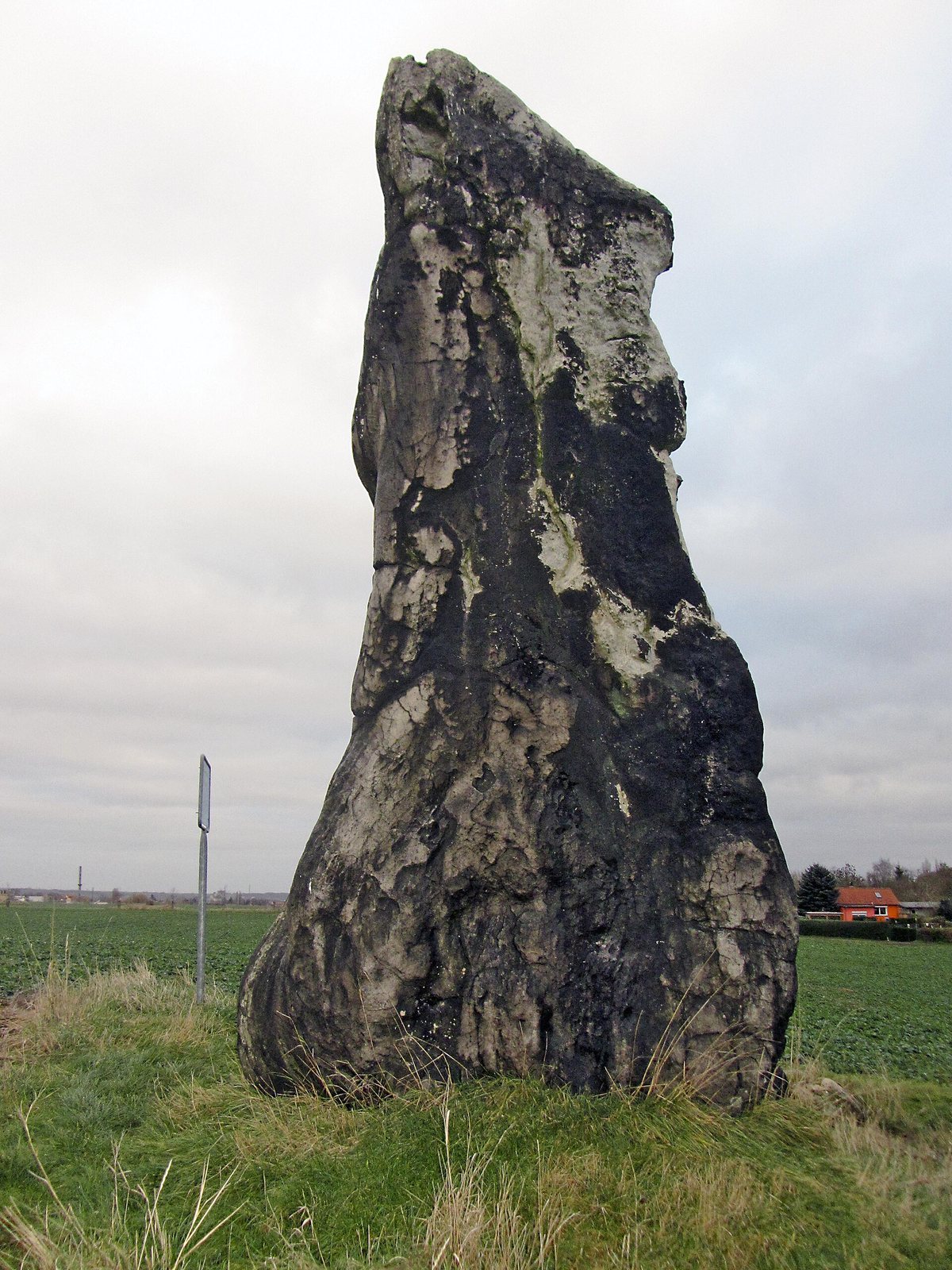
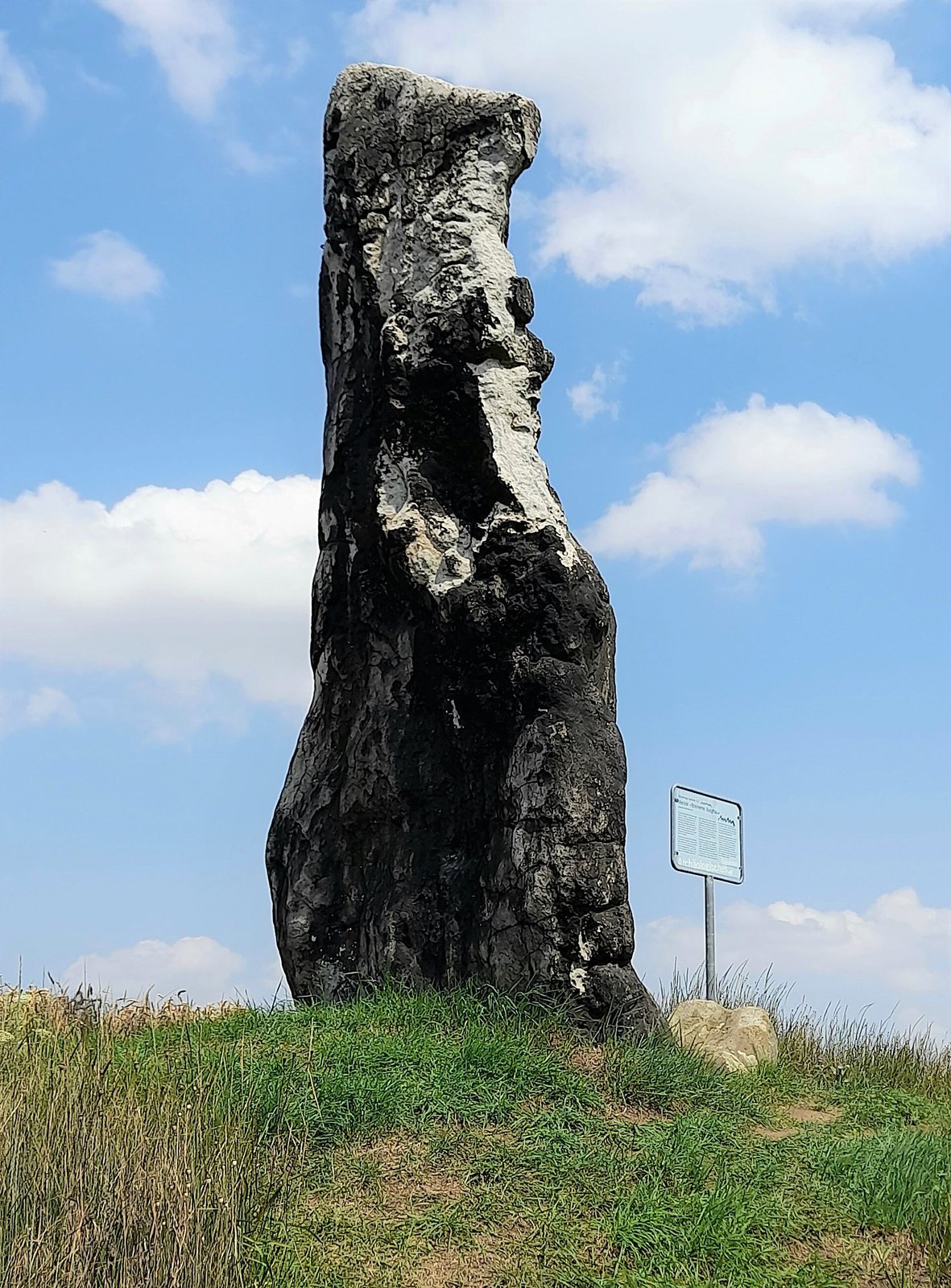
The stone stands at Dölau’s northern edge, on the gently descending southeast slope of a rise. It is made of gray-white lignite quartzite, though dirt has darkened its surface to gray and black. Its cross-section is approximately C-shaped, and its deeply fissured surface is crossed by a prominent crack.
The menhir measures 2.6 metres wide and 1.55 metres deep. Its height is generally given as about 5.5 metres, making it Central Europe’s second-largest menhir after the Gollenstein in Saarland. A 1957 measurement put it at 5.8 metres. In 1846, the geologist and antiquities writer Christian Keferstein estimated its original height at 25 feet, or about 8 metres, and later writers also considered it taller in the past.
Johann Christoph von Dreyhaupt, a historian of the Halle region, measured the stone at 8.5 ells in 1755. An ell was a forearm-based unit of length whose value varied by region; Dreyhaupt’s measurement is roughly equal to the menhir’s present height. This comparison suggests that later losses affected the sides, while breaks at the top occurred before the earliest written descriptions. Weathering has repeatedly broken off pieces, with the latest break occurring in 1890. Its original height remains uncertain.
Whether the menhir once belonged to a group is also uncertain. A map from 1840 refers to three Stone Maidens, while Dreyhaupt recorded a single stone in 1755. Nails remain embedded in the menhir, physical traces of its later customary use.