Halle Cathedral: A Gothic Hall Church and Former Collegiate Church in Germany


Site at a Glance
- Rating
- 4.4
- Popularity
- Low
- Country
- Germany
- Primary era
- Medieval
- External website
- Open
- Eras represented
- Medieval, Early Modern, Modern
- Civilizations
- Holy Roman Empire
- Site type
- Religious
- Remains
- Church
On this page15 sections
History
Halle Cathedral is the oldest surviving church building in Halle’s old town, in Halle (Saale), Germany. Founded by the Dominican order in 1271, it was completed around 1330 as a Gothic monastery church dedicated to Saint Paul of the Holy Cross. The building later became a collegiate church associated with the Archdiocese of Magdeburg, although it was never the seat of the archbishopric. It remains the parish church of Halle’s Evangelical-Reformed community and is now owned by the Cultural Foundation of Saxony-Anhalt.
Dominican foundation and collegiate transformation
The Dominicans were a Catholic mendicant order whose rule emphasized preaching and generally favored austere convent architecture. In keeping with those principles, the church was built without a tower or transept. For a long period, the Archbishops of Magdeburg resided in Halle as territorial rulers of the city, giving the church a place within the ecclesiastical and political landscape of the old town.
In 1520, the Dominicans lost the church and their adjoining convent buildings and were assigned the Church of Saint Maurice instead. From about the same time, Cardinal Albert of Brandenburg commissioned the building master Bastian Binder to remodel the exterior. The work substantially altered the church between 1520 and 1525. In 1523, it was reconsecrated as the collegiate church of the Archdiocese of Magdeburg under a dedication referring to Saint Maurice, Mary Magdalene, and the Lord’s Sweat-Cloth. In popular usage it subsequently became known as the Dom, or cathedral, despite never serving as an archbishop’s seat.
Albert of Brandenburg and the Reformation
Albert planned the church together with the neighboring Neue Residenz as an influential and representative ecclesiastical foundation. He assembled approximately 20,000 relics in the Halle relic treasury, a collection that no longer survives. The financing of relic devotion through the sale of indulgences, which offered remission of punishments for sin within Catholic teaching, became closely associated with Martin Luther’s criticism and the wider Reformation.
From 1523, Albert commissioned an elaborate interior involving Matthias Grünewald, Lucas Cranach the Elder and his workshop, and the sculptor Peter Schro. Between 1519 and 1525, Cranach’s workshop produced 16 Passion altarpieces with 140 painted panels. Only two altars, individual wings, models, and drawings survive. Albert’s opposition to Luther and the spread of the Reformation eventually forced him to leave Halle in 1541, when the city aligned itself with Protestantism. He took the church’s movable furnishings to Aschaffenburg. Surviving pieces are now held in the State Gallery in Johannisburg Castle and other museum collections.
Court church and Protestant parish
After the Magdeburg bishopric was secularized, its secular administrators used the church as a court and palace church. Duke Augustus of Saxe-Weissenfels, the last of these administrators, gave the interior an early Baroque appearance in the mid-seventeenth century by adding galleries and a large show altar. After 1680, Frederick William, Elector of Brandenburg, assigned the building indefinitely to the Evangelical-Reformed community as its parish church. The community held its first service there in 1688.
The church also became associated with the Jena Ladies’ Foundation, a secular collegiate foundation for noblewomen rather than a monastic convent. Established in 1702 by Chancellor Gottfried von Jena with royal Prussian approval, the foundation formally installed its first abbess in the church in 1703. The abbesses were buried inside the church, while other members were buried in the cloister. In 1702 and 1703, Georg Friedrich Handel served as organist on a one-year probationary appointment, early in the career of the German-born Baroque composer and keyboard musician.
Restoration and continuing use
The parish replaced the Baroque organ in 1851 with a new instrument built by Friedrich Wilhelm Wäldner and his son, August Ferdinand Wäldner. Between 1883 and 1896, the interior was remodeled in a nineteenth-century Gothic manner, a process known as regothicization. The Institute for the Preservation of Historic Monuments restored the exterior walls and interior in 1957–1959 despite severe shortages of materials. A comprehensive renovation of the church and adjoining buildings began in 1996 under the Dom Foundation of Saxony-Anhalt and was largely completed by 2005. The building continues to serve Halle’s Evangelical-Reformed parish.
Remains
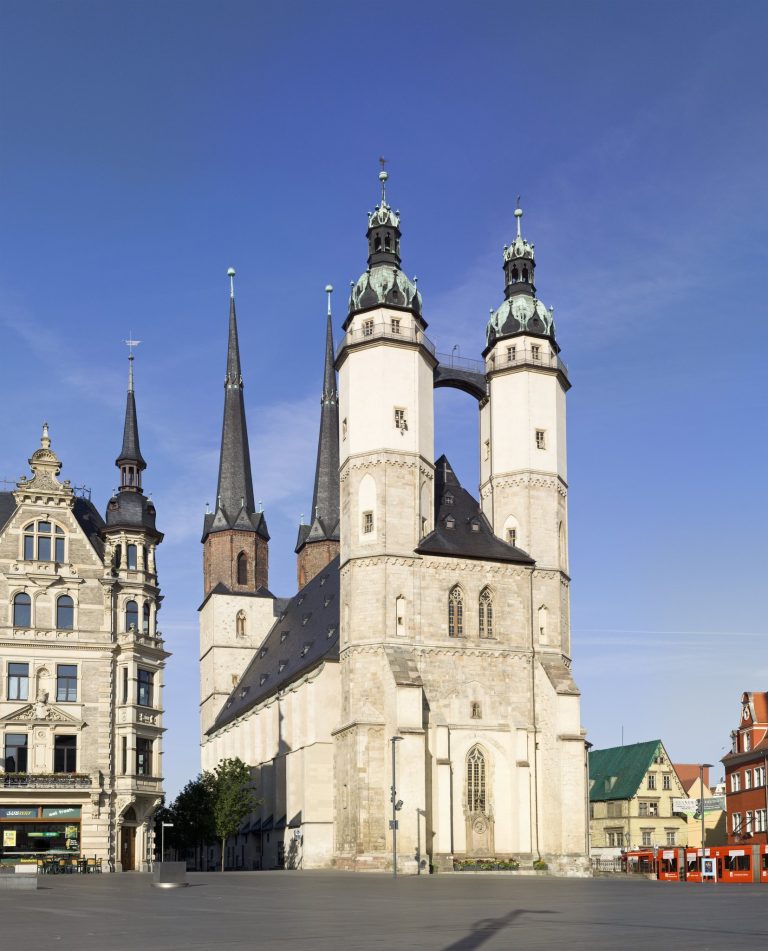
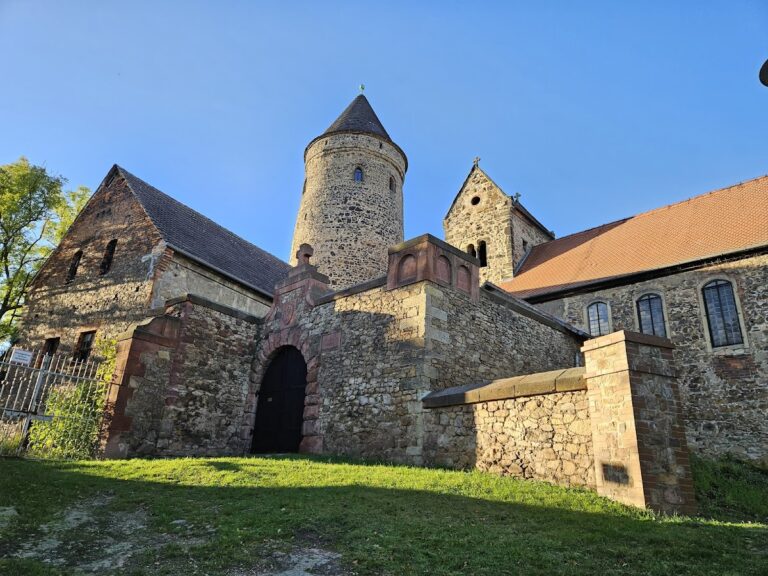
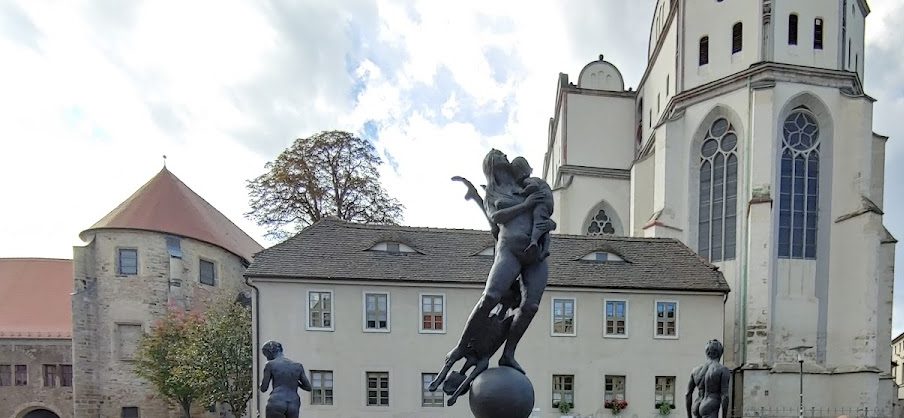
Halle Cathedral stands beside an arm of the Saale at the western edge of Halle’s old town. Together with the Neue Residenz and Moritzburg, it forms part of the city’s architectural frontage along the river and is a major feature of Domplatz. The surviving building is a three-aisled Gothic hall church, a type in which the nave and aisles are of broadly similar height and create a unified interior space. It measures approximately 68 metres long, 20 metres wide, and 18 metres high. Its design is marked by strict regularity, restrained profiles, and restrained tracery.
Gothic structure and surviving convent
The interior is formed by smooth, octagonal piers without capitals and large pointed-arch windows with simple tracery. The nave has eight bays and was formerly divided from the choir by a rood screen, a partition separating the main nave from the sanctuary. On the north side, only remains of the Gothic cloister survive from the former convent complex.
Renaissance alterations
Rounded gables
The exterior received rounded Renaissance gables in 1526. They were originally decorated with frescoes of lilies. The rounded-gable form, known from Italian religious and secular buildings, is described as the first example of its kind north of the Alps.
Portals and pulpit
Several Renaissance entrances survive, including the southeast portal, the portal leading to the sacristy, and a fragment of a portal in the western interior. The richly decorated stone pulpit dates from 1526. Its stairway depicts the Church Fathers, while the pulpit basket shows the authors of the New Testament Epistles, the four Evangelists with their attributes, and Moses holding the tablets of the Law.
Pier statues
A cycle of 17 over-life-size statues was completed in 1525 by Peter Schro, an artist associated with the school of Hans Backoffen. The figures represent Christ, the apostles including Saint Paul, the diocesan patron Saint Maurice, and Saint Mary Magdalene. The statue of Saint Erasmus is almost entirely obscured by the later organ construction, and an eighteenth figure, probably Saint Ursula, has been lost.
Baroque furnishings and memorials
The large show altar in the choir and all the galleries date chiefly from the 1660s, when the church served as a court and palace church. A Renaissance spiral staircase gives access to the south gallery and probably once led to an elevated gallery for singers or musicians. The interior also contains tombstones and epitaphs, including a full-length tombstone of a mother and child from around 1380 and a 1620 epitaph by a Magdeburg master. Two elaborately decorated votive tablets from 1523 record Cardinal Albert’s remodeling of the church.
Organs
Wäldner organ
The first cathedral organ was built in 1667 by Christian Förner of Wettin. It was replaced by the Wäldner organ, constructed in Halle between 1847 and 1851 by Friedrich Wilhelm and August Ferdinand Wäldner. The instrument has 33 stops. New façade pipes and reed stops were installed in 1922, and its tonal arrangement was revised in a neo-Baroque direction in 1946, 1956, and 1972. Inadequate maintenance and a lack of repair funds caused it gradually to fall silent after German reunification.
The main organ was restored and reconstructed in 2017–2018 by the Wegscheider Organ Workshop of Dresden and the Halle conservator Kerstin Klein. The work restored its historically documented original tonal arrangement attributed to August Gottfried Ritter, and the instrument sounded again on 24 December 2018. Its reconstructed features include mechanical slider chests, which use sliding valves to control the wind, and five single-fold bellows. The stated wind pressure is 77 millimetres water gauge for the manuals and 96 millimetres for the pedal, with a pitch of 444 hertz at 17.7 degrees Celsius.
Stephani organ
A second organ, built in 1799 by the Leipzig university organ builder Johann Gottlob Ehregott Stephani, is also installed in the cathedral. It originally served the village church of Kreudnitz, which was removed by earthmoving works between 1968 and 1971. The mechanically operated instrument has slider chests, 11 stops, one manual, and a pedal.
The Evangelical-Lutheran parish of Rötha in Saxony lent the Stephani organ to the cathedral parish in 2008 for an initial period of 25 years. The instrument had been dismantled by the Wegscheider firm to prevent its disposal, displayed temporarily in the Marienkirche in Stralsund, and later brought to Halle after it was discovered there by the pro-rector of Halle’s church music school. It remains playable and is being considered for restoration.