Starborough Castle: A Medieval Fortification and Garden Site
Site at a Glance
- Popularity
- Medium
- Country
- United Kingdom
- Primary era
- Medieval
- Eras represented
- Medieval, Early Modern, Modern
- Civilizations
- British, English
- Site type
- Military
- Remains
- Castle
On this page11 sections
History
Origins and medieval use
Starborough Castle is a medieval castle site on an artificial island near Surrey’s eastern boundary in the United Kingdom, about 3 km southwest of Edenbridge. It began as the manor house of Reginald de Cobham, an English nobleman. On 18 October 1341, Edward III granted him a licence to crenellate the building, meaning royal permission to fortify it with battlements. The house was fortified the following year and became known as Starborough Castle, also called Sterborough Castle.
Fifteenth-century ownership
After the Battle of Agincourt in 1415, Charles, Duke of Orléans, a French prince and poet, was held at the castle as a captive for a time. Around 1476, Edward Burgh acquired the property through his marriage to Anne Cobham, daughter of Sir Thomas Cobham.
Dismantling and garden use
On 4 July 1648, during the English Civil War, Parliament ordered the castle dismantled under Oliver Cromwell’s leadership. Cromwell was a leading Parliamentarian in the conflict, in which Royalists supported King Charles I against Parliament. Parliament feared the castle could be used as a base for a Royalist rebellion.
During the 18th century, the site became part of a country garden. In 1754, Sir James Burrow built a Neo-Gothic garden house, a separate building within a designed garden, using forms revived from medieval Gothic architecture. He also erected a manor house on the site, which was later demolished.
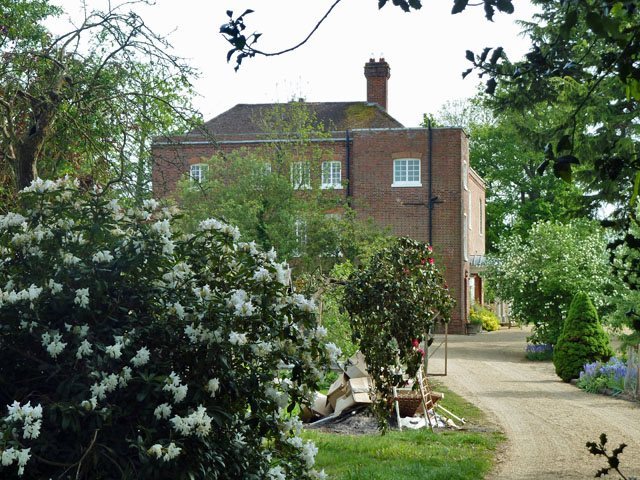
Sir Thomas Turton bought the property in 1793, cleared the moat and improved the water supply. He sold it to William Bruce Smith in 1812. Around 1870, the manor house was replaced by a residence near the lake, designed by John Tonge. James Moore owned the property that year.
Modern ownership and protection
R. V. Toynbee acquired the site in 1933, when it was in ruins. In the 1970s, local farmer and builder Ray Edwards acquired it, restored the garden house and sold the property to Warwick Leadlay, who added outbuildings.
The site became a scheduled monument in 1953, a designation for a nationally important historic or archaeological site protected by law in England. Its walls and garden house received Grade II* listing in 1958, a category for particularly important buildings of more than special interest, between Grade I and Grade II.
Remains
Medieval castle
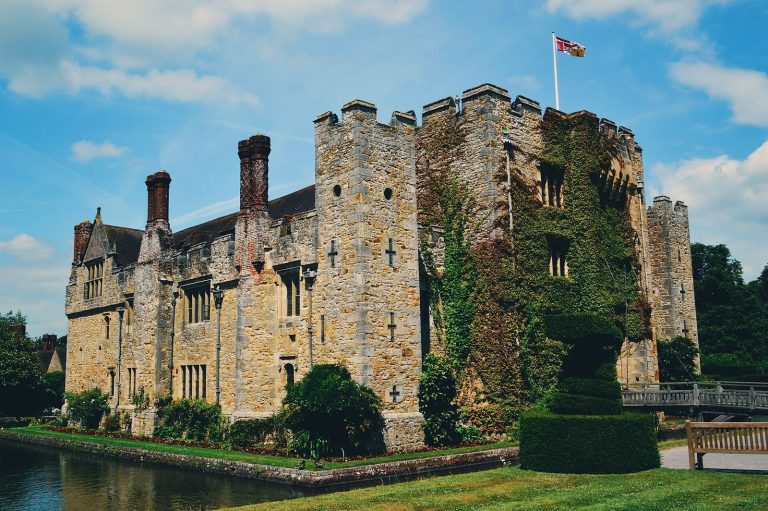
The castle occupied the northeastern part of an artificial island south of the River Eden. It had a four-sided plan, with four towers and a gate, enclosed by a moat. A drawbridge crossed the moat on the south side. The moat survives in its original position. Parts of the medieval castle were reused in a building at the site’s northeastern corner.
Garden house
The garden house is a Neo-Gothic structure built from dressed sandstone, cut and finished for construction. Its medieval-inspired design and its use as a separate garden building distinguish it from the site’s former manor residence.
Later buildings
Lakeside house
The replacement residence was built near the lake around 1870, with John Tonge identified as its designer.
Outbuildings
Outbuildings added by Warwick Leadlay form part of the later building group at the site.