Drübeck Abbey: A Former Benedictine Nunnery in Germany


Site at a Glance
- Rating
- 4.7
- Popularity
- Medium
- Country
- Germany
- Primary era
- Medieval
- External website
- Open
- Eras represented
- Medieval
- Civilizations
- Holy Roman Empire
- Site type
- Religious
- Remains
- Monastery
On this page11 sections
History
Drübeck Abbey is a former Benedictine nunnery in Germany, located at Drübeck on the northern edge of the Harz in Saxony-Anhalt. Its church and convent developed during the Ottonian period, the era of the Saxon rulers from the mid-tenth to the early eleventh century, and the complex remains associated with the history of religious institutions in the region.
Early records and royal privileges
A document dated 26 January 877 was once regarded as the abbey’s earliest record, but nineteenth-century investigations identified it as a forgery. The first confirmed written reference is a deed issued by King Otto I on 10 September 960, which names the convent as Drubechi.
The community followed the Benedictine rule, the monastic discipline associated with Saint Benedict, and its church was dedicated to Saint Vitus, an early Christian martyr. On 8 September 980, King Otto II confirmed the abbess’s right to be elected freely, without oversight from the emperor or a bishop. This charter affirmed Drübeck’s special legal position. During the tenth century, its privileges were comparable to those of the imperial abbeys at Gandersheim and Quedlinburg.
Ottonian rebuilding and later disruption
Construction or extensive rebuilding was underway by 1 August 1004, when a deed issued by King Henry II referred to the work. Otto I, Otto II, and Henry II belonged to the Ottonian dynasty, whose royal and imperial charters granted religious institutions privileges and legal rights. Further major alterations took place in the twelfth century.
Monastic life was temporarily interrupted during the disturbances of the Protestant Reformation and the German Peasants’ War, a sixteenth-century uprising involving rural communities and towns. The Thirty Years’ War, the seventeenth-century conflict that devastated much of the German lands, belongs to the wider period associated with the convent’s cessation of activity.
In 1687, the abbey buildings passed to the Counts of Stolberg-Wernigerode. In 1732, they established a Lutheran women’s foundation in the complex. The courtyards and gardens were then redesigned, including spaces for the foundation’s women and the abbess’s garden.
Evangelical use
In 1946, at the request of the last abbess, Countess Magdalena of Stolberg-Wernigerode, the Evangelical Church Province of Saxony took over Drübeck Abbey. It was used as a convalescent home and conference centre. The last canoness died there on 29 January 1976, aged 87 or 88 according to the stated year of her life.
Since 1996, institutions of the Evangelical Church in Central Germany have occupied the complex, including the Pastoral College and House of Silence, as well as a media centre. The Educational-Theological Institute remained at the abbey until April 2025. Drübeck is now used as a conference venue of the Evangelical Church in Central Germany, and its institutional and architectural heritage is reflected in its inclusion in Saxony-Anhalt’s Romanesque Road.
Remains
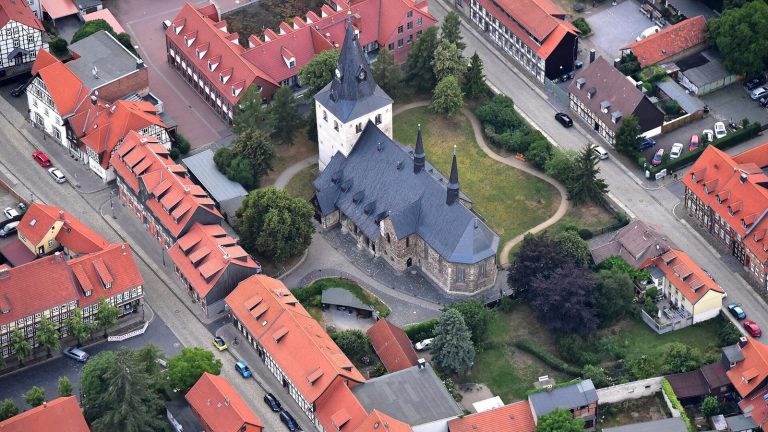
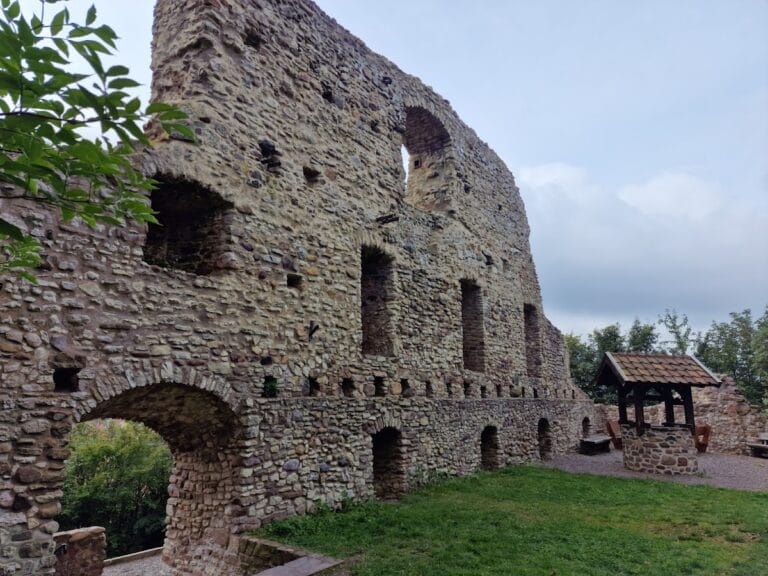
The surviving complex combines an early medieval church with later medieval additions, post-medieval foundation buildings, and gardens shaped by eighteenth-century planning. Excavated foundations and exposed masonry help distinguish the church’s Ottonian beginnings from its later transformation.
Abbey church
Ottonian basilica
The church of Saint Vitus was being built or substantially rebuilt by 1 August 1004 as a flat-roofed basilica with three double bays. Its nave used a simple alternation of piers and columns. The central-nave walls, five columns with Ottonian capitals, and the southern arm of the transept, the cross-arm of a church, probably belong to this phase.
Excavations beside the northern aisle have revealed remains of the aisle, which was lost around 1660. An angular foundation line in the transept area may belong to an earlier predecessor building. These remains provide evidence for construction beneath and alongside the visible church.
Medieval additions and interior features
Extensive alterations in the twelfth century added a monumental westwork, the towered western entrance block of a medieval church, and two towers. The church was vaulted, and its eastern end was reorganized into a tiered chancel arrangement. The church and abbey buildings were severely damaged during the German Peasants’ War. In 1599, a band of robbers led by a man called Brummer set fire to the complex; he was never captured. Emergency repairs were followed by further Baroque alterations.
The crypt, a chapel or burial space below or partly below a church, can be entered from outside the building. It contains a sandstone figural grave slab traditionally identified with Adelbrin, a legendary early abbess and saint. The slab is not contemporary with her supposed lifetime and leans against a wall, with its narrow side resting against a plain floor grave slab. The late Gothic carved altarpiece presents the Coronation of the Virgin by Christ in half-relief, accompanied by male and female saints. A valuable bell made by an unknown master dates from 1449.
Restoration in the 1950s exposed parts of the original structure again, and approximately half of the crypt was cleared or reopened. These interventions made early church fabric and the lower-level space more accessible for historical interpretation.
Gardens and courtyard
Planned grounds
The present external grounds follow a plan drawn by J. A. Dieckmann in 1737. After the Counts of Stolberg-Wernigerode acquired the complex, the courtyards and gardens were redesigned. The garden landscape retains the areas associated with the convent women, including prayer houses, together with the abbess’s garden.
Abbey lime tree
A summer lime tree planted in the abbey courtyard around 1730 is known as the “abbey lime.” It is nearly 300 years old and has a trunk circumference of 5.56 metres. The Harz district designates the tree as a natural monument.