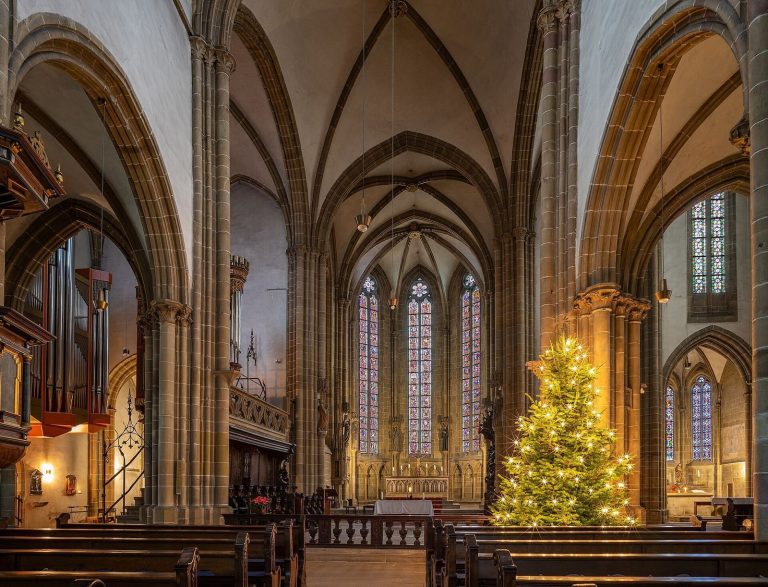
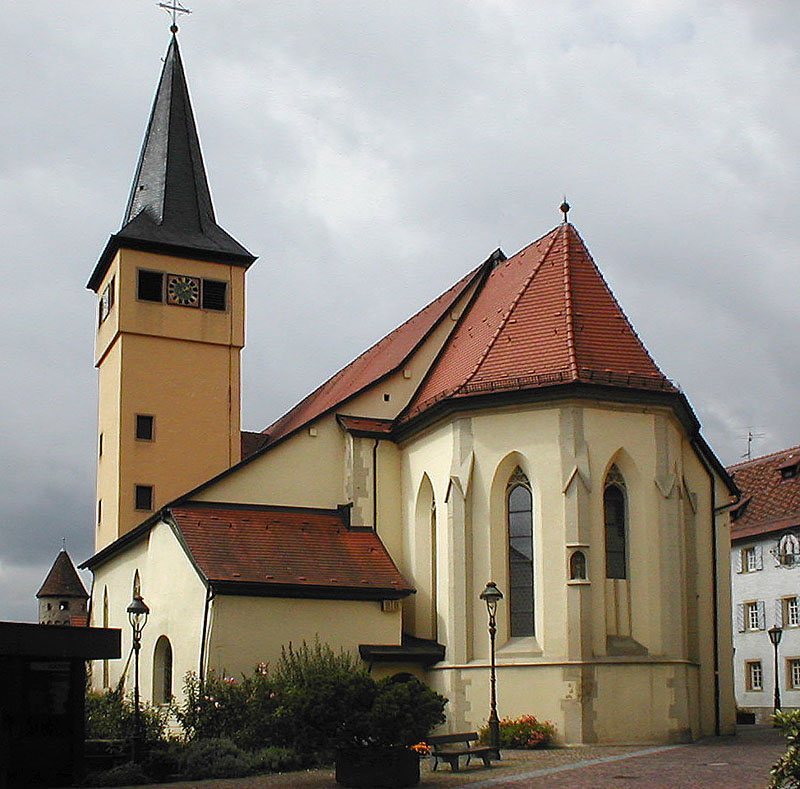
Stadtpfarrkirche St. Nikolaus: A Former Teutonic Order Hospital Church in Germany
Site at a Glance
- Rating
- 4.4
- Popularity
- Very Low
- Country
- Germany
- Primary era
- Medieval
- External website
- Open
- Eras represented
- Medieval, Early Modern, Modern
- Civilizations
- Holy Roman Empire, Teutonic Order
- Site type
- Religious
- Remains
- Church
On this page15 sections
History
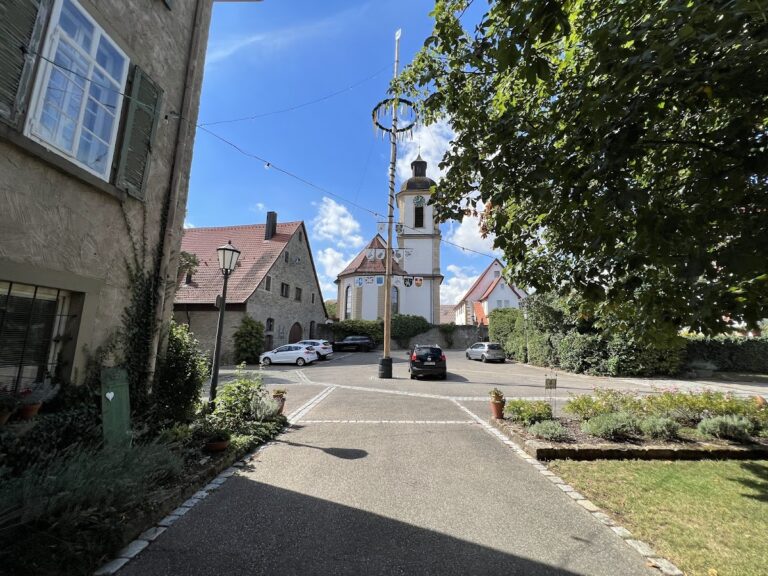
Stadtpfarrkirche St. Nikolaus is a Catholic parish church in Gundelsheim, Germany, whose history developed from a medieval Anna Chapel and whose later form reflects Gothic, Baroque, and twentieth-century alterations. It served for a long period as the hospital church of the Teutonic Order, a medieval religious and military order that also operated hospitals and governed territories. Today it belongs to the Krumme Ebene–Gundelsheim pastoral unit in the Heilbronn-Neckarsulm deanery of the Diocese of Rottenburg-Stuttgart.
Medieval origins and the Teutonic Order hospital
The medieval Anna Chapel stood at the southern edge of the town, beside its wall and moat. During the fifteenth century it was enlarged southward through the addition of an Early Mass Chapel and a church tower. This expansion was probably connected with the foundation of Gundelsheim Hospital by Teutonic Master Eberhard von Saunsheim, a senior official of the order, in either 1420 or 1442.
The hospital was first housed in a two-storey building west of the church, linked to it by a covered passage. St. Nicholas served the hospital exclusively for a long period. Meanwhile, the Georg Chapel, established in Gundelsheim since 1295 and now used as the cemetery chapel, functioned as the town church; its choir was enlarged in 1472.
Damage, rebuilding, and changing use
The church and hospital were damaged during the German Peasants’ War in 1525, a widespread uprising against social and political conditions in the German lands, and were restored afterward. When the original hospital became too small, the Teutonic Order acquired a neighboring building in 1593 and converted it into a hospital.
Around 1700, the church was remodeled in the Baroque style. A small annex was added north of the choir, and its exterior door carries the date 1701. In 1922–23 the nave was extended westward across the former hospital site, approximately doubling its length, while a north aisle was added. The original west tower was renewed in 1976 and now stands near the center of the enlarged church.
The church’s former hospital role is also reflected in its numerous saints’ figures, including almost all of the Fourteen Holy Helpers. This group of saints was traditionally invoked together for protection from illness and other dangers, making the subject especially appropriate to a church associated with healing and care.
Remains
The church is oriented with its choir to the east. Its surviving fabric brings together the medieval chapel complex, the Baroque remodeling, and the westward enlargement of 1922–23. The former hospital occupied the ground west of the earlier church, so the later extension now covers the area where that two-storey building once stood.
Medieval and later fabric
Early Mass Chapel and tower
The fifteenth-century Early Mass Chapel has a Gothic net vault and opens into the main nave through a broad Gothic arch. The church tower also retains Gothic tracery windows. The north aisle, added in 1922–23, is similarly connected to the nave by broad Gothic arches, while the renewed tower occupies a position close to the center of the present church.
Hospital site and choir annex
The former hospital building measured 10 by 10 metres and had two storeys. Its covered connection with the church formed part of the earlier hospital arrangement. The westward extension of 1922–23 occupies this former hospital area. North of the choir, the small annex added around 1700 has an exterior door and bears the date 1701.
Altars and sacred sculpture
Baroque high and side altars
The Baroque high altar stands in the choir. Its central figure is Nicholas of Myra, a fourth-century Christian bishop associated with charity and gift-giving, shown carrying three golden apples, an attribute drawn from one of his principal legends. Pope Urban I, holding grapes, and Blaise of Sebaste, holding a candle, flank him. Urban was a bishop of Rome in the early third century, while Blaise was a Christian bishop and martyr traditionally associated with protection against throat ailments. The side altars are dedicated to Mary and Joseph. The high and side altars are wooden but painted to imitate marble.
Anne altar
The Early Mass Chapel contains an Anne altar assembled from parts of several historical altars. Its central shrine presents Anna Selbdritt, an image type showing Saint Anne with her daughter Mary and the Christ Child seated on thrones. Angels playing musical instruments appear behind them. Wooden standing figures of Saint Catherine and Saint Barbara flank the shrine, each holding an attribute and wearing a crown.
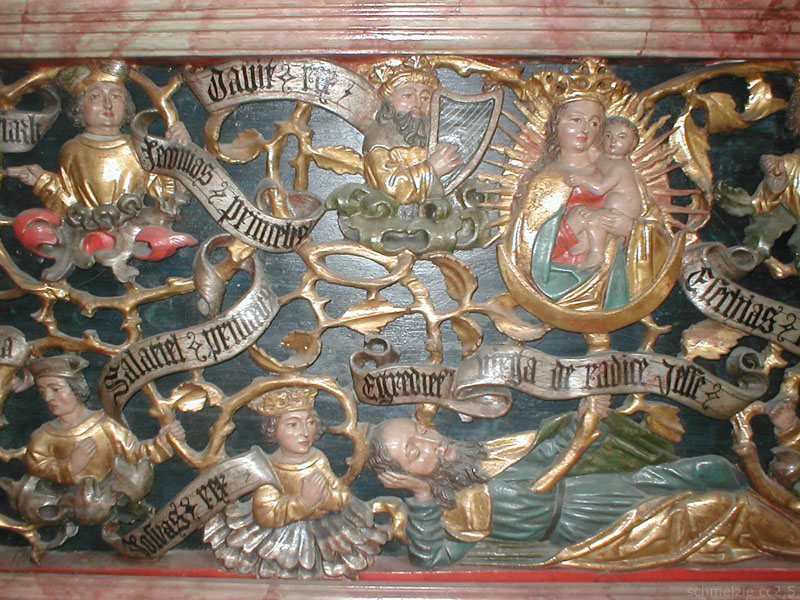
The predella, the lower section beneath the main part of an altar, contains a detailed relief of the Jesse Tree, which represents Christ’s descent from Jesse, the father of King David. The central relief and the two flanking figures are stylistically related to three wooden standing figures on the opposite wall and probably date from around 1500. The predella has later stylistic features and probably dates from around 1525. It likely came from another altar whose original image arrangement has been lost.
The altar components are thought to have been in the Gundelsheim church from an early period and may already have been acquired for the fifteenth-century chapel. Their late Baroque framing was probably produced during a renovation around 1770. The figures and reliefs received several polychrome treatments over time. During restoration in 1969–70, the oldest demonstrable paint layer was exposed and conserved.
Additional saints’ figures
Among the other devotional works is a terracotta Pieta dating from around 1400, displayed behind glass. A Pieta depicts the Virgin Mary mourning the dead Christ. This sculpture originally came from the Michaelskapelle in Böttingen. Together with the other saints’ figures, it forms part of the church’s substantial devotional furnishings.
Funerary monuments and bells
Teutonic Order memorials
Several commanders of the Teutonic Order are commemorated inside the church. Johann Christoph von Buseck and Josef Maria Roth von Schreckenstein are buried in the crypt beneath the high altar, a burial space below the church. Their gravestones stand to the left and right of the high altar. Two sixteenth-century grave slabs mounted on the south wall of the Early Mass Chapel commemorate Heinrich Wolfgang von Rohmberg, probably represented by a stone dated 1541, and Johann Egolf von Westernach.
North aisle memorials
The exterior wall of the north aisle contains three further historical funerary monuments. One commemorates the Teutonic knight Fuchs von Kannenberg, who died in 1543 and is said to have distinguished himself during the German Peasants’ War. Another is the gravestone of Jankoff Meyer, who lived from 1665 to 1740 and converted to Catholicism on his deathbed. The third commemorates the notary Carl Rosenacker, who died in 1594. An epitaph is a commemorative funerary monument or inscription.
Bell peal
The church has five bells. One historical bell was recast at Gundelsheim on 14 July 1673 by Stephan Arnold and Stephan Brunkler. Its inscription identifies Johann Caspar as administrator and dedicates the bell to the Holy Trinity, the Virgin Mary, and Saint Nicholas. Named Maria Susanna, it also records the involvement of the mayoral officials Joerg Franz and Hans Philipp Mueller. The other four bells were made in the twentieth century by the Bachert bell foundry.