St. Vitus: A Medieval Cemetery Chapel in Ihringen, Germany


Site at a Glance
- Rating
- 4.4
- Popularity
- Very Low
- Country
- Germany
- Primary era
- Medieval
- Eras represented
- Medieval, Early Modern
- Civilizations
- Crusader, Teutonic Order
- Site type
- Religious
- Remains
- Chapel
On this page14 sections
History
St. Vitus is a medieval chapel in Germany, standing at the southern edge of the Kaiserstuhl in the Neunkirch settlement of Wasenweiler, a district of Ihringen. Dedicated to Vitus, an early Christian martyr traditionally invoked against epilepsy and other ailments, the chapel was built before the thirteenth century and became the parish church of Wasenweiler and Ihringen.
Early history
The chapel’s beginnings are uncertain. A church dedicated to St. Vitus appears in thirteenth-century records, while a mill at Nünkilche, recorded in 1314, provides an early reference to the settlement. The building itself is older than these written references. Its baptismal or holy-water basin has been dated either to the ninth or tenth century by Joseph Sauer, or to the twelfth century by later investigators. The sacristy probably belongs to this early phase as well.
In the eleventh century, Wasenweiler belonged to Murbach Abbey in Alsace. The settlement became the seat of a deanery in 1275, although that ecclesiastical district was later transferred to Breisach. Between 1290 and 1371, Wasenweiler passed in several stages to the commandery of the Teutonic Order in Freiburg im Breisgau. The Teutonic Order was a medieval religious and military organization that also administered estates and ecclesiastical institutions, while a commandery was one of its local administrative establishments.
Parish church and later alterations
Under the Teutonic Order, the nave was extended westward and raised by two metres. A choir was added in the fifteenth century, when most of the wall paintings in the nave and choir were also created. Until 1716, St. Vitus served as the parish church for both Wasenweiler and Ihringen. After the Reformation made Ihringen Protestant, the chapel served only Wasenweiler. It is now a cemetery chapel belonging to the Wasenweiler-Ihringen parish within the Breisach-Merdingen pastoral unit, the Breisach-Neuenburg deanery, and the Archdiocese of Freiburg.
A fire in the seventeenth or eighteenth century destroyed the choir’s cross-vault, which was replaced with a flat ceiling. A gallery was installed at the west end in 1664, and the paintings gradually disappeared beneath increasingly thick layers of plaster. By 1850, the building was close to collapse and demolition was considered. A private appeal helped secure repairs instead, followed by another renovation in 1914.
Rediscovery and preservation
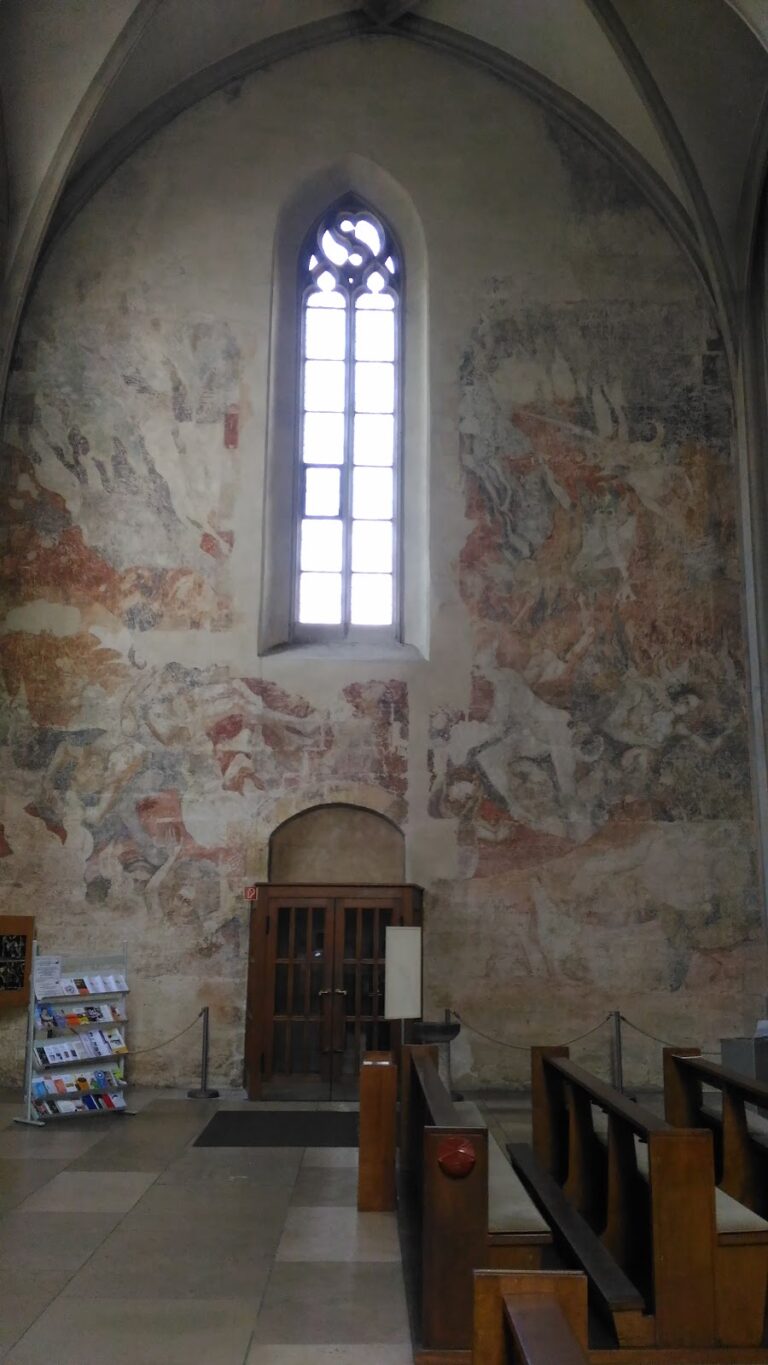
Joseph Sauer uncovered the wall paintings in 1919. Restoration carried out between 2005 and 2010 preserved the medieval imagery. The high-altarpiece had been removed for safekeeping during the Second World War and was later kept in Freiburg’s Augustinermuseum before returning to the chapel in 2011. St. Vitus is principally known for this altarpiece and for its medieval painted cycle.
Remains
Chapel layout
The chapel stands within a cemetery and is formed by a west nave, an eastern choir, and a sacristy adjoining the choir on its north side. The nave measures approximately 10 by 8 metres internally. The choir ends in three sides of an octagon, and a roof turret rises above it. A pointed-arch entrance opens in the west wall, while a straight-headed entrance is set in the south wall. The windows are irregularly arranged in the nave. Each of the choir’s three polygonal sides contains a two-part lancet window with fish-bladder tracery, a late Gothic pattern of flowing, curved forms. A smaller, later lancet window is set lower in the south wall.
Choir and sacristy
The sacristy was originally entered from the nave. A passage connecting it with the choir was opened in 1492, a date carved above the opening. The intervention damaged a wall painting and provides its latest possible date. The choir still retains the corbels that supported its former cross-vault. The sacristy has a barrel-vaulted ceiling and contains a piscina, a small liturgical basin used for washing sacred vessels or disposing of water used in Christian rites. Its form suggests that the room was probably once used for celebrating Mass. A sacrament house, a wall-mounted structure for reserving the Eucharist, is attached to the choir’s north wall and bears a date read as either 1502 or 1507.
Medieval wall paintings
Nave and triumphal arch
The paintings were executed in secco, a technique in which pigment is applied to dry plaster. On the south wall of the triumphal arch, a Crucifixion is shown with three saints and two scenes from the legend of St. Vitus. The south wall of the nave carries further scenes from the Vitus legend in three horizontal framed registers. Depictions of St. Christopher appear above and beside the south entrance. On the north wall of the triumphal arch, an image of St. Anthony the Great can be discerned behind the Baroque high-altarpiece. The north nave wall shows St. Christopher, St. Barbara of Nicomedia, St. Catherine of Alexandria, the Virgin and Child, and St. George.
Choir apostle cycle
The later paintings in the choir form an apostle cycle above a brown dado approximately 1.5 metres high and painted with white blocks. The apostles stand against a green ground decorated with vines and flowers and carry banners whose inscriptions are now illegible. The northern group shows St. Peter with a large key, St. John with a chalice, and St. James the Greater with a pilgrim’s staff. Joseph Sauer initially identified the staff-bearing figure as St. Paul, who would traditionally have been represented with a sword.
The sequence is interrupted by the sacrament house, which is incorporated into illusionistic architectural painting that echoes its form. The reveals of the polygonal choir windows show St. Andrew and St. Philip, Jesus and St. Thomas, and St. Bartholomew and St. Matthew. The southern group was affected by the insertion of the smaller lancet window, while the final field shows St. James the Younger and St. Jude Thaddeus.
Altarpieces and sculpture
High-altarpiece
The three-part high-altarpiece has a raised polygonal niche in the centre and two lower niches at the sides. Intertwined branchwork closes each niche above, and each is covered by a small star vault with a two-part tracery window at the rear. The niches contain standing figures approximately 1.10 metres high. The central figure is the Virgin Mary on a crescent moon with the naked Christ Child. The left figure is probably St. Nicholas of Myra, while the right represents St. Stephen the Deacon. Nicholas’s three golden balls survive, but the stones associated with Stephen’s stoning are missing.
The retable’s dense tracery includes thorn-leaf tendrils with birds and rises from bark-like branches crossing fluted architectural profiles. The carving has been attributed to Sixt von Staufen, particularly through comparison with the Locherer Altar in Freiburg Minster.
Surviving side altar
Two side altars once stood in the chapel and were described as unremarkable Renaissance works. Only the left altar survives. Its probably Baroque side paintings show St. George and St. Elisabeth of Thuringia. The central painting, signed by Fidelis Liebenstein and dated 1803, depicts St. Vitus with his teachers St. Modestus and St. Crescentia. Beneath them, boiling oil is prepared for the martyrdom in which all three were thrown into it. Three wooden sculptures on the altar represent the same scene. They may all portray Vitus, or Vitus together with Modestus and Crescentia.
Bell and early basin
A bronze bell hangs in the wooden roof turret. J. G. Gapp cast it in Freiburg in 1723. It has a circumference of 388 millimetres, weighs 32 kilograms, is tuned to D-flat, and can be rung only by hand. A baptismal or holy-water basin believed to have come from St. Vitus is now held by the Badisches Landesmuseum in Karlsruhe. Its date has been placed in either the ninth or tenth century or the twelfth century, depending on the attribution of its age.