Schloss Umkirch: A Hohenzollern Castle in Germany


Site at a Glance
- Rating
- 4.3
- Popularity
- Very Low
- Country
- Germany
- Primary era
- Early Modern
- Eras represented
- Early Modern, Modern
- Civilizations
- German, Habsburg, Holy Roman Empire
- Site type
- Domestic
- Remains
- Palace
On this page9 sections
History
Schloss Umkirch is a castle in Umkirch, Germany, whose history links the estate to the Lords of Geben, the Kageneck family, the Baden dynasty, and the Swabian Hohenzollerns, the Catholic southern branch of the German princely and royal house centered historically on Hohenzollern-Sigmaringen. A medieval moated castle stood here in the fourteenth century, while the present residence took shape through rebuilding in the eighteenth century and enlargement in the early nineteenth century.
Medieval Origins and Eighteenth-Century Rebuilding
The Lords of Geben held a moated castle on the site during the fourteenth century. The Lords of Tübingen are believed to have lived there in 1474. Later, the families of Roggenbach and Beroldingen enlarged their possessions in Umkirch, and the estate entered the Kageneck majorat in 1740. A majorat was an entailed estate restricted to a designated line of inheritance and generally protected from sale or division.
The medieval castle was demolished in 1743, and its central section was rebuilt. The two side wings were added in 1788 and 1789. In 1785, the estate had been converted into an allod for Flora von Kageneck, meaning property held as her own inheritable possession rather than as a fief. Flora, the daughter of Friedrich von Kageneck and Maria Theresia von Salm-Reifferscheidt and a cousin of the Austrian statesman Metternich, married Count Eugen von Wrbna on 20 June 1798.
Baden and Hohenzollern Ownership
Under Flora von Kageneck, the castle was enlarged in 1816 and 1817 in the style of an Italian country house, with a belvedere added above the building. A belvedere is an elevated architectural feature designed to provide an outlook. Grand Duchess Stéphanie of Baden bought Schloss Umkirch in 1827 for 345,000 gulden and used it as a summer residence in July and August.
Stéphanie’s inheritance agreement of 29 June 1860 assigned the estate to her daughter, Princess Josephine of Baden, who was married to Karl Anton von Hohenzollern. Josephine made Umkirch a family entailed estate on 3 May 1887, making it inalienable. On 19 June 1900, the property passed to her son Karl, who was king of Romania until his death in 1914.
Because the First World War delayed the inheritance, the castle passed at the end of 1916 to Prince Friedrich Victor von Hohenzollern-Sigmaringen. He used it as a summer residence. Friedrich Wilhelm von Hohenzollern was born at Schloss Umkirch, as were Princes Ferfried von Hohenzollern and Leopold of Bavaria in 1943.
War, Occupation, and Later Possession
From September 1944 to April 1945, during the Second World War, the princely family was forcibly evacuated and interned at Schloss Wilflingen. After the war, southern Baden became part of the French occupation zone. General Pierre Pène then lived at Schloss Umkirch as governor of Baden on behalf of the French occupying power from 1946 to 1952. During this period, Friedrich Wilhelm partly lived in his sister’s nearby small country house.
When Friedrich Victor died in 1965, his son Friedrich Wilhelm inherited the castle estate. Schloss Umkirch remained with the Swabian Hohenzollerns, and Karl Friedrich von Hohenzollern was its owner from 2010.
Associated Parks
The estate’s history also includes two associated parks. The southern park began when Friedrich von Hohenzollern donated a property of approximately eight hectares to Princess Auguste Viktoria of Hohenzollern, the wife of Manuel II, the last king of Portugal. After her death, the park returned to Friedrich Wilhelm von Hohenzollern. He later sold the park and castle, and the park has belonged to publisher Werner Semmler since 1993.
Remains
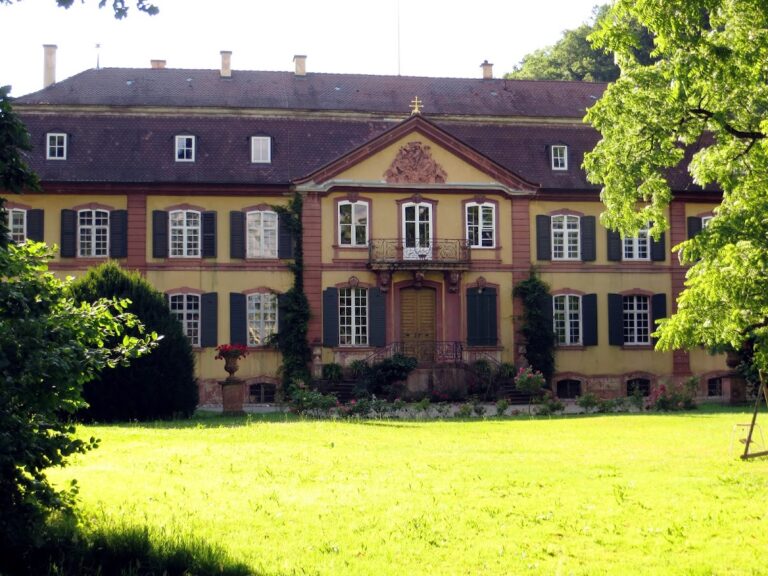
Schloss Umkirch consists of a central building with two side wings, a form created through the rebuilding of the former moated-castle site and later enlargement in the Italian country-house style. The building is crowned by a belvedere added in 1816 and 1817. The Kageneck-Wrbna coat of arms remains visible in the gable, preserving a link to the family associated with the estate’s late eighteenth-century history.
Castle Park and Southern Park
Fürstlich-Hohenzollern’sche Schlosspark Umkirch
The Fürstlich-Hohenzollern’sche Schlosspark Umkirch is an approximately eleven-hectare landscape park belonging to the castle. A landscape park is a designed setting intended to resemble a natural or pastoral environment rather than a formal geometric garden.
Queen-Auguste-Victoria-Park
South of the castle park lies the park now known as Queen-Auguste-Victoria-Park. It grew from the approximately eight-hectare property given to Princess Auguste Viktoria, where she had a neo-Baroque country house built. Neo-Baroque is a modern revival of the Baroque style, using formal composition and emphatic decoration. She named the estate Fulwell-Park after Fulwell, her place of exile in the London Borough of Richmond upon Thames. The expanded park covers approximately eleven hectares.
Nearby sites