Limburg Castle: A Medieval Rhine-Crossing Fortress in Germany


Site at a Glance
- Rating
- 4.3
- Popularity
- Low
- Country
- Germany
- Primary era
- Medieval
- Eras represented
- Medieval
- Civilizations
- Holy Roman Empire
- Site type
- Military
- Remains
- Castle
On this page7 sections
History
Limburg Castle is a medieval hill castle in Germany, located at Sasbach am Kaiserstuhl on a spur above the Rhine. First documented between 1215 and 1221, it probably succeeded nearby Old Limburg and served to monitor a Rhine crossing. The castle is also known as Limpurg, while older literature calls it Lindberg Castle.
Early records and Habsburg connections
The castle entered the written record again in 1239. Its early history was closely connected with the Habsburgs, a major European ruling dynasty whose medieval possessions included lands along the Upper Rhine. In 1215, Albrecht of Habsburg held the abbot of Ebersmünster captive at Limburg. Castle bailiffs included Konrad of Bodman in 1231, Heinrich of Falkenstein in 1239, and Konrad, possibly also of Falkenstein, in 1242.
In 1239, Gottfried of Habsburg-Laufenburg married Adelheid, daughter of Count Egino of Freiburg, and granted her half of Limburg Castle as her dower, property assigned to a wife through marriage. During the three-week Freiburg feud with King Rudolf in 1281, Egino transferred control of the castle to Eberhardt of Habsburg and Rudolf of Habsburg-Laufenburg.
Division among noble houses
Count Rudolf of Habsburg later sold his share to Kuno of Bergheim. Kuno’s sons Ludwig, Konrad, and Werner sold their portions back to Egino of Freiburg in 1300. In 1336, the Freiburg holders allied themselves with the city of Freiburg, while another share passed to the Lords of Müllnheim. In 1381, Johann of Müllnheim zu Richenberg came into conflict with Margrave Hesso of Hachberg over the village of Ihringen, and the margrave deprived him of his rights at Limburg.
The Zähringers, a powerful princely family of southwestern Germany, the Habsburgs, the Counts of Freiburg, and the Counts Palatine of Tübingen all appear among the castle’s former owners. Around 1480, the Counts Palatine of Tübingen and Lichteneck held Limburg jointly with the Lords of Rathsamhausen. From 1498 to 1590, the Counts Palatine of Tübingen controlled the castle.
Decline and later memory
Limburg was still described as habitable in the sixteenth century, but by 1701 it was considered a ruin. After the Tübingen line became extinct in 1645, the House of Austria granted the reverted fief, including Sasbach and Limburg Castle, to Franz Girardi of Kastel, an imperial war councillor. Bombardment during the Second World War in 1945 destroyed substantial parts of the keep.
A later tradition claims that Rudolf of Habsburg, who became Rudolf I and was the first Habsburg king of the Romans, was born at Limburg Castle in 1218. The claim has no contemporary evidence. It originated with an unsupported statement by Fugger-Birken, while Abbot Martin Gerbert cited older historians in 1772 to present Limburg as a plausible birthplace.
Remains
Setting and defenses
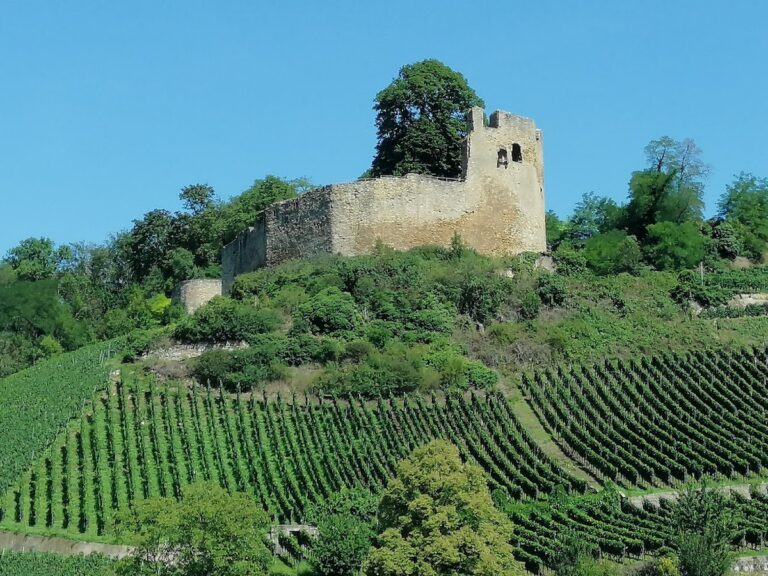
The ruin occupies the Limberg, a 272-metre-high spur of the Kaiserstuhl, a volcanic mountain massif in southwestern Germany. The castle stands on a slope about 40 metres above the Rhine. Steep rocky ground bordered it to the north and west, while a deep ditch defended the southern and eastern sides. The entrance probably stood on the southern side. A defensive wall, reaching up to two metres in thickness, enclosed the complex.
Terraces and surviving structures
The castle’s core covered approximately 40 by 80 metres and extended across three terraces. The lowest terrace contained a well and several buildings. Representative residential buildings occupied the middle terrace, while the upper terrace held the keep, the principal fortified tower, with a residential building attached. Considerable wall remnants survive, although the keep was partly destroyed by the 1945 bombardment.
Nearby sites