Evangelische Heilig-Kreuz-Kirche Augsburg: A Lutheran Preaching Church in Germany
Site at a Glance
- Rating
- 4.6
- Popularity
- Very Low
- Country
- Germany
- Primary era
- Early Modern
- External website
- Open
- Eras represented
- Early Modern
- Civilizations
- Holy Roman Empire
- Site type
- Religious
- Remains
- Church
On this page25 sections
History
Evangelische Heilig-Kreuz-Kirche Augsburg is a Lutheran church in Germany that was rebuilt in 1652–1653 as an Early Baroque preaching church. Its origins reach back to 1210, when the Augustinian Canons built a chapel dedicated to Saint Catherine of Alexandria on the grounds of the Heilig Kreuz monastery in Augsburg’s old town. The chapel eventually served local townspeople, while the collegiate church was used mainly by the canons. Its history reflects the Reformation, the religious settlement following the Thirty Years’ War, and Augsburg’s distinctive arrangement of Catholic and Protestant institutions.
From Saint Catherine’s Chapel to the Protestant congregation
The medieval chapel was renovated and partly rebuilt in the middle of the fifteenth century, when its dedication changed to Saint Ottmar. Martin Luther visited the Heilig Kreuz monastery in 1511 during his journey to Rome. In 1525, amid the Reformation, Augsburg’s city council assigned the Ottmar Chapel to the newly formed Protestant congregation as a preaching church. Protestant Sunday services were held there regularly, making the chapel an important center for the city’s emerging Lutheran community.
The Augustinian Canons relinquished their former rights in 1561. The Protestant congregation then enlarged the chapel and gave it the name Heilig-Kreuz-Kirche. This arrangement ended during the Counter-Reformation. Following the Restitution Edict, which required the return of certain church properties to the Catholic Church, the Protestant congregation was expelled and its church was demolished in 1630. The congregation had no independent church building until 1653.
Rebuilding after the Peace of Westphalia
The Peace of Westphalia, the group of treaties concluded in 1648 that ended the Thirty Years’ War, returned the former church site to Augsburg’s Protestants. Augsburg was a parity-based imperial city, meaning that recognized Christian confessions shared civic rights and institutions. This settlement enabled a Protestant Heilig-Kreuz-Kirche to be rebuilt beside the Catholic church of the same name, creating a distinctive double-church arrangement.
Pastor Thomas Hopfer played a major part in securing the funds for the rebuilding campaign. In 1650, he undertook a year-long collection journey with two companions, visiting prominent Protestant princes in Central Europe, the Danish royal court, and Queen Christina of Sweden. Contributions from princes, towns, congregations, and private individuals eventually produced 46,407 guilders for construction. Hopfer was dismissed by the city council in 1661 after disputes with the council, despite his role in financing the rebuilding, and he was not buried in the church.
The foundation stone was laid on 4 May 1652. The joiner Johann Jakob Krauss built the present church during 1652 and 1653, and the new building was consecrated on 24 October 1653. It was Augsburg’s first Protestant church building. Major Baroque works of art and furnishings were added progressively during the following decades, giving the interior much of its present character.
Early repairs and wartime uses
The church’s copper-covered roof caused problems from the beginning. Repairs cost 600 guilders in 1654, 300 guilders in 1655, and about 1,000 guilders in 1668. By 1682, approximately 3,000 guilders had been spent without achieving a satisfactory result. The congregation therefore ordered the entire roof to be removed and replaced with a more durable one.
During the wars with France, the church was used in 1800 as a storehouse for hay, straw, and gunpowder. In the same year, and again after the Battle of Ulm in 1805, the French army used it as a prison camp for more than 1,200 Austrian prisoners of war. The building briefly served as a supply store in 1809. After the damage caused by these uses was repaired, worship resumed in 1807. A memorial plaque unveiled in 2015 commemorates the period when the church served as a prison camp.
In 1814, the church became a filial church of St. Anna. It regained its status as an independent parish in 1841. The building survived the air raids on Augsburg in 1944 without damage, while the adjoining Catholic Heilig-Kreuz-Kirche was destroyed. A comprehensive renovation was carried out between 1979 and 1981, the first major renovation to take place in more than three centuries.
Modern recognition
The congregation celebrated the church’s 350th anniversary in 2003. After the anniversary, the building was also described as a European Peace Church, a designation associated with its history beside the Catholic Heilig-Kreuz-Kirche and with the religious conflicts that shaped its past. It is included in the Bavarian monument list. In March 2021, the Bavarian State Office for Monument Protection classified it as a monument of national importance.
Remains
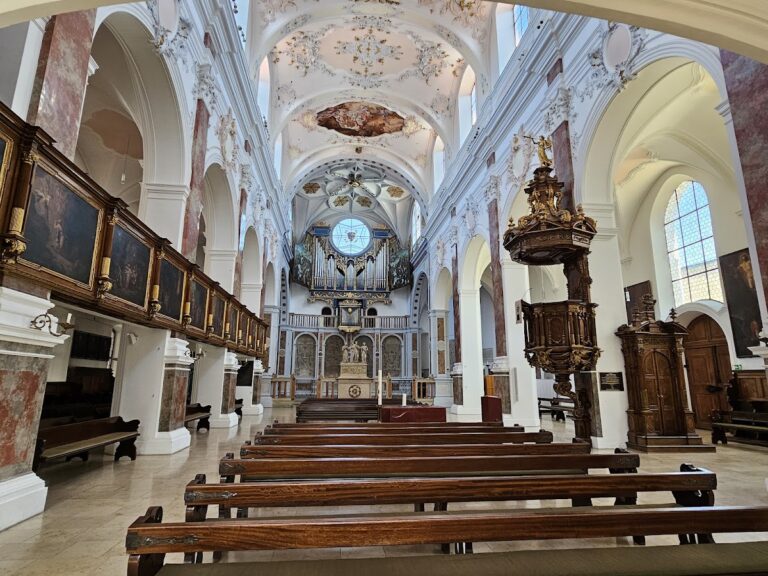
The present church is an Early Baroque Lutheran preaching church organized around a nave, a strongly recessed choir, galleries, and adjoining service and burial spaces. Its plan is an irregular right-angled trapezoid, the result of restricted building space and the Augustinian Canons’ refusal to surrender additional land. Two galleries carried on slender Tuscan columns make the nave interior appear almost square. The building’s surviving furnishings form a closely connected ensemble of seventeenth- and eighteenth-century architecture, painting, sculpture, memorials, and liturgical equipment.
Exterior and interior arrangement
Facade and walls
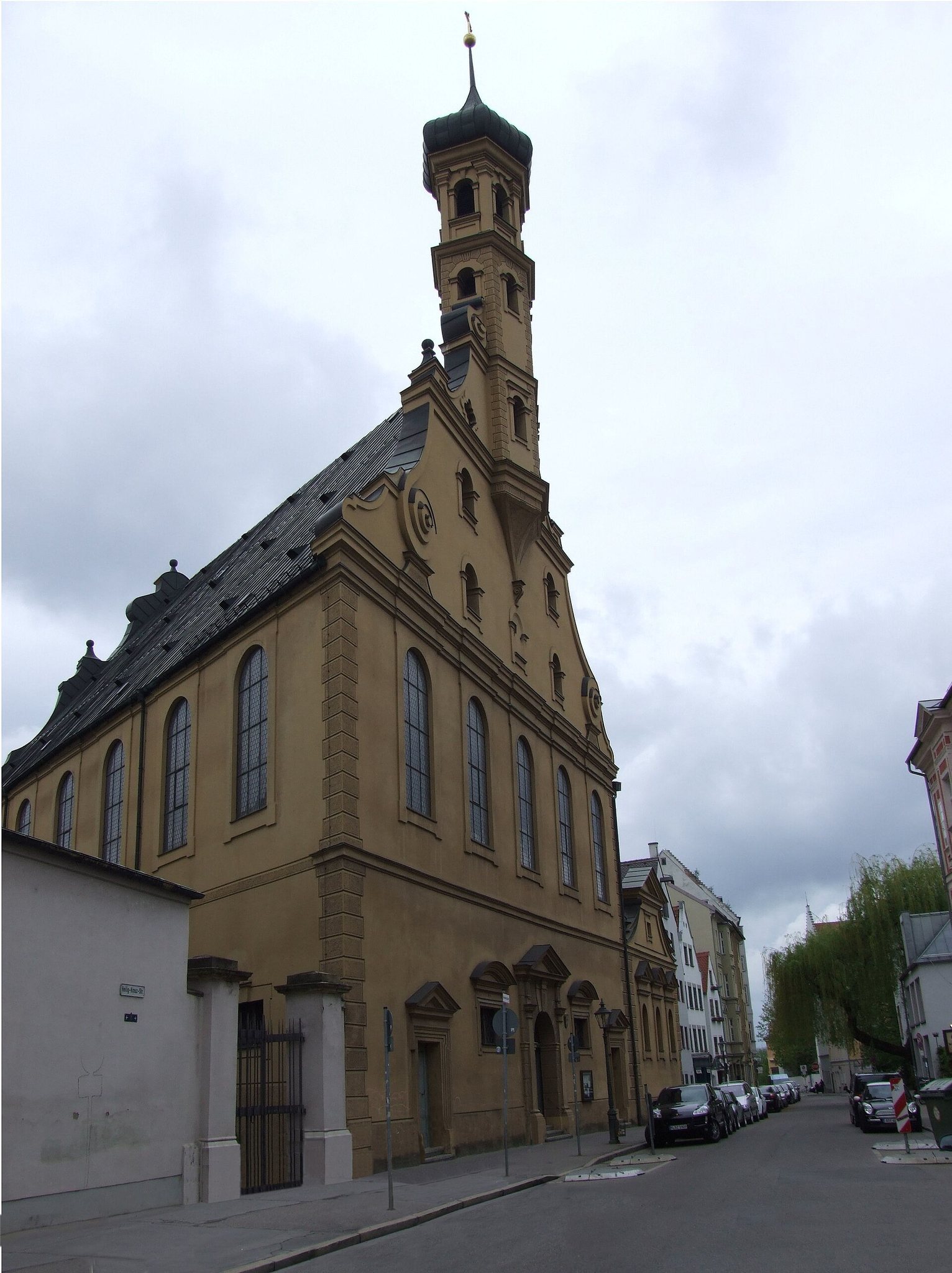
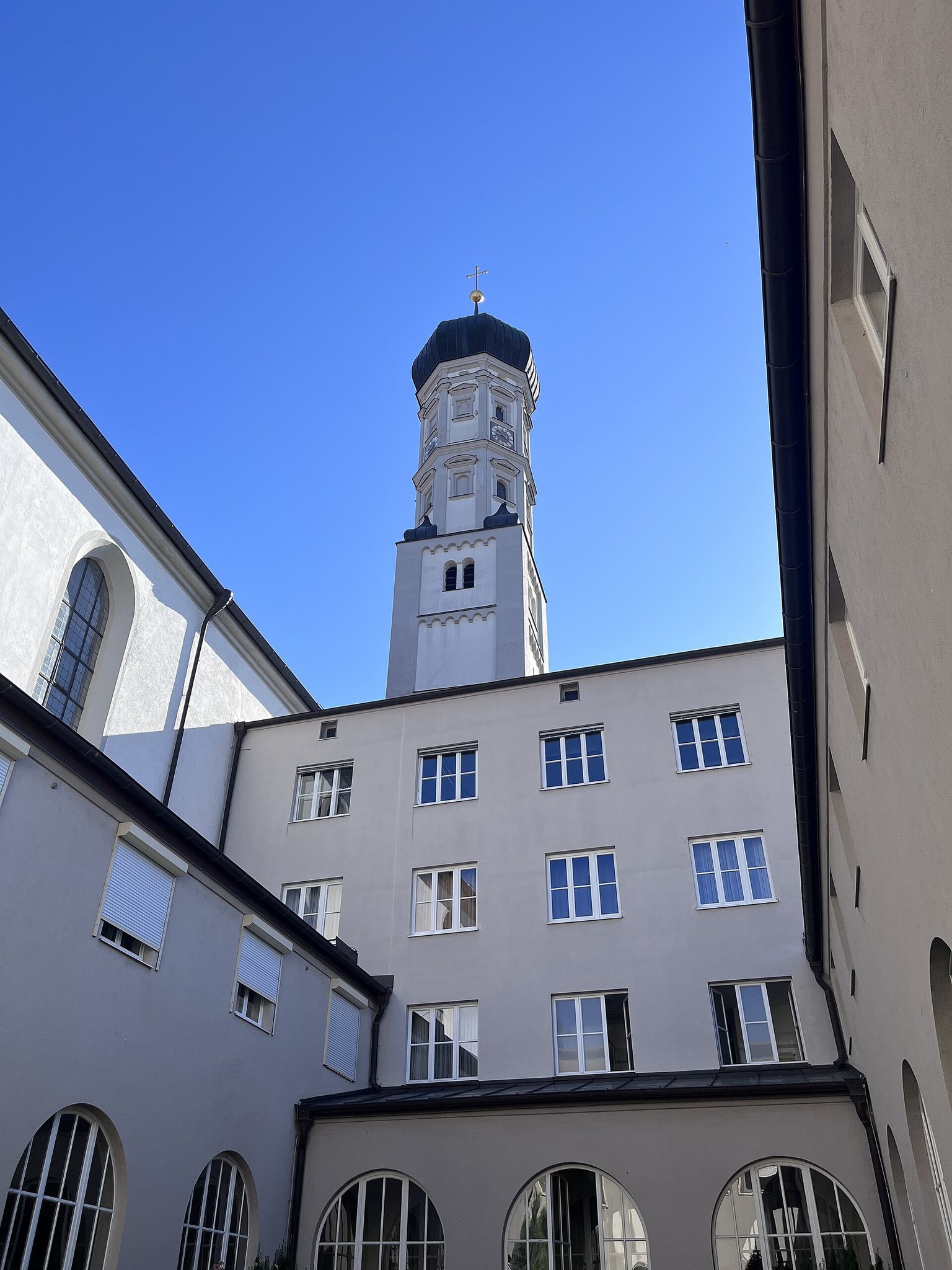
The eastern facade has two principal levels and a three-level volute gable. A volute is a spiral-shaped architectural ornament commonly used in Baroque gables. Four small round-arched windows pierce the gable, which is crowned by a prominent six-sided turret with an onion-shaped helm. Three entrance portals have triangular pediments, while two transversely rectangular windows with segmental-arched pediments are placed between them. Five tall, narrow round-arched windows occupy the upper facade.
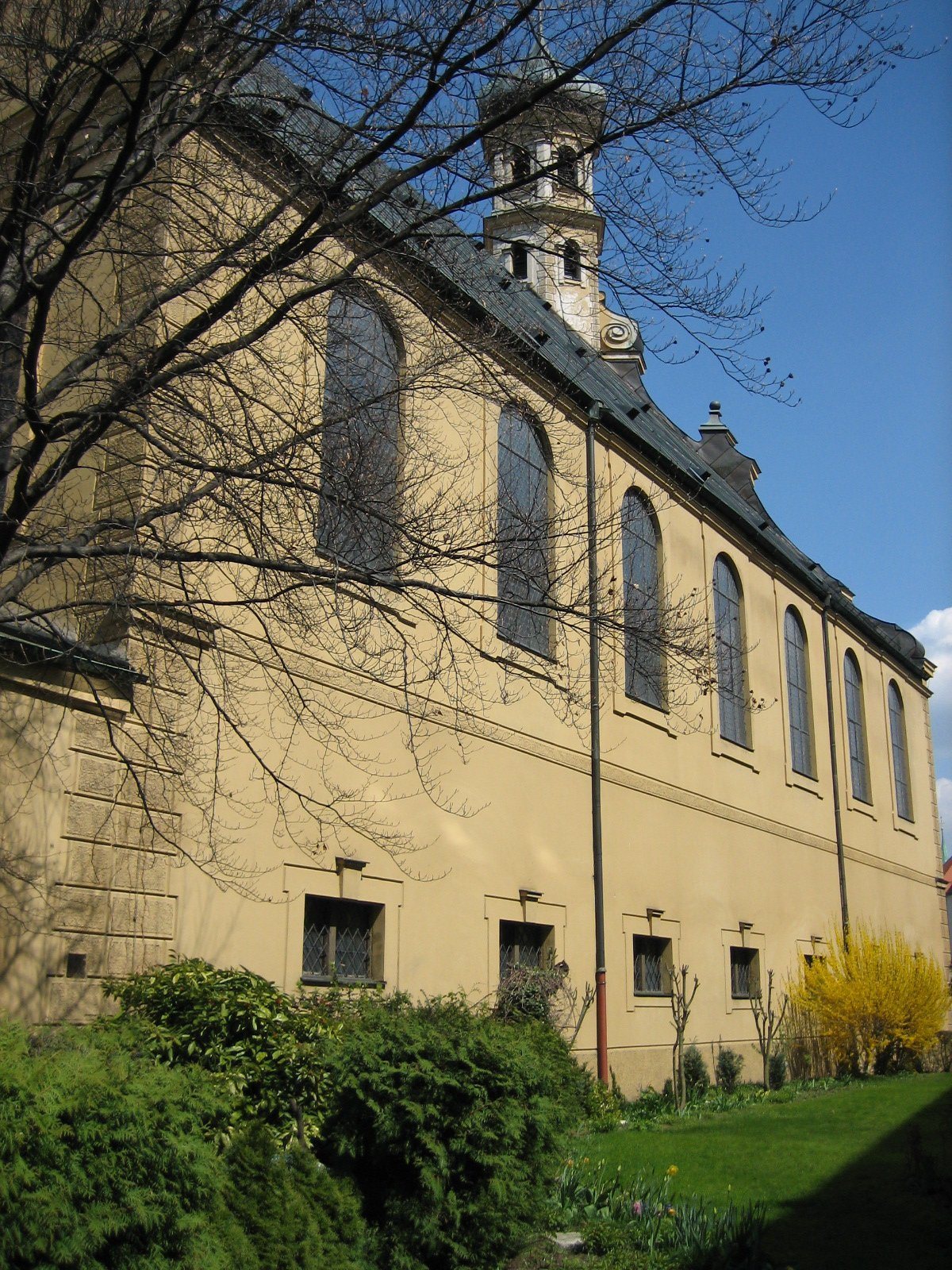
The south wall of the nave has seven transversely rectangular windows on the lower level and seven tall, round-arched windows above. The irregular plan affects the north wall, which has four upper-level round-arched windows. The west wall has one round-arched window on each side. The nave roof and the roofs of the attached buildings are clad in copper.
Nave and choir
The nave has a freely suspended painted wooden coffered ceiling. Its ornamental decoration is repeated in reduced form on the undersides of the galleries. A brass chandelier from the middle of the seventeenth century hangs near the altar, and most of the pews date from the construction period. Ulrich Haldenwanger made the pews, which originally provided seating for 950 women and 710 men.
At the west, the nave connects to a strongly recessed choir with a five-eighths termination, a polygonal ending formed from five sides of an imagined octagon. The choir is covered by a barrel vault with intersecting curved sections. A curved organ gallery divides the choir. At organ level, two windows flank a central blind window on the west side. The small burial space known as the Gottesäckerle adjoins the choir on the south, while the sacristy is attached to the north wall of the nave.
Choir furnishings and paintings
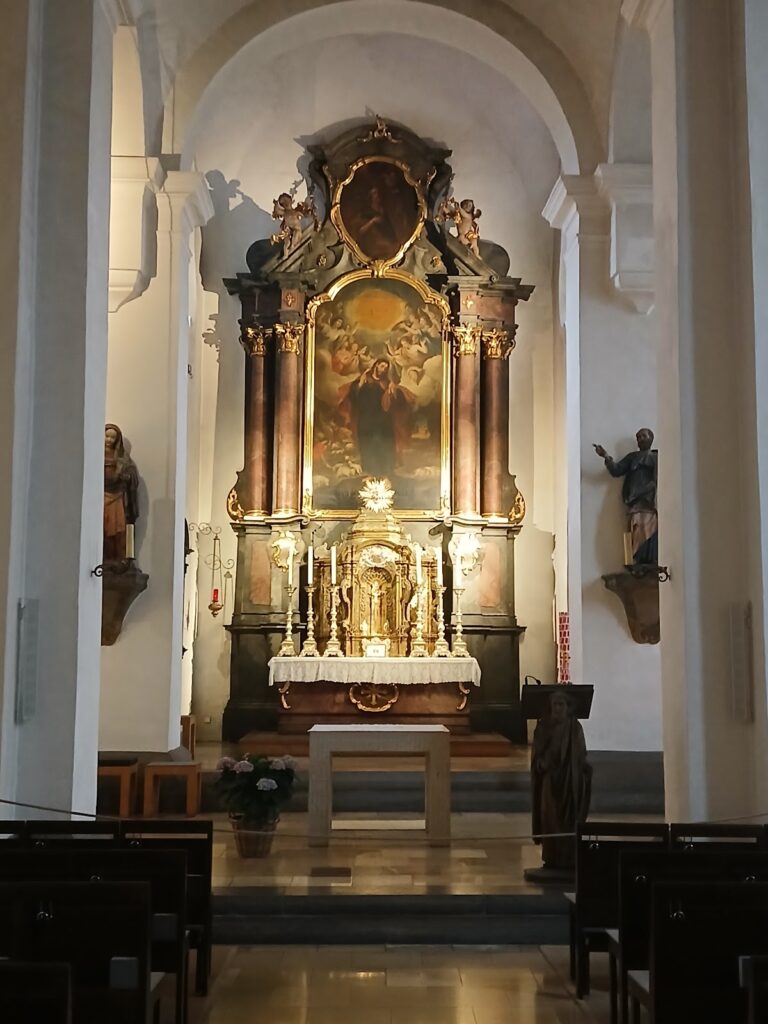
The 1767 Rococo altar mensa, or altar table, was made by Ignatz Verhelst after a design attributed to Johannes Esaias Nilson. It carries a silver-bodied altar cross from about 1680 and is flanked by two slender, smooth columns with Corinthian capitals. Behind it stands a black-marble memorial tablet with a Latin inscription describing the circumstances of the church’s rebuilding.
Four large choir paintings were acquired through donations from members of the congregation and the painters. They are Johann Heiss’s Baptism of Christ, Johann Ulrich Mayr’s Resurrection of Christ, Johann Spillenberger’s Peter’s Pentecost Sermon, and Joseph Werner’s Last Supper, all dated 1673–1674. Three ceiling paintings of musical putti were made by Johannes Rottenhammer around 1611 for the organ of the demolished predecessor church. They show putti playing a violin, a lute, and a tambourine.
The principal ceiling fresco, The Three Theological Virtues, and four surrounding frescoes were painted around 1730 by Johann Georg Wolcker. They were long attributed to Johann Georg Bergmüller, but archival evidence identifies Wolcker as their painter. The smaller frescoes explain the four lower choir paintings allegorically through baptism, the Crucifixion, Pentecost, and the Last Supper. The stucco in the choir vault was made by the Wessobrunn artist Franz Xaver Feichtmayr.
Nave paintings and preaching furnishings
Pulpit and Passion group
The Rococo pulpit on the north wall was made by Ignatz Verhelst in 1762 after designs by Johannes Esaias Nilson. A putto on the sounding board holds the tablets of the Ten Commandments and a book inscribed EVANGELIUM. Another putto adores the Hebrew name of God, which is surrounded by rays. Beneath the sounding board, a dove in a radiant halo represents the Holy Spirit.
A large Crucifixion from about 1660 hangs above the pulpit. Together with Johann Heinrich Schönfeld’s Carrying of the Cross and Descent from the Cross, painted in 1665, it forms a Baroque Passion group. Schönfeld received 800 guilders for the former work and donated the latter to the church.
North-wall paintings
The north wall contains a Baptism of Jesus from about 1570–1580, produced in the workshop of Jacopo Tintoretto. When the painting was transferred to the Protestant church, the halos of Jesus and John the Baptist were removed. Nearby are an unknown artist’s Christ on the Mount of Olives from about 1660, Johann Christoph Beyschlag’s Jacob’s Dream from about 1690, and Ernst Philipp Thomann von Hagelstein’s Marriage at Cana from about 1700.
Other works on the north wall include Thomann von Hagelstein’s Christ Presenting a Child to the Disciples from 1712, an unknown master’s Jews Crossing the Red Sea from about 1620, and an unknown master’s Capture of Christ from the middle of the seventeenth century. Part of a series of twenty portraits of the church’s pastors and deacons is also displayed there. The portraits date from the middle of the seventeenth to the early nineteenth century, and about half have unidentified painters.
East, south, and west walls
Ten preacher portraits hang on the east wall, five below and five above the gallery. They include an unidentified portrait of pastor Thomas Hopfer, pastor Georg Daniel Beisser by Franz Joseph Degle from 1774, deacon Hieronymus Daniel Schleißner by Gabriel Spitzel, pastor Johann Urlsperger by Johann Jacob Haid, and pastor Hieronymus Ostertag by Johann Christoph Beyschlag.
The south wall contains six preacher portraits and a painted building chronicle from 1697 framed by strapwork. Its central painting is Johann Andreas Romul, also called Rumpelt’s, The Crucified from 1750. Seven paintings from 1670–1680, attributed to Johann Ulrich Mayr and donated in 1727 by churchwarden Johann Christoph Haffner, depict John the Baptist, the Man of Sorrows, the Sorrowful Virgin, and the four Evangelists with their attributes.
The west wall contains a portrait of pastor Johann Jakob Brucker, who wrote a documentary history of the Protestant parish church. Other paintings include Johann Georg Bergmüller’s God the Father with the Globe from about 1730, an unknown master’s Last Supper from about 1670, and Schönfeld’s Christ’s Sermon by the Sea from about 1660. The painting by Bergmüller may have formed part of a larger altarpiece.
To the right of the choir are Schönfeld’s Feeding of the Five Thousand from about 1661–1662, Johann Heiss’s Annunciation from about 1690, an unknown master’s painting of biblical verses on a black ground framed by strapwork, and Friedrich Sustris’s Adoration of the Shepherds from about 1570. The biblical text consists of slightly shortened verses from 1 Kings 8:28–30.
The clock and gallery program
Wall clock and vanitas fresco
The wall clock dates from 1612 and was made for the earlier Protestant Heilig-Kreuz-Kirche. After that church was demolished, the clock was transferred to the Heilig Kreuz monastery and returned to the rebuilt Protestant church in 1653. Johann Georg Wolcker surrounded it with a fresco in 1730 that presents the Baroque vanitas theme, emphasizing the transience of worldly life.
In the fresco, an angel with baptismal equipment represents the beginning of life, while Chronos, the personification of time, carries an hourglass and a scythe to signify passing time and death. Putti above display a triangle containing the eye of God, and the date 1730 appears below in Roman numerals. The fresco was long attributed to Bergmüller, but archival evidence identifies Wolcker as its painter. Franz Xaver Gegenreiner installed a new mechanism behind the old dial in 1792. The fresco was whitewashed in the late nineteenth century and uncovered again in 1980. The mechanism underwent extensive servicing in 2015.
Gallery paintings
The church has south and east galleries whose parapets were painted in grisaille by Matthäus Strasser after designs attributed to Matthäus Gundelach. Grisaille is a technique using shades of gray to imitate relief sculpture. Produced around 1654, the eighteen scenes form nine typological pairs. Each pairing connects a New Testament event with an earlier Old Testament scene understood as a symbolic precursor.
The pairs show the Nativity with the Creation of Adam, the Baptism of Jesus with the Flood, the Canaanite woman’s appeal with Jacob wrestling with God, the calming of the storm with the Crossing of the Red Sea, the Last Supper with the Passover meal, the Crucifixion with the Sacrifice of Isaac, the Resurrection with Jonah’s rescue from the whale, the Ascension with the Ascension of Elijah, and the Last Judgment with the destruction of Sodom.
Each scene is enclosed by a painted cartouche within a rectangular frame. A biblical chapter reference appears above, and a rhymed interpretive verse is placed below. Several individuals donated the gallery paintings, which pastor Thomas Hopfer used as the basis for his sermons.
Sacristy and burial spaces
Sacristy exterior and crypt
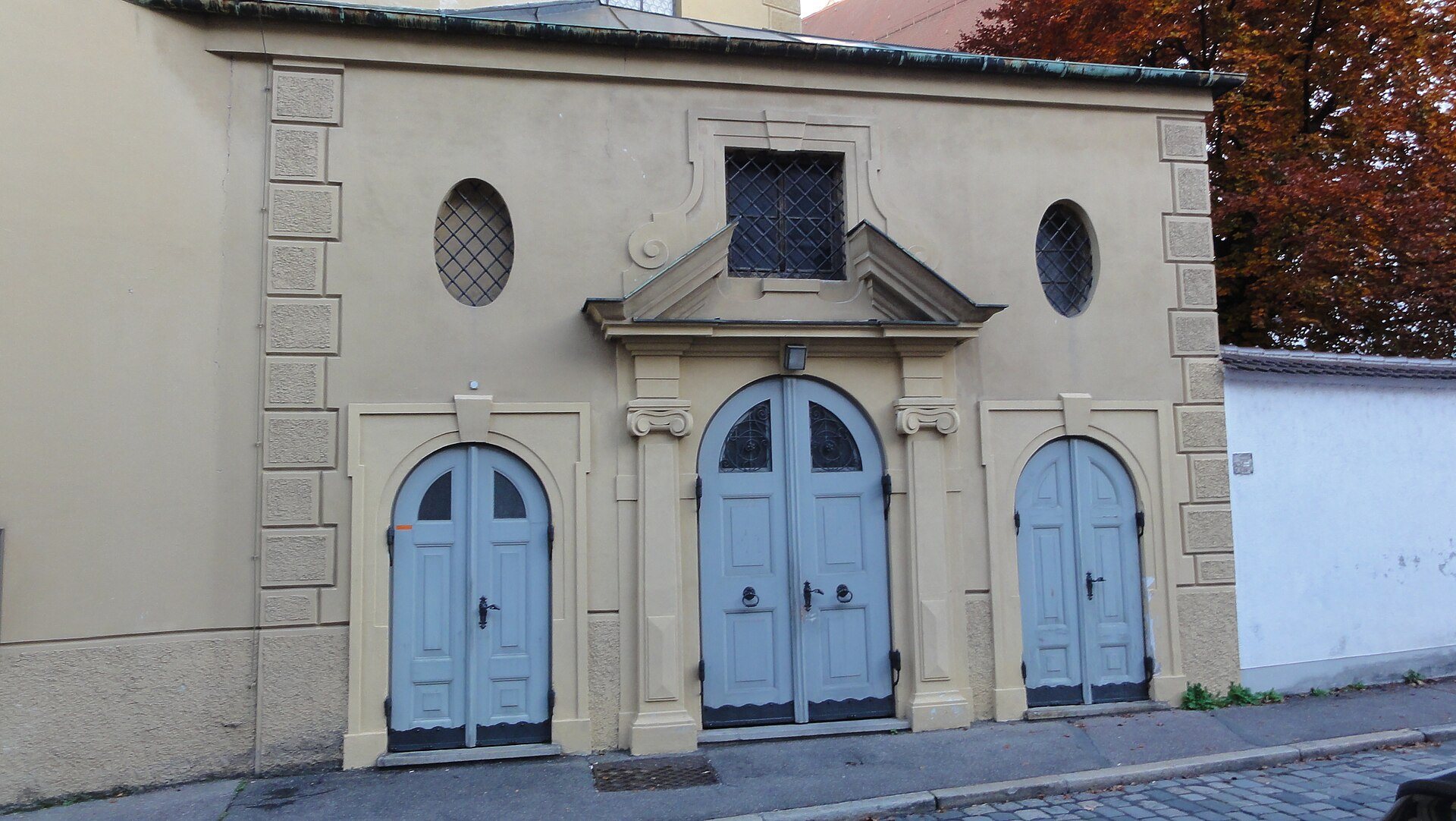
The sacristy has a single-story, east-facing facade with three windows. The outer windows have triangular pediments, while the central window has a segmental-arched pediment. Above them is a curved gable topped by a triangular pediment. The same window arrangement appears on the north wall, followed toward the west by the external entrance.
The entrance leads first to the Small Sacristy, which contains the stair to the pulpit, and then to the Great Sacristy. A crypt beneath the sacristies contains the graves of pastors of Evangelische Heilig-Kreuz-Kirche. The first burial took place in 1689.
Small Sacristy
The Small Sacristy contains three oil paintings by unknown artists. They are the Anointing of Jesus’s Feet from about 1660, the Transfiguration of Christ from about 1670, and Christ on the Cross with Mary and John from about 1670.
Great Sacristy
The Great Sacristy has the character of a picture gallery. Three works from the circle of Lucas Cranach the Elder, all dated 1515, depict the Annunciation, the Adoration of the Shepherds, and the Adoration of the Magi. Donated to the church in 1669, they were assembled as a triptych on the east wall in 1843.
The room also contains an unknown artist’s Christ on the Cross from about 1700, flanked by late-sixteenth-century paintings of Martin Luther and Philipp Melanchthon from a workshop in the succession of Lucas Cranach the Younger. To the right of the altar are Ernst Philipp Thomann von Hagelstein’s Jesus Presenting a Child to His Disciples from about 1700 and a painting from the circle of Johannes Rottenhammer, Jesus the Friend of Children from the early seventeenth century. Both hang in broad gilded acanthus frames.
A large triptych on the west wall is attributed to Johann König and shows the Creation of Eve, the Last Supper, and the Baptism of Christ, all from about 1620. The north wall has a richly decorated black wooden epitaph with twisted columns, a broken pediment, gold ornament, and a heraldic cartouche. Its central oil painting, the Raising of Lazarus from 1684, comes from the circle of Johann Heinrich Schönfeld.
Gottesäckerle
The Gottesäckerle has three portals, with a broken pediment above the central portal. Its funerary monuments include a marble epitaph from 1757 for the merchant Christoph Miller, a wooden epitaph from 1676 for deacon Johann Georg Stierlin, a heraldic gravestone from 1718 for Jacob Fuhrmann, and a red-marble heraldic medallion from the sixteenth century.
The room also contains two of the twenty preacher portraits, an unknown artist’s Jacob Wrestling with the Angel from about 1700, and a relief of Christ Carrying the Cross from the late seventeenth century.
Organ and bell
Organ history
Marx Günzer built an organ for the earlier Protestant Heilig-Kreuz-Kirche in 1610–1611, and Johannes Rottenhammer painted it. The instrument was removed in 1629 and transferred to the Catholic Heilig-Kreuz-Kirche. It returned to the rebuilt Protestant church in 1653. David Jakob Weidner repaired and enlarged it in 1697 for more than 300 guilders.
Hieronymus Baur began a new organ in 1729, and Georg Friedrich Schmahl completed it after Baur’s death in 1730. Its seven-part Baroque case has remained unchanged. The Steinmeyer company installed another organ in 1908, and Richard Rensch built the present instrument in 1992. It has 35 stops distributed across three manuals and a pedal.
Bell
The church’s bell was donated in 1653 by Baron Ferdinand von Rehlingen and cast in Augsburg by Johannes Herold. It was hung in the gable turret. The bell cracked while being rung for the death of Emperor Charles VII in January 1745 and was recast in Augsburg by Abraham Brandtmair and Franziskus Kern.
The bell is 91 centimeters high and 113.5 centimeters in diameter. Its inscriptions commemorate the recasting on 1 July 1745 for the gathering of the faithful at the church. A replacement clapper was installed in summer 2021 because the earlier clapper had worn out and risked damaging the bell.