St. Anne’s Church, Augsburg: A Carmelite Monastery and Lutheran Parish Church


Site at a Glance
- Rating
- 4.7
- Popularity
- Low
- Country
- Germany
- Primary era
- Early Modern
- External website
- Open
- Eras represented
- Medieval, Early Modern, Modern
- Civilizations
- German, Holy Roman Empire
- Site type
- Religious
- Remains
- Church
On this page16 sections
History
St. Anne’s Church, Augsburg, in Germany, is an Evangelical Lutheran parish church that originated as the church of a Carmelite monastery. The Carmelites, a Catholic mendicant order whose communities combined worship, monastic life, preaching, and burial patronage, acquired a residential building and adjoining property in 1275. Construction of the church began in 1321 with financial support from Bishop Friedrich I and a guarantee from the Langenmantel family. Its medieval core was Gothic, although later rebuilding and decoration gave the complex a combination of Gothic, Renaissance, Baroque, Rococo, and Classicist elements.
The Carmelite Foundation and Medieval Expansion
A fire destroyed the monastery in 1460. Rebuilding followed during the later fifteenth century, and the church gained additional chapels during that century. Further alterations took place in the sixteenth century, as the monastery and church became increasingly connected with Augsburg’s religious and civic life.
The Goldsmiths’ Chapel was built in 1420 through the foundation of Afra Hirn and enlarged in 1496 as a side chapel for the Augsburg goldsmiths’ guild. Another important foundation began in 1506, when Jörg Regel and his wife Barbara, born Lauginger, established the Holy Sepulchre Chapel. Jakob Fugger founded a memorial and burial chapel with his brothers Ulrich Fugger and Georg Fugger in 1509, the latter represented after his death in 1506. The Fugger Chapel was completed by 1512 and richly furnished in the years that followed. Its foundation was formally recorded in 1521 and continues to exist.
Luther and the Reformation
Martin Luther stayed in the Carmelite monastery from 7 to 20 October 1518 while discussing his views with Cardinal Thomas Cajetan, the papal representative who questioned him at Augsburg. Luther refused to recant his 95 theses, his criticism of indulgences and other church practices, and escaped the city at night with the assistance of the Carmelite Christoph Langenmantel vom Sparren. Langenmantel, the son of an Augsburg mayor, helped him avoid arrest by imperial soldiers.
Johannes Frosch, prior of the Carmelite convent, joined the Reformation, resigned his office in 1523, left the order, and married in 1525. On Christmas Day that year, the first Protestant liturgy at St. Anne’s was celebrated, with Communion distributed in both kinds, bread and wine. Augsburg introduced the Reformation under an evangelical order of worship protected by the city council, making St. Anne’s one of the city’s earliest Protestant churches.
The former monastery buildings became the site of the Protestant Gymnasium bei St. Anna in 1531, and the Carmelite monastery was dissolved in 1534. St. Anne’s became Protestant in 1548, while the Fugger Chapel remained Catholic because the Fugger foundation continued to maintain it. The church therefore preserves a Catholic burial chapel within an Evangelical Lutheran parish church.
Confessional Conflict and Later Development
The monastery cloister later became a burial place for Augsburg patricians. The cloister courtyard served as a cemetery called Gottesäckerlein from 1596 until 1806, when the cemetery was closed. A building for the Augsburg City Library was erected at the Annahof in 1562 and 1563, and its foundations were rediscovered during the construction of the underground car park.
Augsburg’s confessional tensions reached St. Anne’s on 8 August 1629, when Emperor Ferdinand II deprived Protestant preachers of their offices and the church was closed. Protestant worship was held outdoors in the following years. The Peace of Westphalia in 1648 restored legal equality between Catholics and Protestants and allowed St. Anne’s to resume its religious function. Since 1650, prayers for peace have been held at the church each 8 August in commemoration of these events.
In 1731 and 1732, the Protestant community cared for Protestants expelled from the Catholic Archdiocese of Salzburg, with the intervention of pastor Samuel Urlsperger. The formerly Gothic nave and aisles were remodeled in the Baroque style in 1747 and 1748. Johann Andreas Scheidemann prepared the plans, Franz Xaver Feichtmayr and Johann Michael Feichtmayr the Younger produced the stucco work, and Johann Georg Bergmüller painted the ceilings.
War, Restoration, and Ecumenical History
Air raids on 25 and 26 February 1944 caused severe damage to the church. After Augsburg’s capitulation, the United States Army held several victory and thanksgiving services there. The return of the so-called Fugger Altar, together with the necessary stonework, was completed on 10 June 1945. Repairs continued into the 1970s, followed by extensive restoration of the former church and monastery complex from 2007 to 2014 and a comprehensive renovation in 2016 and 2017.
The Lutherstiege museum opened in adjoining church rooms in 1983 and reopened in 2012 after a long closure. It presents Luther’s stay in Augsburg and the events that led to the Reformation and the division of Western Christianity. On 31 October 1999, representatives of the Catholic and Evangelical Lutheran churches signed the Joint Declaration on the Doctrine of Justification at St. Anne’s. The agreement addresses Catholic and Lutheran understandings of justification, a central theological issue in the Reformation-era division, and the signing became an important event in the ecumenical movement.
St. Anne’s stands on Annastrasse, formerly Annagasse. The street has been a pedestrian zone since 1971, while the square opposite the church is now Martin Luther Square, formerly Annaplatz until 1933. Access to the church has been through the Annahof since 1890; before then, the approach was through the former cemetery courtyard.
Remains
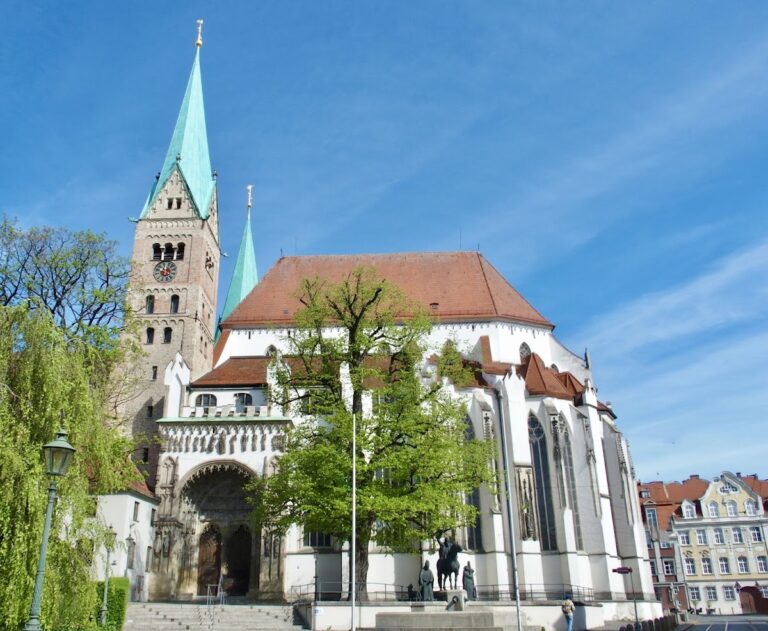
The surviving complex combines a three-aisled basilica with an elevated nave, a polygonal eastern choir, chapels placed alongside the church, the former Carmelite cloister, and adjoining monastery rooms. The eastern choir has buttresses and is separated from the street by an enclosing wall. The church’s present appearance reflects medieval construction, Renaissance memorial architecture, Baroque remodeling, Rococo decoration, and later restoration.
Church Structure and Side Chapels
Main Church and Tower
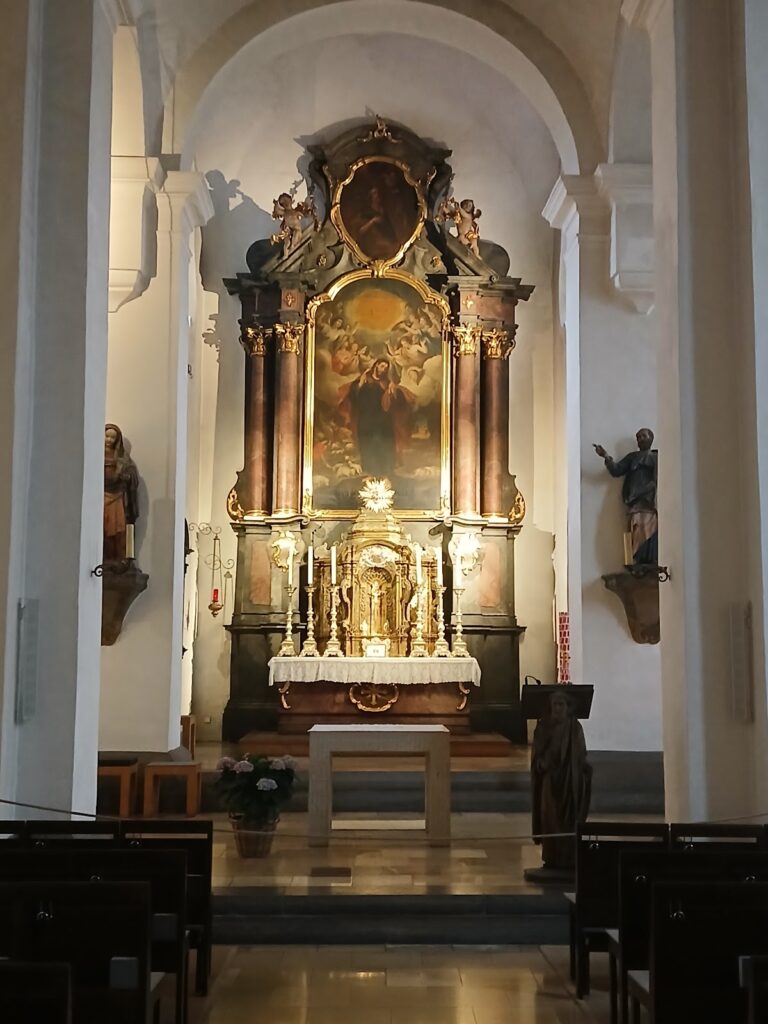
The main body is a three-aisled basilica with a raised central nave. Its Baroque interior is organized by pilasters and covered with stucco. Johann Georg Bergmüller’s ceiling frescoes include the Sermon on the Mount, the Crucifixion, and the Last Judgement. The eastern choir contains a Neo-Gothic altar made in 1898 by Wilhelm Vogt, a cabinetmaker from Memmingen. Its panel painting, Jesus Blessing the Children, was painted by Lucas Cranach the Elder around 1534 to 1540.
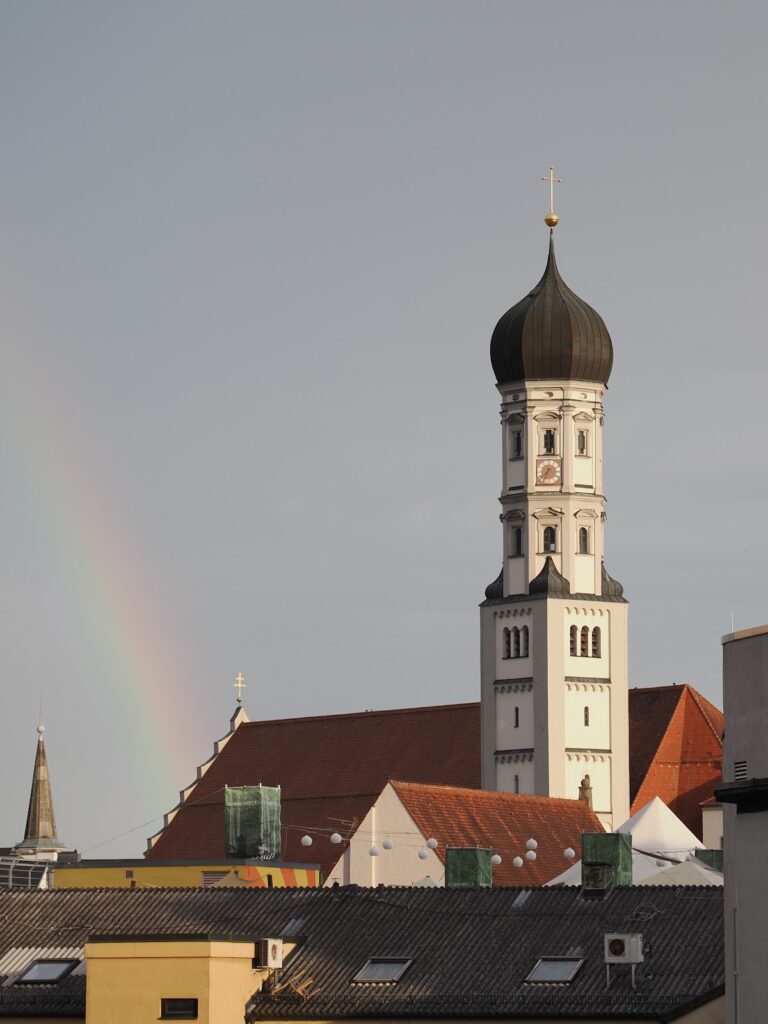
The tower stands on the south side where the nave and choir meet. Probably dating from the fourteenth century, it is turned approximately 45 degrees from the main building for structural reasons. Augsburg master builder Elias Holl raised and redesigned it in 1602. Six bells now hang in the church, two in the tower of the Goldsmiths’ Chapel and four in the main tower. Their tones are es” and f’ in the chapel, and e’, g’, a’, and c” in the main tower. The smallest bell was cast in 2011 by the Bachert bell foundry. Wartime requisitions for armaments led to the renewal of an earlier three-bell peal cast in 1826.
Goldsmiths’ Chapel
The Goldsmiths’ Chapel lies north of and parallel to the eastern choir and has its own small bell tower. Its Gothic ceiling frescoes and wall paintings include a Passion cycle from around 1420, the date of the chapel’s original construction. Other paintings show the Three Kings, the Crucifixion, and the Last Judgement, and date from 1485. An eighteenth-century tomb monument commemorates the Amann patrician family. The frescoes were repaired in the nineteenth century.
Holy Sepulchre Chapel
The Holy Sepulchre Chapel was added on the western side of the church from 1506. It was initially accessible only from the northwest corner of the cloister. Its ciborium, a canopy over a sacred installation, was built after 1555, while the chapel’s present form resulted from rebuilding by Johann Holl around 1590. From 1656, it served as the burial chapel of the Österreicher family, and it was renovated in 1748.
Fugger Chapel
The Fugger Chapel forms the raised western end of the extended central nave. Completed by 1512, it was partly planned under Italian influence and draws on Venetian, Florentine, and Roman memorial chapels. Its design places it among the early Renaissance buildings north of the Alps. The Fugger family crypt lies beneath the floor. Jakob Fugger was buried there after his death in 1525, alongside his brothers Georg Fugger and Ulrich Fugger the Elder and his nephews Raymund Fugger and Hieronymus Fugger.
The chapel’s furnishings included a marble balustrade and pavement, stained glass, choir stalls, a sculptural Lamentation of Christ, memorial reliefs associated with designs by Albrecht Dürer, and organ shutters painted by Jörg Breu the Elder. Adolf Dauher and Hans Daucher created the central Corpus Christi group and the putti on the marble balustrade. The possible participation of Hans Burgkmair the Elder and Hans Hieber rests on stylistic attribution. The chapel’s purpose has been interpreted both as a traditional place of medieval commemoration and concern for salvation and as an expression of Jakob Fugger’s wish to enter the nobility, distinguish his family from Augsburg’s patricians, and preserve the Fugger name in the manner of Italian patrons.
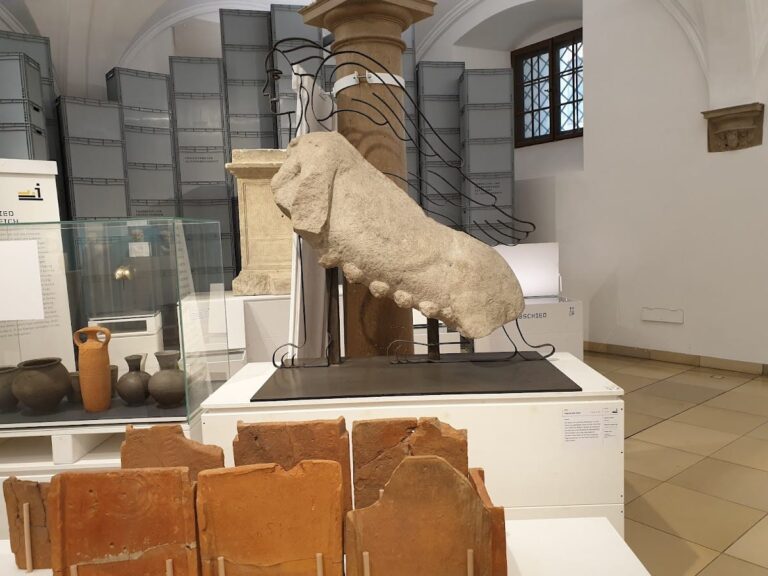
Six limestone putti, probably commissioned by Raymund Fugger and made around 1530 by Hans Daucher, originally stood on the chapel’s marble balustrade. Five were rediscovered in the Augsburg region in the early 1920s, while the sixth remained missing; a replacement copy was stolen in 2001. Two original figures were auctioned in Paris in 2019 and acquired with support from the Ernst von Siemens Art Foundation, federal and state cultural foundations, and the City of Augsburg. The rediscovery raised questions about the twentieth-century reconstruction, and the fifth putto may have come from another architectural setting.
The figures carry balls, an attribute of Fama, the Roman personification of fame and renown. Some also bear features identifying them as guardians of the Fugger burial chapel. The original putti are now on loan in the Maximilian Museum for protection, while copies stand in the chapel.
Paintings, Pulpit, and Organs
Interior Paintings and Pulpit
The wooden pulpit was made by Heinrich Eichler the Elder in 1682 and 1683. Opposite it, on the balustrade of the southern gallery, is a Passion and Easter cycle by Johann Spillenberger and Isaak Fischer. Other biblical paintings on the nave walls include works by Jörg Breu the Elder and Heinrich Eichler the Elder.
Portraits of Martin Luther and Elector John Frederick I of Saxony hang to the left of the altar in the eastern choir. Both came from the workshop of Lucas Cranach the Elder. The Luther portrait recalls his stay in Augsburg in 1518, while the portrait of John Frederick represents his support for the Protestant cause as a member of the Schmalkaldic League, a sixteenth-century alliance of Protestant German princes and cities formed to defend the Reformation. The paintings formerly hung above the seats of the city councillors.
Main Organ
The main organ occupies the western rear wall of the Fugger Chapel. Jan Behaim of Dobrau built an organ there in 1512 with a seven-part Renaissance case and a smaller rear division, called a Rückpositiv, placed behind the player and facing the congregation. After successive repairs, alterations, and extensions, a new Steinmeyer instrument was installed in the historic case with 41 stops on three manuals and pedal.
The 1512 organ and its historic case burned during the air raid of 25 February 1944. The organ-case wings survived because they had previously been evacuated. Jörg Breu the Elder painted the wings, and the lower left section of the left wing contains portraits of the Fugger brothers. After the war, the Moser firm of Munich reconstructed the case and façade pipes. Simon of Landshut built the present organ in 1977 and 1978, and Schmid of Kaufbeuren enlarged it in 1992. It has 45 stops on three manuals and pedal with mechanical action.
Choir and Positive Organs
Steinmeyer built a lectern organ for the eastern choir in 1948 as Opus 1770, after the choir had been restored. It had electro-pneumatic action, a main division that could be enclosed, and a Rückpositiv divided into two sections on either side of the lectern. The instrument had 29 stops on two manuals and pedal. It was dismantled in 1974, and most of it was sold to the Evangelical Confessional Church in Gersthofen. Its west-facing Rückpositiv is now a dummy, while the eastern-choir organ work survives with a movable pedal-less console. The former original console, slightly modified, stood unused in the lectern access area in autumn 2023.
A positive organ in the main nave was built in 1974 by the workshop of Rudolf Kubak. A second Kubak positive organ was made for the Goldsmiths’ Chapel in 1995. Each instrument has four stops: Gedackt 8 feet, Rohrflöte 4 feet, Principal 2 feet, and Quint 1 1/3 feet.
Cloister and Annahof
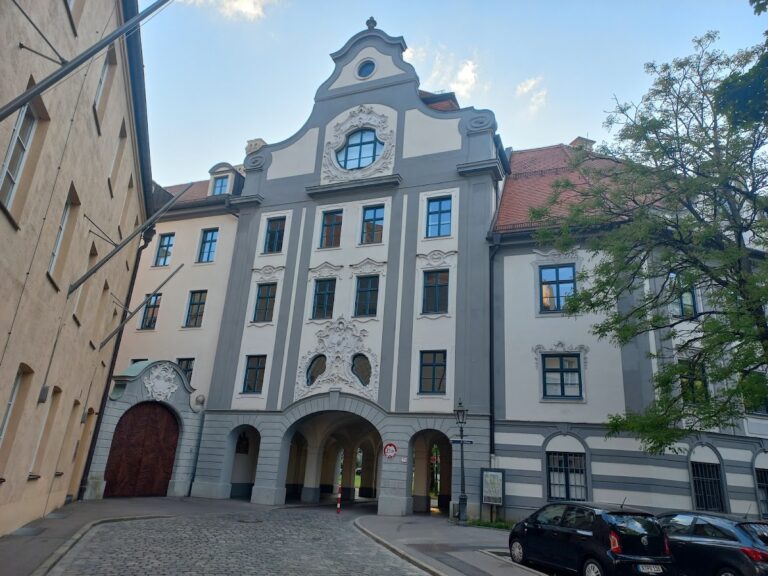
The former Carmelite cloister and adjoining rooms remain beside the church. The Annahof courtyard between Fuggerstrasse and the pedestrian zone was restored to its original form while being modernized. It contains an underground car park and a cafe and is bordered by the Augustanasaal meeting room, the Hollbau, and the former Anna Gymnasium building, now a branch office of the Higher Regional Court of Munich.
Memorial plaques in the Annahof commemorate Martin Luther, the Joint Declaration on the Doctrine of Justification, and Adam Gumpelzhaimer. The courtyard also contains the Dove Fountain by Augsburg sculptor Joseph Lappe. Its square basin displays the four Evangelists, Matthew with an angel, Mark with a lion, Luke with an ox, and John with an eagle.
Nearby sites