Catholic Holy Cross Church, Augsburg: A Former Collegiate and Pilgrimage Church


Site at a Glance
- Rating
- 4.4
- Popularity
- Very Low
- Country
- Germany
- Primary era
- Medieval
- External website
- Open
- Eras represented
- Medieval, Early Modern, Modern
- Civilizations
- German, Holy Roman Empire
- Site type
- Religious
- Remains
- Church
On this page14 sections
History
Catholic Holy Cross Church, Augsburg, is a Roman Catholic church in Germany, a former collegiate church of the Augustinian Canons Regular and a pilgrimage church dedicated to the Holy Cross. The present building was constructed as a late Gothic collegiate church between 1492 and 1508, probably to designs by Burkhart Engelberg. Since September 2020, it has been a filial church, meaning a subsidiary church attached to a larger parish, of the cathedral parish in the Diocese of Augsburg.
Origins and the medieval pilgrimage
A chapel dedicated to the Holy Cross may have stood outside Augsburg’s town walls during the time of Bishop Ulrich. A hospice was established beside it in 1143. Around 1160, Bishop Konrad of Hirscheck transferred the hospice to the Augustinian Canons, members of clerical communities following the Rule of Saint Augustine. They built the first permanent church after their earlier mother monastery, St Nicholas in the Wood near Muttershofen, was abandoned and its community was redirected from a proposed move to Hammelberg to Augsburg’s suburb.
The parish has existed since 1199. Its pilgrimage grew around the relic known as the “Miraculous Treasure,” linked by tradition to a Eucharistic miracle. In 1194, a woman was said to have taken a consecrated host home, enclosed it in wax, and kept it for five years before confessing. Bishop Udalschalk ordered it to be taken to Augsburg Cathedral. During Mass, the host was said to swell, shed its wax covering, become blood-red or flesh-like, and divide into two parts joined by vein-like strands. It was later returned to Heilig Kreuz in a solemn procession and venerated there.
The pilgrimage extended beyond the Augsburg region and continued into the twentieth century. The annual Feast of the Miraculous Treasure was held on 11 May. In 1486, the theologian and preacher Johann Geiler of Kaysersberg supported the devotion by preaching in Augsburg. In 1494, Bishop Friedrich II of Zollern and the cathedral chapter undertook a detailed examination of the relic.
Rebuilding and collegiate development
A fire destroyed the church and monastery in 1314, prompting the construction of a new church. The lower part of the present tower dates from this rebuilding and may originally have been connected with Augsburg’s town fortifications. The late Gothic church that followed was built under Provost Vitus Fackler between 1492 and 1508. Holy Roman Emperor Maximilian I donated a window to the new building, and the tower was raised further in 1514.
In 1627, Provost Johannes Schall supplied the church with new altars, seating, and a pulpit. More extensive Baroque alterations began in 1677. Michael Thumb designed the upper part of the tower and directed the construction of a new convent building from 1681 to 1687. Between 1716 and 1719, Johann Jakob Herkomer remodelled the interior, changing the windows and columns and adding a Baroque dome above the choir and the Miraculous Treasure. Johann Georg Bergmüller painted a series of wall and ceiling frescoes in 1732, including a cycle on the Holy Cross, but the paintings are now lost.
The church also developed an extensive musical tradition under the Augustinian Canons, with numerous compositions originating from the collegiate foundation. Wolfgang Amadeus Mozart played the organ during a visit in 1777. In 1782, he returned to the monastery with his father Leopold and his sister Nannerl; Leopold Mozart had earlier sung in the church choir as a boy. The Augsburg choir Musica Suevica continues to provide music for solemn services, including works from the former Augustinian Canons’ repertoire.
Secularization, war, and renewed religious use
The monastery was dissolved during secularization in 1803, when religious institutions were suppressed and their property transferred to secular authorities. The complex passed into municipal ownership. From 1805, it served the French army as a military hospital, and from 1808 to 1882 the Royal Bavarian military used it as a barracks. The relatively small parish was dissolved in 1809–1810. A proposal to turn the church into a theatre was abandoned after public protest. Restoration took place in 1877–1878, and after the military departed, the former collegiate complex housed a school for building technicians.
In 1932, Bishop Joseph Kumpfmüller transferred Heilig Kreuz to the Dominicans, the Order of Preachers, and the church became the church of a Dominican priory, a religious house governed by a prior. Air raids on Augsburg during the night of 25–26 February 1944 severely damaged the building. Fire took hold of the roof, sections collapsed into the choir and buried it, and the former monastery buildings were totally destroyed.
Reconstruction began in 1946 according to plans by Michael Kurz and Robert Pfaud. The late Gothic spatial arrangement was restored in simplified form, using a cast-concrete shell vault. The roof structure was installed in April 1948, and the nave was completed by 1950. Art historians criticised the simplified interior at the time. The destroyed Baroque choir dome was replaced by an octagonal tent roof by 1957, while the tower regained its Baroque onion cupola in October 1989. The interior was renovated in 2013. In 2020, the Dominican Order returned pastoral responsibility for the pilgrimage church to the Diocese of Augsburg. The church is listed as a protected monument in the Bavarian monument register.
Remains
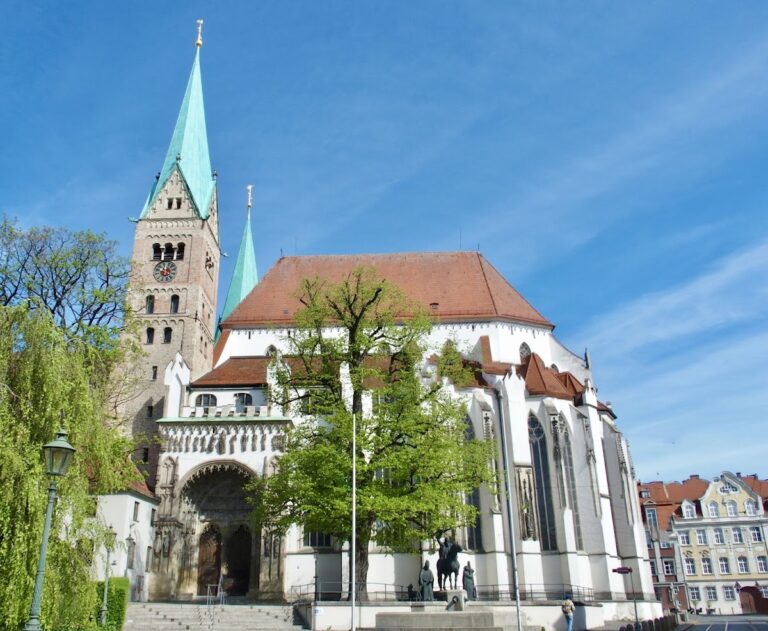
The surviving church is a late Gothic hall church with three aisles and a relatively plain exterior facade. In a hall church, the nave and side aisles are approximately equal in height, creating a unified interior space. The present fabric combines the late Gothic arrangement with Baroque additions and postwar reconstruction. The church stands directly beside the Evangelical Holy Cross Church, which occupies the site of the former Ottmar Chapel. That chapel replaced the Katharine Chapel in 1445 and was transferred to the newly established Evangelical congregation in 1525 for use as a preaching house.
Building fabric and tower
Tower and exterior
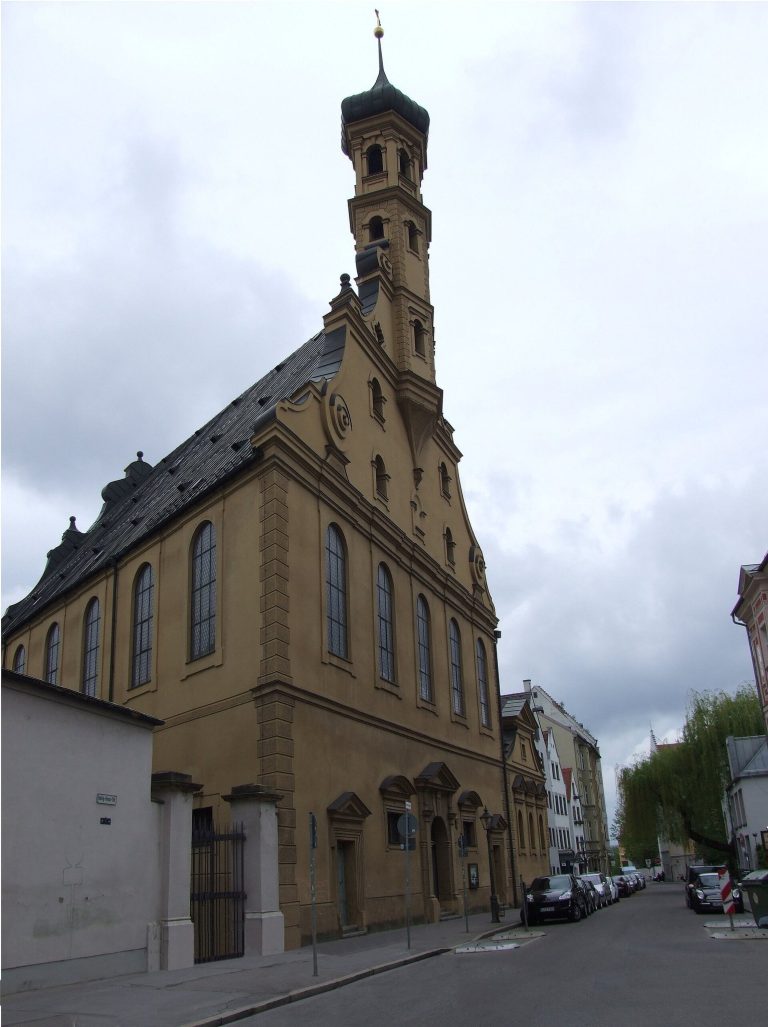
The Baroque bell tower has lower storeys that are cubical and Romanesque in character. Its upper section ends in an onion-shaped cupola, a bulbous Baroque tower roof restored in 1989. The lower part belongs to the rebuilding after the fire of 1314 and may originally have formed part of Augsburg’s town fortifications.
Vaults and interior structure
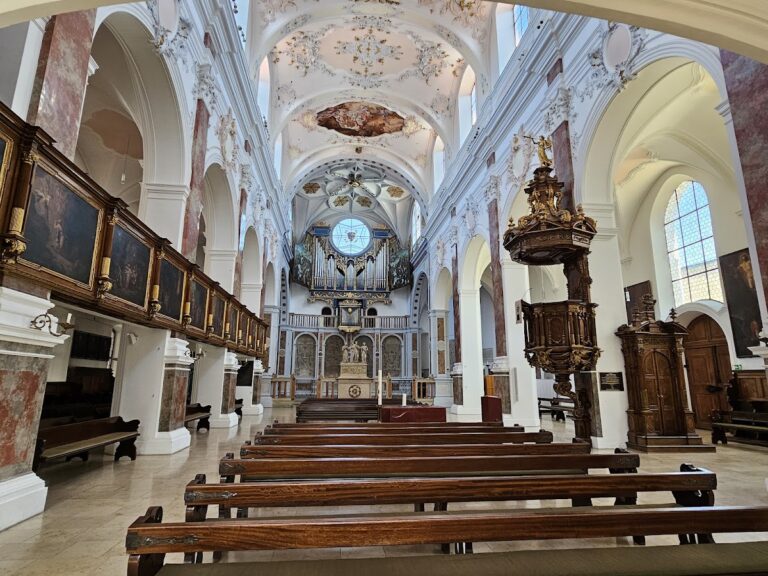
Slender round pillars support the postwar cast-concrete shell vault, a thin curved structural vault. A late Gothic net-rib vault survives beneath the organ gallery. The sacristy north of the choir contains a three-bay net vault, a Gothic vault whose ribs form an intersecting network, dated 1504. The reconstructed interior follows the earlier late Gothic spatial arrangement in simplified form.
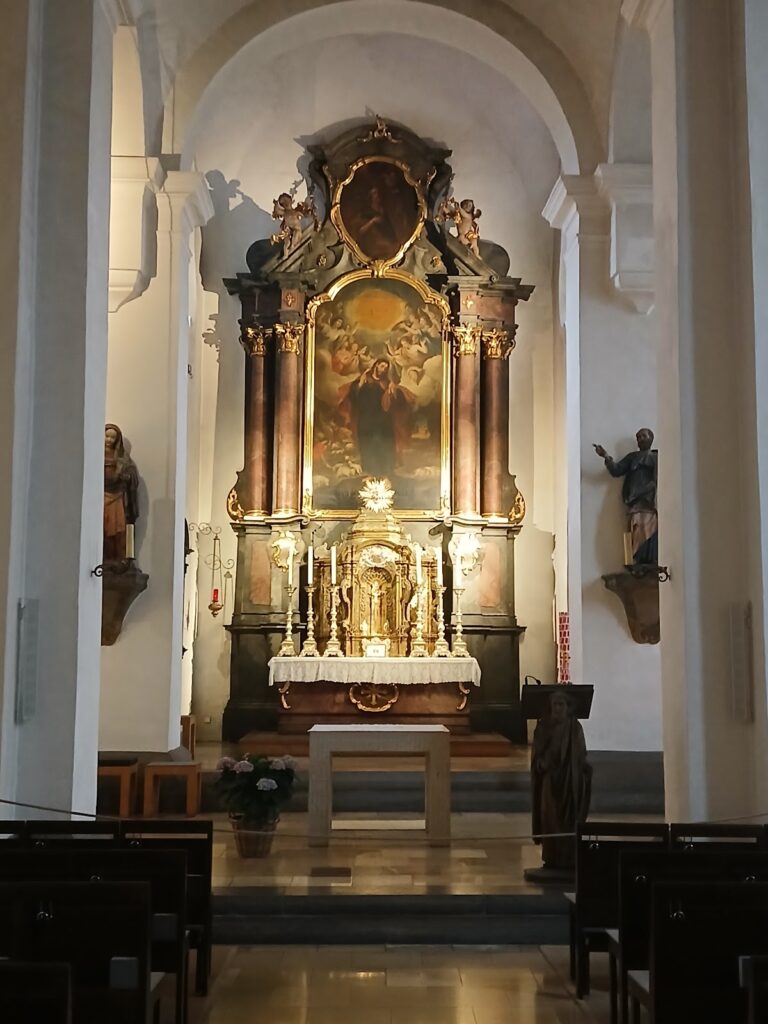
The Baroque dome that once covered the choir was destroyed in 1944. It was replaced by an octagonal tent roof by 1957. The choir was redesigned during the interior renovation of 1976–1982, with later work also reflected in its furnishings and sculptural arrangement.
Relic, furnishings, and choir
Miraculous Treasure
The Miraculous Treasure is kept in the church inside a ceremonial monstrance, a liturgical vessel used to display the consecrated host. It was originally held in a rectangular silver repoussé shrine donated by the Rechberg noble family in the thirteenth century. Repeated alterations and ornamentation transformed the shrine into the present monstrance. The relic and its ceremonial vessel have been moved out of the church several times for circumstantial reasons but are preserved there. After the 8 a.m. Mass, the tabernacle, the enclosure where the Eucharist is reserved, is opened for approximately half an hour so that the faithful may view the consecrated host.
Paintings, sculpture, and screen
The church’s earlier rich furnishings survive only in part. Preserved works include Johann Matthias Kager’s Presentation of Mary in the Temple, painted in 1616, and a wooden crucifix made by Georg Petel in 1626. An Assumption of Mary altarpiece from the 1620s is attributed to Peter Paul Rubens or his workshop. An early seventeenth-century altarpiece showing the Miracle of the Cross of Saint Helena is attributed to Giuseppe Vermiglio. Saint Helena is traditionally associated with the discovery of the True Cross.
Johann Michael Hoch and Johann Georg Rummel made the lavish wrought-iron screen in 1744. Ignaz Wilhelm Verhelst created three figures representing the Finding of the True Cross in 1782, of which two survive. Following the 1976–1982 choir renovation, Hans Ladner created a sculptural arrangement combining Baroque figures of Saint Helena and the Byzantine emperor Heraclius with abstract forms and a simple wooden cross. The choir also contains three glass windows by Hubert Distler, a new main altar designed as a people’s altar, and a new tabernacle by Ladner that houses the Miraculous Treasure.
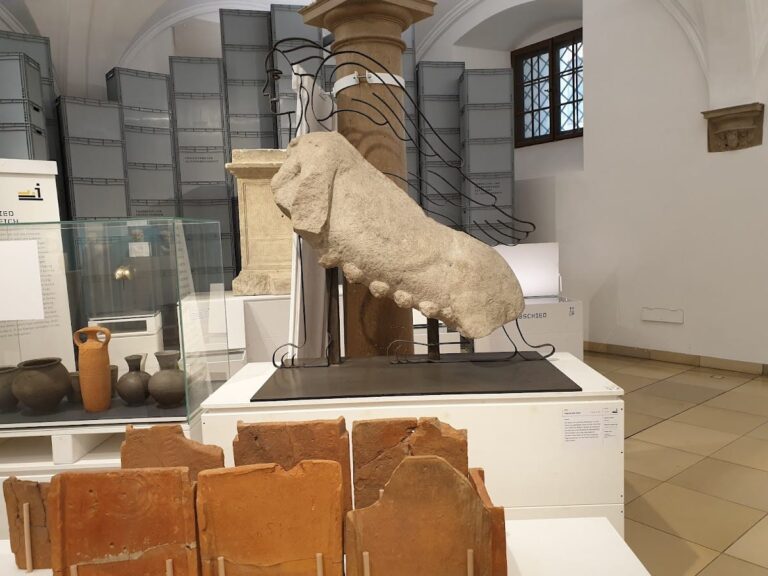
An ancient cross relic associated with the church’s name can be seen in the Diocesan Museum.
Organs and musical remains
Earlier instruments
Christoph Egedacher of Munich installed an organ on the rood screen, the historical screen separating the choir from the nave, in 1661. Johann Andreas Stein of Augsburg built a new organ for the west gallery in 1766. It was altered in 1787 and enlarged by Josef Mühlbauer of Augsburg in 1891. Heinrich Koulen of Augsburg built another organ in 1917, but it was destroyed in the bombing of 25–26 February 1944.
Present organ
The present organ was built in 1949 by G. F. Steinmeyer of Oettingen as Opus 1784. It has 19 speaking stops distributed across two manuals and a pedal. Its equipment includes the couplers II/I, I/P, and II/P, two free combinations, an organ cancel device, tutti, a crescendo pedal, and a Zimbelstern, a small rotating ornamental bell device used as an organ effect.