Domstift Ratzeburg: Cathedral Chapter and Ecclesiastical Estate


Site at a Glance
- Rating
- 4.6
- Popularity
- Low
- Country
- Germany
- Primary era
- Medieval
- External website
- Open
- Eras represented
- Medieval
- Civilizations
- Holy Roman Empire
- Site type
- Religious
- Remains
- Monastery
On this page15 sections
History
Domstift Ratzeburg was an ecclesiastical administrative body in Germany, founded in 1154 as the cathedral chapter of the newly refounded Diocese of Ratzeburg. Established under the rule of the Premonstratensians, a twelfth-century order of religious canons, it combined communal religious life with responsibility for cathedral worship and diocesan administration. The chapter held administrative, liturgical, judicial, patronage, and landholding rights, becoming the diocese’s largest ecclesiastical landholder and most influential clerical community.
Foundation and Premonstratensian rule
Heinrich the Lion, Duke of Saxony, founded the diocese and its chapter in 1154, probably as a daughter foundation of the Magdeburg Cathedral Chapter of Our Lady. Pope Hadrian IV confirmed the refoundation and the chapter’s Premonstratensian constitution in 1158. The diocese became a suffragan of the Archdiocese of Bremen-Hamburg, meaning that it stood under that archbishop’s ecclesiastical supervision.
The chapter first operated at St. Georg auf dem Berge and probably moved to the new cathedral by about 1158. This relocation gave the institution a second patron saint. The Virgin Mary remained its original patron, while John the Evangelist was added through the cathedral foundation. The resulting dual patronage was unusual among cathedral chapters. The surrounding territory was still sparsely settled, and some communities followed pagan Slavic traditions. Missionary work was therefore probably an important purpose of the new foundation, alongside parish care and the administration of the diocese.
Ratzeburg was one of only three Premonstratensian cathedral chapters, together with those at Havelberg and Brandenburg. The chapter also probably founded the Premonstratensian house at Gramzow around 1177. Its early work included missionary activity and, at least until 1401, participation in pastoral care within the parishes. It held patronage over ten parishes, giving it authority to present or appoint clergy to those ecclesiastical benefices.
Bishops and internal government
Hadrian IV confirmed the chapter’s right to elect the bishop in 1158, but this privilege initially conflicted with Heinrich the Lion’s claim to investiture, or the power to appoint a bishop. Isfried, formerly provost of the Premonstratensian foundation at Jerichow and not a member of the Ratzeburg chapter, became bishop between 1178 and 1180. After Heinrich’s deposition in 1180, most later bishops came from the chapter, with Lambert of Barmstede and Wipert of Blücher among the exceptions.
Twenty-two Ratzeburg bishops originated from the chapter. Nineteen had previously held ecclesiastical offices, including nine provosts and three priors. The last three, Heinrich Bergmeier, Georg of Blumenthal, and Christoph von der Schulenburg, had been secular clergy and chapter members. Relations between the bishops and canons were often tense, although their shared Premonstratensian affiliation encouraged cooperation. The bishop required the chapter’s agreement for financial decisions, the incorporation of parish churches, contracts, new monastic foundations, and the introduction of feast days. Pardam von dem Knesebeck was the first bishop required to accept an electoral capitulation, a formal agreement limiting the bishop’s freedom of action.
From the time of Marquard von Jesow, most bishops lived at their castle in Schönberg, although the episcopal court near the cathedral continued to be used occasionally. An arrangement made in 1372 generally divided papal payments and other taxes between the provost and the chapter. The provost paid one-third, while the chapter paid two-thirds.
Offices, membership, and communal life
The provost originally headed the community, supervised canons and vicars, managed financial and economic affairs, represented the chapter, and exercised archidiaconal powers, a delegated form of ecclesiastical jurisdiction. His authority declined during the fourteenth century as the prior and other officers acquired wider responsibilities. Under Provost Eckhard Hake, who held office from 1319 to 1342, the chapter became heavily indebted. A committee of four was appointed to supervise him, and a further commission was established in 1330 to settle disputes involving the provost, the chapter, and individual canons. In 1486 Pope Innocent VIII ranked the provost as the chapter’s highest dignity after the bishop and required papal confirmation within four months of election.
The prior was originally the provost’s deputy and the second dignity of the Premonstratensian chapter. He directed worship and choral prayer, supervised the vicars, and represented the chapter at order assemblies and provincial synods. By the late fifteenth century he also held judicial authority. After the 1504 conversion, the prior was known as the dean and assumed much of the chapter’s leadership. A scholaster is recorded from 1238 in connection with the cathedral school, while the treasurer, first called custos and later thesaurarius, managed sacred oil, wine, vestments, lighting, and other liturgical requirements. The chamberlain provided canons with clothing and shoes while communal life continued.
A master of works, recorded from 1261, supervised cathedral construction and the chapter’s brickworks. From about 1355, an officialis maior administered the chapter’s economy and buildings, and an officialis minor was added in the fifteenth century to manage income from memorial foundations. Economic records survive from 1444. The chapter normally met daily during its earlier period and probably weekly by the late Middle Ages. The dean’s oath of 1551 refers to regular Friday meetings, with extraordinary sessions for elections and other important matters.
The chapter’s intended membership was apparently thirteen, although its usual size ranged from fourteen to twenty-five. In 1301 it proposed a maximum of twenty-five members: the provost, sixteen priests, four deacons, and four subdeacons. That number was reached in 1301 and 1327. Subdeacons were initially subordinate to the scholaster rather than full canons. Regional nobles were strongly represented until the fourteenth century, after which bourgeois members became more numerous. At the 1504 conversion, about four of the fourteen canons were noble and ten were bourgeois. Bourgeois canons often came from Rostock, Wismar, Lübeck, and nearby areas, while noble members mainly came from Mecklenburg, Saxony-Lauenburg, and Brunswick-Lüneburg.
The chapter probably abandoned its vita communis, or shared communal life in the cloister precinct, at the beginning of the fifteenth century. Records from 1438–1439 and 1457 show canons living in their own houses with separate households. Lay brothers probably helped manage the estates until the fourteenth century, with their number limited to ten in 1308. Secular clergy increasingly served as vicars at side altars and celebrated memorial services founded by clerics and laypeople. Sixteen vicars were serving by 1500.
Conversion into a secular chapter
In 1504 the Premonstratensian chapter became a secular collegiate chapter, a body of secular canons that no longer followed a monastic order rule. Bishop Johannes von Parkentin and Dukes Johann IV and Magnus I of Saxony-Lauenburg requested the change from Pope Alexander VI, arguing that the canons had not followed the Premonstratensian rule for decades. Pope Julius II confirmed the transformation on 22 May 1504. Ratzeburg was the first of the three Premonstratensian cathedral chapters to abandon its order constitution.
Fourteen existing members adopted secular status and its associated privileges, while eight new canonries with prebends were added. A prebend was income assigned to support a canon holding a canonry. The reorganization was also intended to provide the Saxon-Lauenburg princes with legally trained court officials. Under the new constitution, two canonries were provided by the bishop and six by the duke, producing a nominal total of twenty-two positions. The full number was not always occupied. Before 1504, admission required legitimate birth, solemn profession, a profession certificate, and an admission fee. Thereafter, new canons swore an oath and paid 100 Luebian marks, entering through co-optation, presentation by a patron, or papal provision.
Eight additional canonries were formed from the chapter’s patronage parishes of Berkenthin, Seedorf, Buechen, Siebeneichen, Stapel, and Lauenburg, together with the episcopal parish churches of Nusse and Herrenburg. Their patronage relationships continued, so the new arrangements did not amount to incorporation.
Political conflict and the Reformation
Pressure from the Dukes of Saxony-Lauenburg intensified under Johann IV and Magnus I. In 1492 Johann IV imposed levies on the chapter’s estates, claiming ancient custom. From 1517, conflict with Magnus I forced the chapter and bishop to flee temporarily to Lübeck, where the archive and cathedral treasury were kept. Pope Leo X issued a protection privilege in 1517, but the dispute continued. The chapter and bishop again sued Magnus at the Imperial Diet of Worms in 1521. The Imperial Chamber Court ruled against the duke in 1524, and a further conflict ended temporarily in the chapter’s favor through a settlement at Speyer in 1532. The costs of these disputes forced the sale of much of the cathedral treasury in 1530, while property seized by Magnus and later retained by Franz I was not returned.
After Bishop Georg of Blumenthal died, Duke Franz I tried to secure the bishopric for his son Magnus. In 1550, however, the chapter unanimously elected its former provost, Christoph von der Schulenburg. Franz I responded by commissioning the mercenary commander Vollrad von Mansfeld. On 23 May 1552, Mansfeld’s troops attacked the cathedral, plundered the church and the canons’ houses, damaged the interiors, and imprisoned the canons they found. The occupation lasted two months. The canons were compelled to recognize Franz’s son as bishop, and the troops extorted 4,000 Reichstaler to spare the cathedral from being burned.
Christoph von der Schulenburg resigned in 1554 and received 10,000 Rhenish guilders from Duke Johann Albrecht I. The duke then secured the postulation of his seventeen-year-old brother, Christoph of Mecklenburg, as bishop. Because of his age, Christoph served only as administrator. Lutheran ideas had entered the chapter by the 1530s. Joachim Blücher became the first known canon to resign his canonry and marry, in 1538. In 1566 the chapter formally introduced Lutheran teaching, abolished Catholic ceremonies, established Lutheran preaching, and permitted canons to marry. Georg Usler became the first Lutheran cathedral preacher. From 1581, adherence to the Augsburg Confession, the principal doctrinal statement of the Lutheran churches, was required for admission.
Choral prayer continued after the confessional change, although Catholic rites were abolished. Before the Reformation, canons had performed assigned duties during choral prayer, high mass, processions, and weekly Gospel readings. Vicars increasingly attended processions, liturgical feasts, vespers, and high mass on specified feast days. The cathedral also remained associated with the pilgrimage cult of Ansverus, a medieval Christian figure who was not canonized. Bishop Ludolf I, who died in 1250 after imprisonment by Duke Albrecht I of Saxony-Lauenburg, was venerated locally as a saint by 1340. A foundation required his remains to be carried in procession on 29 March if the bishop gave permission.
Abolition and later memory
Chapter 8 of the Peace of Osnabrück, one of the treaties forming the Peace of Westphalia that ended the Thirty Years’ War in 1648, provided for the chapter’s abolition. Vacant offices were not to be refilled, and ecclesiastical prebends were to pass to the ducal household. The chapter resisted and reached an agreement with the duke on 15 December 1652. This regulated the continued use and administration of its estates until the death of the last canon. The eight canons still living in 1649 continued to receive support, exercise patronage and school rights, and administer chapter property.
Heinrich Hoinckhusen, who died in 1683, was the last canon of Domstift Ratzeburg. Buildings associated with the chapter continued to be used by canons until their deaths after 1652. The cathedral remained a religious center and a ducal burial place, while the continuing title “Dompropst” for the cathedral pastor preserved a medieval chapter tradition.
Remains
Cathedral island and chapter precinct
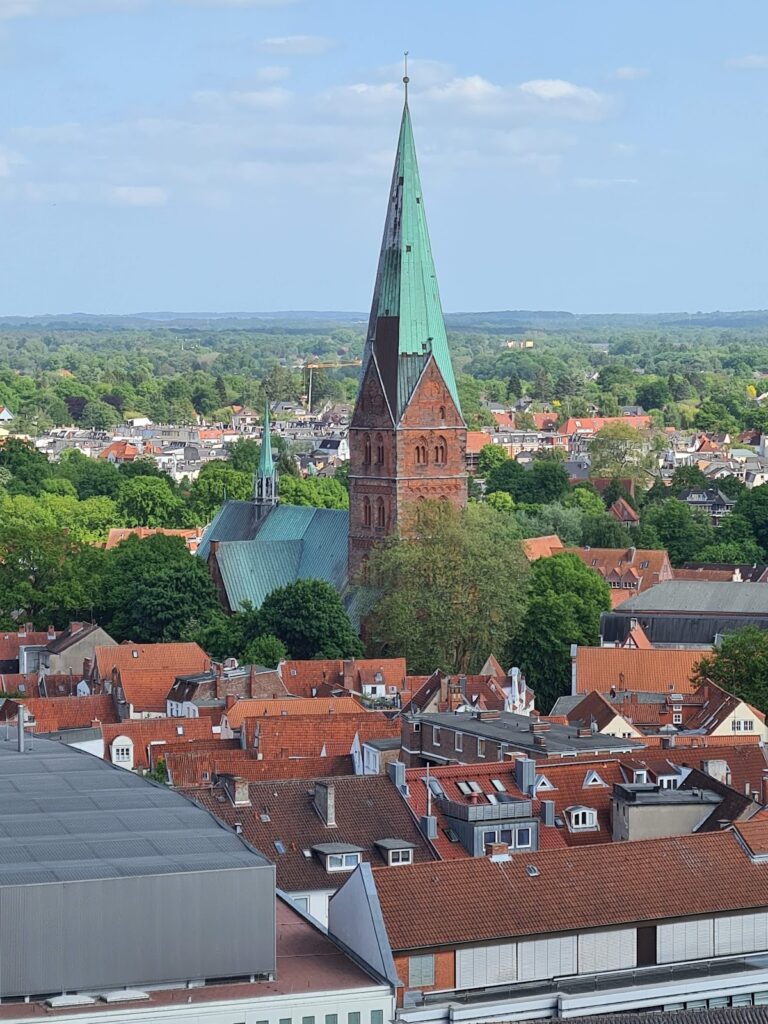
The cathedral and its precinct occupy an island in Lake Ratzeburg, near the old town but geographically separated from it. Two ferry causeways connect the island with the rest of the town, replacing earlier wooden bridges. The chapter precinct contained the cloister area, the canons’ curiae, the bishop’s court, the cathedral school, and buildings for worship, residence, administration, economic management, and brick production.
When communal life ended, the canons occupied separate curiae with their own households. These residences continued in use by canons until their deaths, including after the chapter’s institutional abolition. The bishop’s court stood near the cathedral and was used intermittently, while most bishops from the time of Marquard von Jesow lived at the episcopal castle in Schönberg.
Cathedral and devotional features
Cathedral church and treasury
The cathedral became the chapter’s principal setting when the community moved from St. Georg auf dem Berge by about 1158. Its dual dedication to the Virgin Mary and John the Evangelist reflected the chapter’s original patronage and its association with the new cathedral. Liturgical equipment included a silver pyx donated by Bishop Philipp in 1211. A pyx was a small container for consecrated elements or other sacred contents, although the contents of this example are unknown. Treasury records from the sale in 1530 list two crosses containing wood attributed to Christ’s Cross, three silver reliquary ornaments, an arm of Saint James, an arm associated with Saints Victor and Gereon, and two monstrances containing unspecified relics.
Ansverus and Ludolf I
The cathedral contained the tomb of Ansverus, whose cult made it a pilgrimage focus from the late Middle Ages. It was also associated with the remains and local veneration of Bishop Ludolf I. A foundation provided for his remains to be carried around the cathedral in procession on 29 March, subject to the bishop’s permission. These devotional practices formed part of the cathedral’s religious life before the Reformation.
School and institutional buildings
Cathedral school
A cathedral school probably stood within the chapter precinct. A scholaster is recorded in 1238, while a cleric serving as schoolmaster usually supervised the school. It educated young canons and subdeacons, and some pupils participated in choral prayer and mass as altar servers or choristers. The school continued after the chapter’s conversion to Lutheranism in 1566. It was refounded within the cloister precinct in 1655 and probably remained there until about 1845, when the Lauenburg Learned School replaced it in the same rooms.
Administrative and economic facilities
The precinct also accommodated the chapter’s administrative and economic work. The treasurer managed the treasury and materials required for worship, the chamberlain handled clothing and shoes for the canons during the period of communal life, and the master of works supervised construction and the chapter’s brickworks. Later officials administered the buildings, estate income, and revenue from memorial foundations. The surviving economic records begin in 1444, providing evidence for the institutional management of the precinct and its property.