Petrikirche in Dortmund: A Medieval Gothic Hall Church
Site at a Glance
- Rating
- 4.5
- Popularity
- Low
- Country
- Germany
- Primary era
- Medieval
- External website
- Open
- Eras represented
- Medieval, Early Modern
- Civilizations
- Holy Roman Empire
- Site type
- Religious
- Remains
- Church
On this page9 sections
History
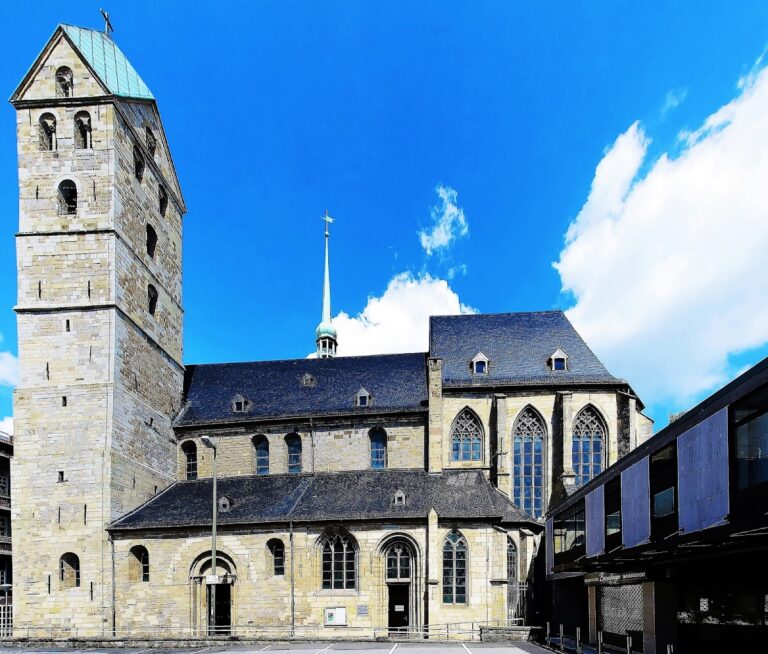
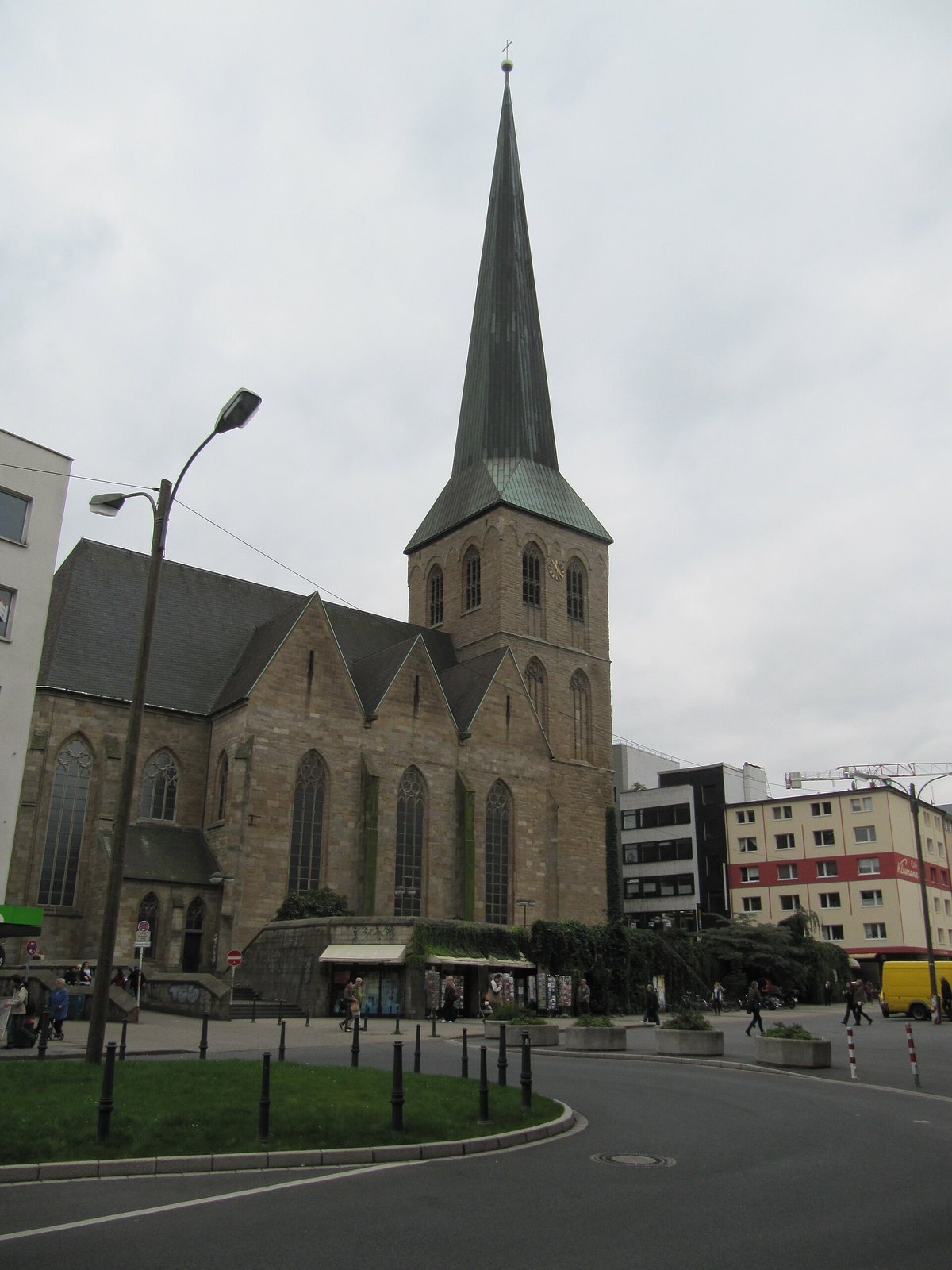
Petrikirche is a Protestant medieval church in Germany, standing in central Dortmund on the Westenhellweg. Built in the High Gothic period, it belongs to the group of medieval churches formed with St. Reinold’s Church and Marienkirche along this historic urban route.
Medieval construction and the tower competition
Construction of the three-bay church began in 1322. Work on its tower started in 1396, and the tower reached clock level in 1469. Its original spire was added in 1523. During the fifteenth and sixteenth centuries, Petrikirche and St. Reinold’s Church competed to have Dortmund’s highest church tower, a rivalry reflected in Petrikirche’s unusually tall spire.
Destruction and reconstruction
The spire collapsed in 1752. The church was rebuilt in 1759 with Baroque and Neoclassical elements, while its historic spire form remained unreconstructed for a long period. On 23 May 1943, bombing during the Second World War almost completely destroyed the building.
Reconstruction took place between 1954 and 1966. It followed the medieval form of the church, including the transverse gable roofs over the side aisles. The spire was restored to its historic height on 17 November 1981.
Parish history and preservation
Petrikirche was formerly Catholic and is now Protestant. On 1 July 2007, its previously independent parish merged with the Nicolai and Martin parishes to create the Evangelical St. Petri-Nicolai parish. Declining membership and reduced financial resources prompted the merger, producing an enlarged congregation of approximately 9,000 members.
An association founded in 2003 supports the preservation, repair, and restoration of the church and its Golden Wonder of Westphalia altar. Petrikirche and the historic fountain north of the chancel are listed as protected monuments in Dortmund’s monument register.
Remains
Church layout and exterior
Petrikirche is a Westphalian urban hall church, a type in which the central nave and side aisles are nearly equal in height, creating a unified interior space. The High Gothic building has an almost square ground plan, three aisles, three bays, and a comparatively short chancel. Light sandstone forms the main construction material.
The reconstructed church preserves the medieval arrangement of transverse gable roofs above the side aisles. Together, these roofs create a row of three small pointed gables beneath the higher roof of the central nave. The church stands within the Petrikirchhof precinct between Westenhellweg and Kampstraße. Westenhellweg follows the historic Hellweg, a major medieval route linking Duisburg, near the confluence of the Ruhr and Rhine, with the Teutoburg Forest near Paderborn.
The church reaches a total height of 105 metres. Its spire is approximately 60 metres high, with a lower structure of 15 metres and a pointed upper section of 48 metres, finished with a globe and cross.
Interior furnishings and musical features
Golden Wonder of Westphalia
The interior contains the Golden Wonder of Westphalia, a richly carved late-Gothic winged altar, or Antwerp retable. Made in Antwerp and dated to 1521, it has hinged panels that open and close to display different images and carved arrangements. In its closed position, it shows the Adoration of the Eucharist. The first open position contains 36 detailed images, while the festive open side has 30 compartments filled with gilded carved figures.
The altar measures 5.65 metres high and 7.49 metres wide. It was commissioned in Antwerp and originally stood in a Franciscan church. After that church was demolished in the nineteenth century, the altar was transferred to Petrikirche.
Organ and bells
A small post-war Walcker organ originally provided 17 stops across two manuals and a pedal. In organ building, stops select the available sounds, manuals are the hand-operated keyboards, and the pedal is the foot-operated keyboard. In 2013, Orgelbau Schulte received the commission to adapt a Romantic organ made in 1868 by the English firm Radcliff & Sagar for St. Mary’s Church in Woodkirk near Leeds, which had been removed after that church closed.
The adapted instrument was inaugurated at Petrikirche on 6 September 2015. Its technology, wind system, wind chests, case, and console were newly made in the Kürten workshop, giving it the character of a new instrument rather than a straightforward conversion. The organ stands in a simple cube 7.5 metres high and measuring 3 by 2 metres in cross-section. Its grey-glazed birch-board casing leaves parts of the mechanism visible. The instrument contains 1,049 pipes and is operated from a free-standing mobile console connected by a LAN cable to a Sinua Castellan control system.
The historic peal consisted of four bronze bells, dated 1710, 1639, 1497, and 1639. Although these bells were not surrendered during the Second World War, they were destroyed in 1945. The present peal consists of five cast-steel bells made by the Bochum Association for Cast-Steel Manufacture.