St. Philip’s Castle: A Bastioned Fortress at the Entrance to Mahon Harbor


Site at a Glance
- Rating
- 4.4
- Popularity
- Low
- Country
- Spain
- Primary era
- Early Modern
- External website
- Open
- Eras represented
- Early Modern
- Civilizations
- British, Spanish
- Site type
- Military
- Remains
- Fort
On this page9 sections
History
St. Philip’s Castle is a sixteenth-century Spanish fortification in Spain, built as a bastioned fortress to defend the town and harbor entrance of Mahon on Menorca. Standing on the southern side of the harbor mouth in the present municipality of Es Castell, the castle commanded access to one of the Mediterranean’s deepest natural harbors. It was also positioned to support Spanish communications with Italy during the sixteenth and seventeenth centuries.
Spanish Foundation
In March 1551, Menorca’s defenses were judged insufficient after repeated Ottoman naval attacks in the western Mediterranean. Count Hugo de Cessane, an Italian engineer, was commissioned to design a new castle, and construction began in 1552. Cessane died in 1553, however, and the plans for the fortification were lost.
Giovanni Battista Calvi became the new engineer in 1554. He prepared a different design and moved the castle to its present location. The raising of the flag in 1556 indicated that the fortress was regarded as an operational military post. The earlier Spanish fortification is associated with the aftermath of the Ottoman admiral Khayr ad-Din Barbarossa’s sack of Mahon and with Piyale Pasha’s attack on Menorca in 1558.
British and French Conquests
England conquered Menorca in 1708, although the island did not formally become British territory until 1714. British forces strengthened St. Philip’s Castle and depended heavily on naval superiority to support its defense. Estimates placed Menorca’s defensive requirement at between 6,000 and 10,000 men, while the British garrison numbered about 2,000 to 3,000.
The castle became the central target during the struggle for Menorca in the Seven Years’ War, an international conflict fought from 1756 to 1763 by Britain, France, Spain, and other European powers. After a French naval victory at Menorca in May 1756, French forces led by Marshal Louis François Armand du Plessis, Duke of Richelieu, attacked the fortress in late June. The British garrison, commanded by William Blakeney, surrendered after a 71-day siege that lasted from 18 April to 28 June 1756, and Menorca passed to France.
In Britain, the loss of the castle and the island was treated as a major military failure. Admiral John Byng was held responsible for failing to prevent the French capture of Menorca, and he was court-martialled and executed. The Treaty of Paris of 1763 ended the Seven Years’ War and returned Menorca to Britain. British forces then reconstructed the castle during the 1760s on the site of the earlier Spanish fort.
Demolition and Partial Reconstruction
Spanish forces captured Menorca during the Spanish invasion of 1781 and partly demolished the castle. Only towers and artillery batteries considered necessary for responding to possible attacks were retained. In 1783, King Charles III ordered the demolition of the remaining portions of the fortification.
Britain conquered Menorca again in 1798, and the castle was partially reconstructed. After the Peace of Amiens, Menorca returned permanently to Spain in 1802. British forces abandoned the island while the rebuilding remained incomplete. King Charles IV ordered another demolition in 1805, leaving the batteries required for the defense of Mahon Harbor.
During the British occupation, St. Philip’s Castle also served as a naval arsenal supporting Gibraltar, Britain’s other colony in Spanish territory. Since 1998, the ruins have been managed with the other fortifications of Mahon Harbor and Cala San Esteban by the Consortium of the Military Museum of Menorca and the Military-Historical Heritage of the harbor and Cala San Esteban. This arrangement enabled the partial recovery of underground galleries and their conversion into a museum.
Remains
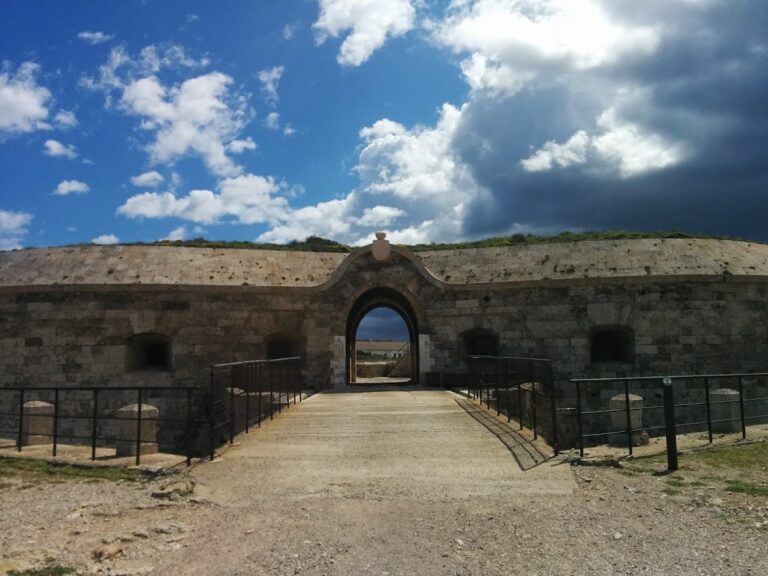
The surviving site is a ruined stone-built fortress whose remaining defensive elements reflect the repeated demolitions and reconstructions that followed its military use. Towers and artillery batteries form the principal visible parts of the complex, while underground galleries and a subterranean tunnel extend the fortress below ground. An eighteenth-century gun battery is also among the surviving remains.
Defensive Structures and Underground Works
Towers and Artillery Batteries
The towers and batteries represent the portions of the castle retained after its partial demolition in 1781 and the further destruction ordered in 1783 and 1805. The batteries were maintained for the defense of the entrance to Mahon Harbor, and their position reflects the fortress’s role in directing artillery toward the harbor mouth. The surviving complex remains in ruins, with selected military elements preserved within the larger site.
Underground Galleries and Tunnel
Subterranean galleries form part of the fortress’s surviving structure. Some were partially recovered under the modern management of the ruins and adapted for museum presentation. A subterranean tunnel is also among the surviving or visitable remains, preserving part of the underground circulation and defensive system.
San Carlos Lighthouse
The area around the fortress later contained the San Carlos lighthouse, built in 1852. It consisted of a 16-metre tower with a single-storey keeper’s residence at its base. Because the lighthouse stood within the direct firing range of the fortress artillery, complaints that military exercises damaged the building and alarmed the keepers’ families continued until it closed in 1912.
After the closure, a movable light on a metal support replaced the lighthouse. The support could be lowered during artillery exercises and raised afterward, and the light was visible for approximately 9.5 nautical miles. During the 1970s, it was replaced by a fixed light on a 15-metre concrete tower painted with black and white bands. The new light’s range reached approximately 13 nautical miles. The former lighthouse was destroyed in 1917, and parts of it were reused in constructing the new Favàritx lighthouse.
Nearby sites