Mola Fortress: A Spanish Coastal Defence Complex


Site at a Glance
- Rating
- 4.4
- Popularity
- Medium
- Country
- Spain
- Primary era
- Modern
- External website
- Open
- Eras represented
- Early Modern, Modern
- Civilizations
- British, Spanish
- Site type
- Military
- Remains
- Fort
On this page8 sections
History
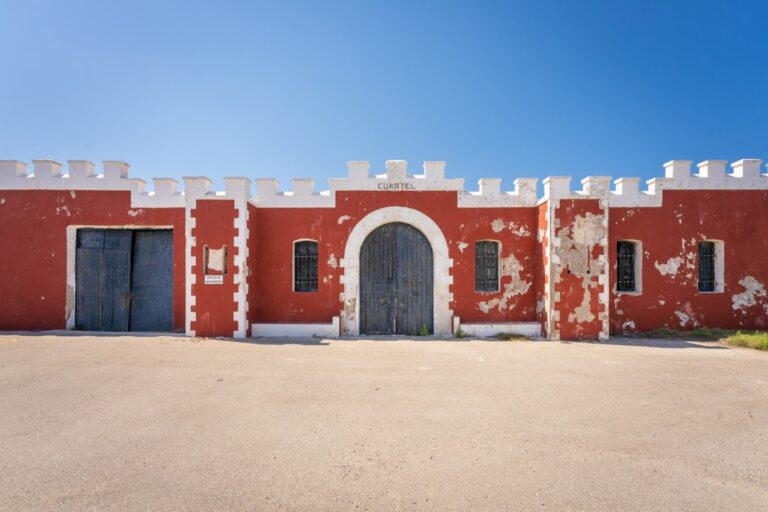
Mola Fortress is a Spanish military complex at Maó, Spain, built as a nineteenth-century coastal fortification on the Mola peninsula at the entrance to Mahón Harbour. Its construction ran from 1849 to 1875, after Queen Isabella II, whose reign lasted from 1833 to 1868, ordered the project. The fortress was intended to defend the harbour, serve as the operating base for the Army on Menorca, and provide a final stronghold for its forces.
Menorca’s Harbour Defences
Mahón Harbour had supported Spanish connections with the Crown’s Italian possessions since the sixteenth century. During British rule of Menorca, it became a base for the British Mediterranean fleet, and in the nineteenth century it stood between the French route from Toulon to Algiers and the British route linking Gibraltar with Malta.
Earlier defences included San Felipe Castle, built in 1555 and later enlarged under Spanish rule. After the British took Menorca in 1708, they strengthened the harbour with a double enclosure and Fort Marlborough. During their third occupation of the island, they added two defensive towers on the Mola peninsula in 1799, including the Princess Tower, which was later incorporated into Mola Fortress.
Construction and Later Defences
Renewed tensions in the western Mediterranean followed France’s occupation of Algeria, creating the immediate strategic setting for the new fortress. Work began after San Felipe Castle was demolished in 1850. The fortification was inaugurated in 1852 before its construction was complete, and Isabella II visited the works in 1860. The building campaign finally ended in 1875.
Advances in artillery had made the fortress outdated by the time it was completed. In response, modern coastal batteries were installed around the Mola peninsula in 1896. Some of their guns had an approximate range of 40 kilometres. Mola Fortress was declared a Spanish Historic Heritage monument of Cultural Interest in 1993 and is recorded as restored.
In November 2007, the Government of the Balearic Islands and the Ministry of Defence agreed that the former Punta Afuera defensive installation would be ceded to the regional government for 15 years, with extensions possible up to a total of 75 years. Its planned rehabilitation as a scientific centre formed part of the later civilian use of the military complex.
Remains
Peninsula Fortress and Associated Defences
Mola Fortress and the Princess Tower
Built of stone on the Mola peninsula, the fortress occupies the land beside the easternmost point of Spain and faces San Felipe Castle across the mouth of Mahón Harbour. Its fortified area includes the Princess Tower, one of the two defensive towers erected on the peninsula by the British in 1799. The tower’s incorporation links the nineteenth-century complex with the earlier defensive works that protected the harbour.
Coastal Batteries and Punta Afuera
The fortress forms part of a coastal defensive system that included batteries positioned around the peninsula’s shoreline in 1896. A battery is a fortified position equipped for one or more artillery pieces. These installations included guns with an approximate range of 40 kilometres. The former Punta Afuera defensive installation is another associated military component, whose rehabilitation was planned for scientific use.
Landscape Setting
The surrounding area has distinctive geomorphological features that support habitats for endemic plant species and provide nesting grounds for endangered seabirds. The peninsula is protected as a Natural Area of Special Interest and as a Special Protection Area for Birds, a designation intended to safeguard important bird habitats.
Nearby sites