Karlsborg Fortress: Sweden’s Central-Defense Stronghold


Site at a Glance
- Rating
- 4.4
- Popularity
- Medium
- Country
- Sweden
- Primary era
- Modern
- External website
- Open
- Eras represented
- Modern
- Civilizations
- Swedish
- Site type
- Military
- Remains
- Fort
On this page8 sections
History
Karlsborg Fortress is a Swedish fortress established in the nineteenth century as part of Sweden’s central-defense strategy. After Sweden lost Finland and experienced the Napoleonic Wars, military planners proposed concentrating the country’s political leadership, central administration, military command, and strategic reserves in an inland stronghold rather than defending every border region. In a crisis, the king, government, Riksdag, central military command, and Sweden’s gold reserves were expected to withdraw there.
Foundation and construction
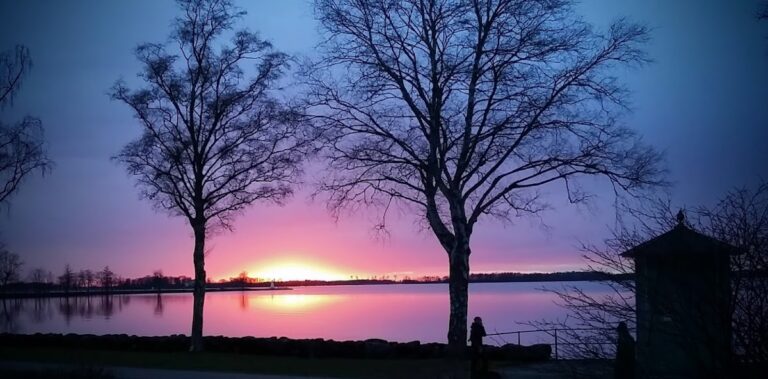
Statesman and engineer Baltzar von Platen selected the Vanäs Peninsula beside Lake Vättern in connection with the planned Göta Canal, which was intended to meet the lake. Construction began in 1819, within a project broadly dated from 1818 to 1909. The fortress covered nearly 100 hectares and was planned to house 6,000 enlisted men, along with an additional 8,000 to 10,000 people.
The ramparts were largely complete by about 1830. During an inspection by King Karl XIV Johan in 1832, the fortress was named after him. After studying European fortifications, architect Johan af Klen prepared plans modeled on Fort Winiary at Posen, now Poznań in Poland. The principal fortified building was constructed between 1845 and 1869 and inaugurated in 1869.
Changing military purpose
By the inauguration of the principal fortified building, the central-defense doctrine had become obsolete. Karlsborg’s proposed function as a crisis and reserve capital was no longer current, although construction continued until the fortress was completed in 1909. Advances in artillery during the second half of the nineteenth century also made the completed fortress vulnerable to modern weapons. Vaberget Fortress was built about five kilometers west of Karlsborg in the early twentieth century as an additional protective position.
Karlsborg was active as a fortress from 1831 to 1925, and it lost its intended central-defensive role in 1918. The installation was abandoned as a defense installation in 1928, but its military use continued in other forms. It remained a garrison, barracks, and storage facility, and it has housed the Göta Signal Regiment since 1918. The Life Regiment Hussars has also been based there since 1984, while the Swedish Parachute Ranger School and the Swedish Special Operations Group have been housed at the fortress. The complex serves as the Special Operations Group’s headquarters.
Later use and protection
During the Second World War, Karlsborg Fortress was used as a depot for Sweden’s gold reserves. A settlement grew beside and within the fortress, first providing housing for fortress personnel and later expanding partly because the Göta Canal passes through Karlsborg. The fortress has been protected as a Swedish byggnadsminne, a legally protected historic building or site of particular cultural and historical value, since 1935.
Remains
Karlsborg Fortress occupies approximately 100 hectares on the Vanäs Peninsula beside Lake Vättern in Västergötland. The complex is primarily built from limestone quarried at Omberg, together with gravel. Its principal fortified structure is a 678-meter-long, two-storey masonry building containing casemates, which are fortified spaces for troops, weapons, ammunition, or other military functions, and embrasures, the openings through which weapons could be operated. Three large towers form part of the building.
Fortified core
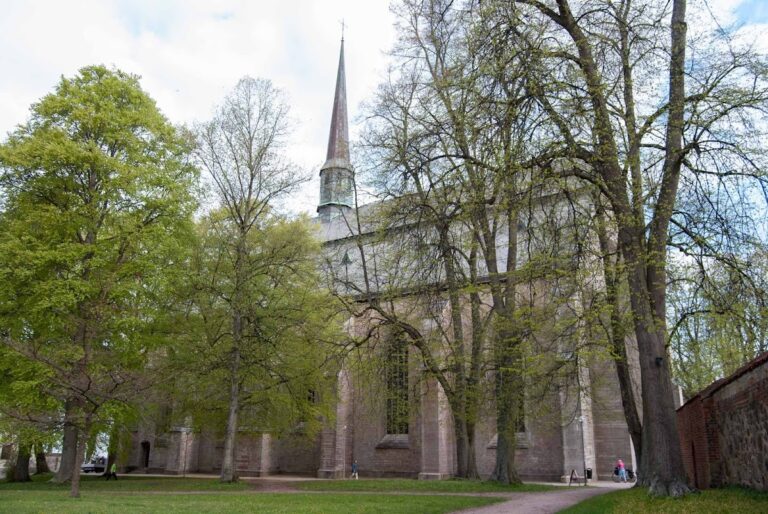
The garrison church occupies the center of the principal building on its second floor, above the Fortress Museum. The church was also designed to serve as an assembly hall for the Riksdag during a crisis. Its chandelier is made from 276 bayonets rather than crystal prisms. The museum occupies space within the fortress and forms part of the complex’s surviving institutional layout.
Garrison settlement
Buildings from mainly the second half of the nineteenth century form a small settlement within the fortress. Among them are a Royal Villa in the Empire style and a garrison hospital. These structures accompanied the fortified core and provided facilities for the personnel and community connected with the installation.
Additional defensive and industrial features
Vaberget Fortress lies approximately five kilometers west of the main fortress. Built in the early twentieth century, it provided an additional protective position in response to the increasing power of artillery. A munitions factory stands next to Karlsborg Fortress.
Nearby sites