St. Petri: An Evangelical Lutheran City Church in Rochlitz, Germany


Site at a Glance
- Rating
- 4.2
- Popularity
- Very Low
- Country
- Germany
- Primary era
- Medieval
- External website
- Open
- Eras represented
- Medieval, Early Modern, Modern
- Civilizations
- Electorate of Saxony, German, Holy Roman Empire
- Site type
- Religious
- Remains
- Church
On this page10 sections
History
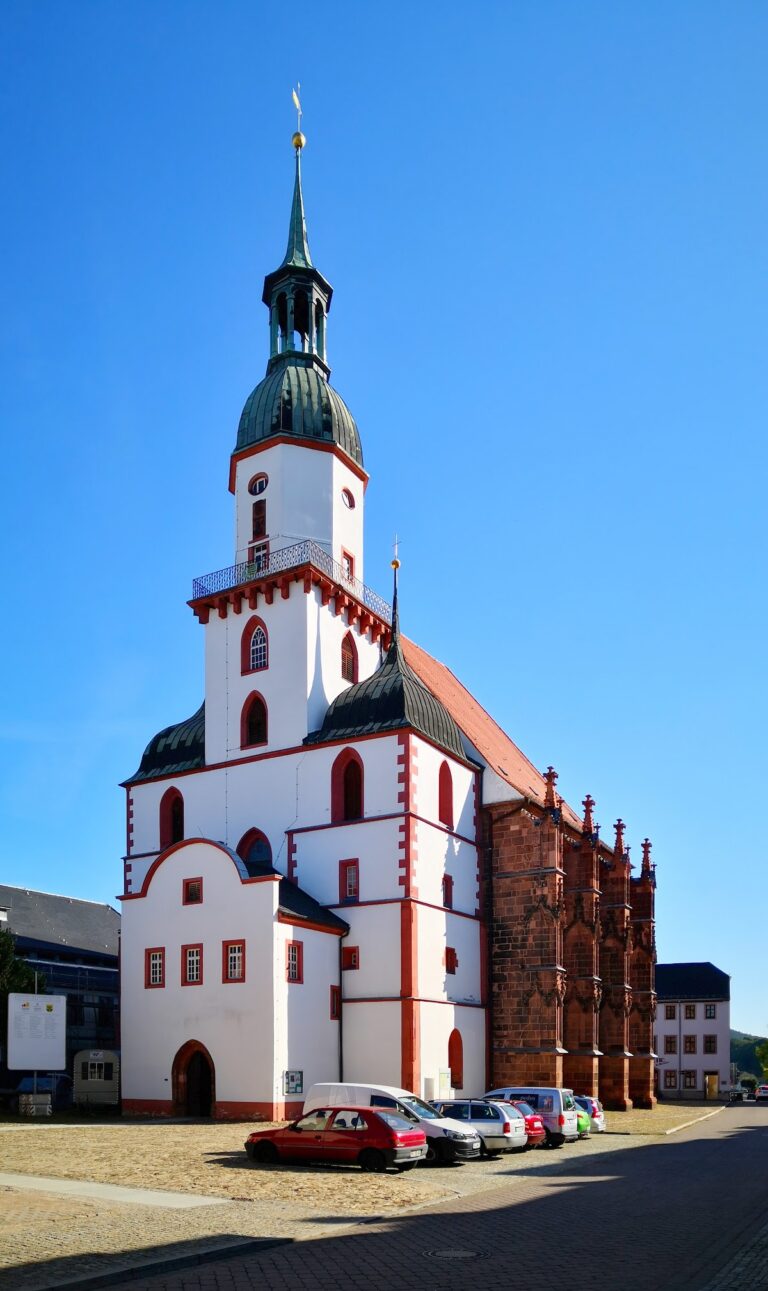
St. Petri, also called Petrikirche, is an Evangelical Lutheran city church in Rochlitz, Germany. It began as the church of the Rochlitz castle district and later became the parish church of the town that grew at the foot of the castle during the twelfth century. The church was first documented in 1168, when the foundation charter of Zschillen Monastery confirmed the monastery’s right of patronage over it.
Medieval origins
A longstanding tradition attributes the foundation of St. Petri to Henry I, also known as Henry the Fowler, who ruled East Francia from 919 to 936 as the first king of the Ottonian dynasty. This association belonged to a foundation tradition rather than a confirmed building record and was said to have been supported by an inscription on a chalice that has since been lost.
Gothic rebuilding
Between 1470 and the end of the fifteenth century, the earlier Romanesque church was remodelled in the Gothic style. The work followed the example of the Kunigundenkirche near the market. The main body of the present building was created during this phase, although the church initially had no tower.
War damage and Baroque-era furnishing
St. Petri was damaged during the Thirty Years’ War, the major European conflict fought from 1618 to 1648. By 1658, the church had acquired its large continuous gable roof and tower. Its interior was refurnished in 1699 and again in 1729. A 20-register organ by Gottfried Silbermann, an eighteenth-century German organ builder, had been installed in 1727.
Gothic Revival and conservation
From 1892 to 1894, the interior was completely redesigned under the direction of the Leipzig architect Julius Zeißig in the Gothic Revival style, a nineteenth-century movement that revived medieval Gothic forms. Silbermann’s organ was replaced during this remodelling. Between 1993 and 1998, the interior furnishings were restored, while the exterior plaster and paintwork were renewed.
Remains
Plan and exterior
St. Petri is a three-aisled Gothic hall church, meaning that its nave and side aisles are approximately equal in height and form a unified interior space. The nave measures 18 metres in length and 19 metres in width and is divided into three structural bays. It opens directly into the choir without a transept. The choir is as wide as the central nave and ends in a five-eighths polygonal termination, a five-sided ending based on an implied eight-sided figure.
The southern aisle extends one bay beyond the choir, creating a four-bay external facade. The fourth bay contains an octagonal tower with a hooded roof and lantern. Its wooden upper structure is completely clad in slate. The earlier Gothic building had a nave gable roof set transversely to the choir roof and crowned by a small roof turret. A gabled projection at the upper end of the fourth southern bay served as an ossuary.
The church has white exterior walls and a slate-covered gable roof with a half-hipped western end. Cornice-divided buttresses project only slightly from the walls. Rochlitz porphyry appears in the buttresses, the surrounding masonry, and the tracery of the three-light windows, and the building is constructed entirely of this stone. The church stands on the eastern extension of the spur carrying Rochlitz Castle, between Petrigasse and Sörnziger Weg near the Zwickauer Mulde. The route of the Muldental railway runs immediately beside it and is closed except for special services.
Interior and furnishings
Painted decoration and altar
The interior is richly painted. Gathered curtains appear on the choir walls, while floral and ornamental motifs fill the vault panels alongside imagery associated with Christian belief. The decoration includes an angel, the Lamb of Christ, and the four Evangelists. It also depicts Martin Luther and Philipp Melanchthon, leading German figures of the Protestant Reformation, together with the Renaissance painter Lucas Cranach the Elder and Frederick the Wise, Elector of Saxony and a political supporter of the Reformation.
The Gothic Revival altar has pinnacled superstructures and a principal painting entitled Jesus Saves the Sinking Peter, by Alexander Stichart. Three coloured choir windows show scenes from the life of Jesus Christ. At the western end, a separate entrance room is incorporated into the building, while a gallery runs around three sides of the nave.
Organ
The present organ was built in 1896 by the Rochlitz organ builder Paul Schmeisser. It is a mechanical slider-chest instrument, a type in which movable sliders control the air supply to the pipes of each stop. The organ has 26 registers distributed across two manuals and pedal, with both its key action and stop action operated mechanically.