Church of Our Lady of the Seven Sorrows in Vajnory


Site at a Glance
- Rating
- 4.6
- Popularity
- Low
- Country
- Slovakia
- Primary era
- Early Modern
- External website
- Open
- Eras represented
- Medieval, Early Modern
- Civilizations
- Habsburg, Hungarian
- Site type
- Religious
- Remains
- Fortified Church
On this page12 sections
History
The Church of Our Lady of the Seven Sorrows is a Roman Catholic parish church in Vajnory, Bratislava, Slovakia. Traditionally dated to 1270–1278 or 1270–1279, it represents a medieval foundation later enlarged in the Baroque period. Archaeological research in 2008 instead placed the church’s foundation in the fourteenth century, so its beginnings remain uncertain.
Medieval origins and dedication
The church was initially dedicated to the Virgin Mary. It was later placed under the patronage of Saint Ladislaus, the king of Hungary, before returning to Marian dedication in 1968 as the Church of Our Lady of the Seven Sorrows. This devotion concerns seven traditional episodes of suffering in Mary’s life, particularly those connected with the Passion of Christ. The church’s patronal feast is celebrated on September 15.
Baroque enlargement
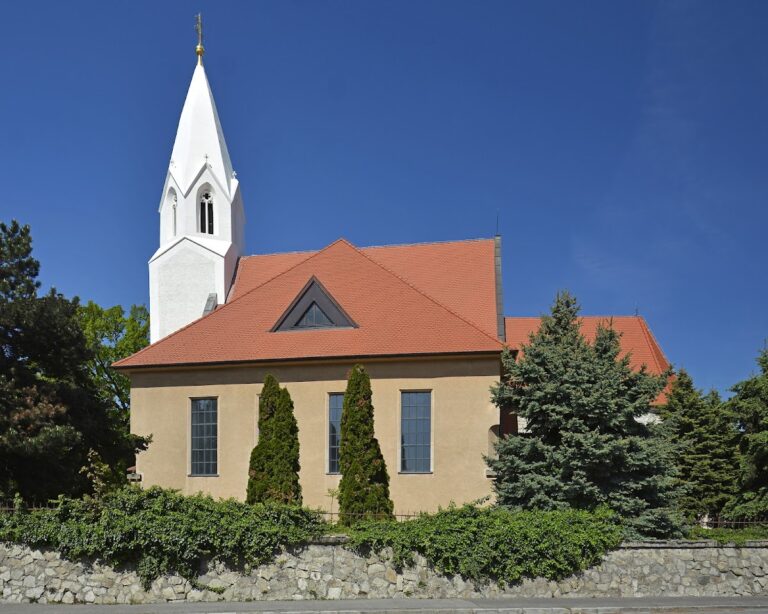
Between 1771 and 1779, the building was enlarged and altered during the Baroque period through the construction of a new nave. This intervention created the later form of the church while preserving the older sanctuary as a distinct part of the building.
Modern history and commemoration
The church was entered in Slovakia’s central register of monuments as a National Cultural Monument on October 23, 1963. It was consecrated on December 22, 2001.
In 2010, the remains of Titus Zeman, a native of Vajnory and a Salesian priest, were transferred to the church crypt. The Salesians of Don Bosco are a Catholic religious order particularly associated with the education and pastoral care of young people. Zeman had first been buried in the local cemetery, and his remains were later exhumed and examined during the process for his beatification. A memorial plaque was unveiled in the entrance hall on January 17, 2012.
Remains
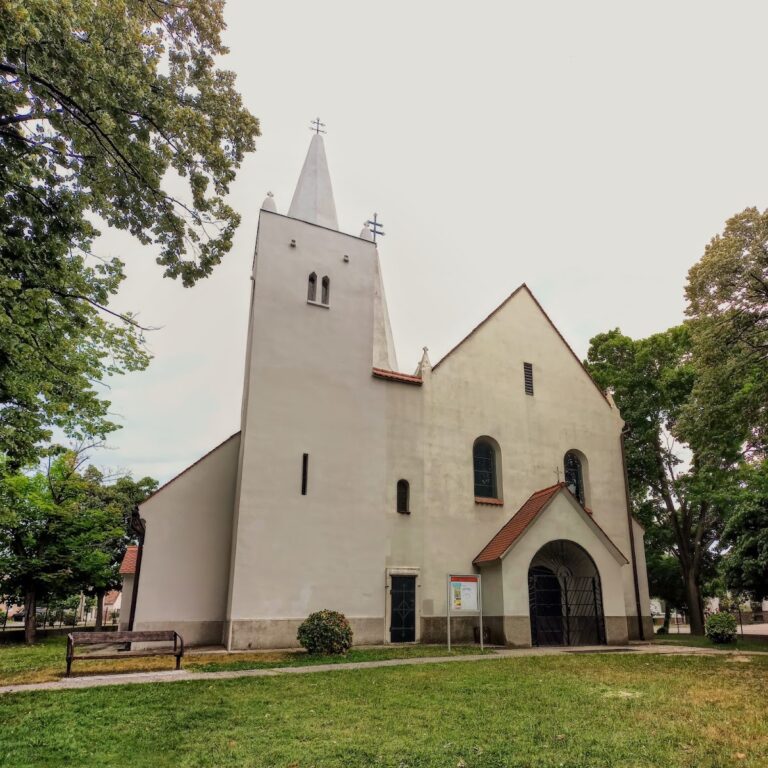
The church is a single-nave building with a polygonally terminated sanctuary. Its medieval and later sections are enclosed within a wider complex bounded by a wall, which also incorporates a south vestibule, a two-storey sacristy, an ossuary, and Stations of the Cross.
Medieval sanctuary and later church
Gothic sanctuary
The sanctuary has a Gothic rib vault, a vaulted ceiling whose structural ribs form its supporting framework. Medieval bosses, ornamental elements placed at the intersections of the ribs, remain part of the ceiling. Wall paintings decorate the sanctuary with compositions incorporating ornamental designs associated with the women of Vajnory.
Baroque nave and tower
The later nave is covered by seven bays of a Prussian vault, a masonry vault formed from a series of shallow transverse sections. The tower is topped by a pyramidal roof. Its otherwise plain shaft contains loopholes set within smooth sections.
Furnishings and enclosure
Main altar
The main altar dates from the end of the nineteenth century and forms part of the church’s interior furnishings.
Church complex
A boundary wall surrounds the church complex and includes the south vestibule, the two-storey sacristy, and the ossuary. Stations of the Cross are incorporated into the enclosure surrounding the building.
Vajnory Madonna
The Vajnory Madonna is an oak-wood figurine from the beginning of the fourteenth century. The Virgin holds a royal orb in her right hand and the infant Jesus in her left. It was discovered in the church attic in 1941 and sold to the Bratislava City Museum in the same year. From 1943 to 1967, the figurine stood on a console in the Bratislava church of the Poor Clares. Since 1959, it has formed part of the Bratislava City Gallery collections and is displayed in the permanent Gothic panel painting and sculpture exhibition at Pálffy Palace on Panská Street. A replica is kept at the Vajnory Local Office.