St. Nikolaikirche: Göttingen’s University Church


Site at a Glance
- Rating
- 4.3
- Popularity
- Very Low
- Country
- Germany
- Primary era
- Medieval
- External website
- Open
- Eras represented
- Medieval, Early Modern, Modern
- Civilizations
- Holy Roman Empire
- Site type
- Religious
- Remains
- Church
On this page10 sections
History
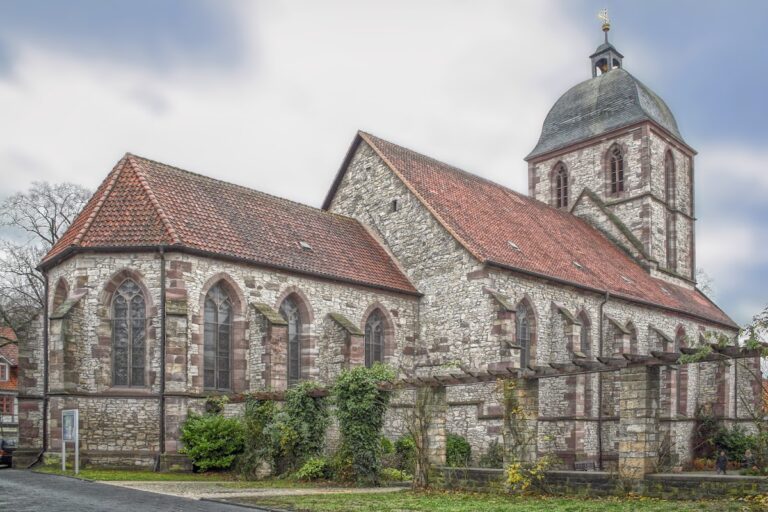
St. Nikolaikirche is a Gothic hall church in Göttingen, Germany, whose present building was begun at the end of the thirteenth century and completed around the middle of the fourteenth century. It has origins in the late twelfth century and stands in the old town’s Nikolaiviertel, the medieval quarter named after the church. Its history later became closely connected with the University of Göttingen, which has used it as its university church since 1822.
Medieval parish church
The Nikolaiviertel developed in a relatively secluded area between Groner Straße and the southern town wall. Linen and wool weavers from Flanders settled there, helping shape the quarter in which the church stood. Parish priests are documented at St. Nikolaikirche from 1356. The present three-aisled hall was built partly on the foundations of earlier structures, incorporating the church’s Romanesque origins into a later medieval Gothic building.
Johann Sutel, a Göttingen reformer, became the church’s first Protestant preacher in 1530 and the city’s superintendent in 1535. St. Nikolaikirche later suffered damage during the Thirty Years’ War, the seventeenth-century conflict that affected much of Europe. Repairs continued into the early eighteenth century and were completed in 1709, when the Romanesque tower roofs were replaced by pointed spires.
Damage and secularization
An explosion at the powder tower near St. Albani Church severely damaged St. Nikolaikirche in 1762. The southern of its two towers collapsed in 1777. A towerless western extension was then built in front of the nave and inaugurated in 1781, changing the church’s exterior form.
The church was secularized in 1802 and used as a storehouse by the Göttingen garrison during the French period. The University of Göttingen lost its original university church in 1803, when the Paulinerkirche was converted into a university library. Disputes over the university’s shared use of the Johanniskirche led students to petition in 1819 for St. Nikolaikirche to become the new university church.
University church
The university acquired the church and adapted it according to plans by Justus Heinrich Müller, the university master builder. It was rededicated in 1822 and has since belonged to the Georg-August-Universität. The respective dean of the Faculty of Theology holds authority over it.
St. Nikolaikirche has been used by the Protestant Student Community and, since 1949, also by the Catholic University Community, both university-affiliated student chaplaincy organizations. University services follow a distinctive pattern in which a different person usually preaches on almost every Sunday during a semester. Most preachers are members of the Faculty of Theology, while representatives of other academic disciplines also occasionally take part.
After the Second World War, university preachers included Wolfgang Trillhaas from 1946, Götz Harbsmeier from 1965, Manfred Josuttis from 1977, Jörg Baur from 1978 to 1997, and Erik Aurelius. Martin Doerne also served during this postwar succession. Jan Hermelink and Florian Wilk currently hold the office. Comprehensive maintenance took place between 1983 and 1988, including a major renovation from 1984 to 1987.
Remains
Medieval structure
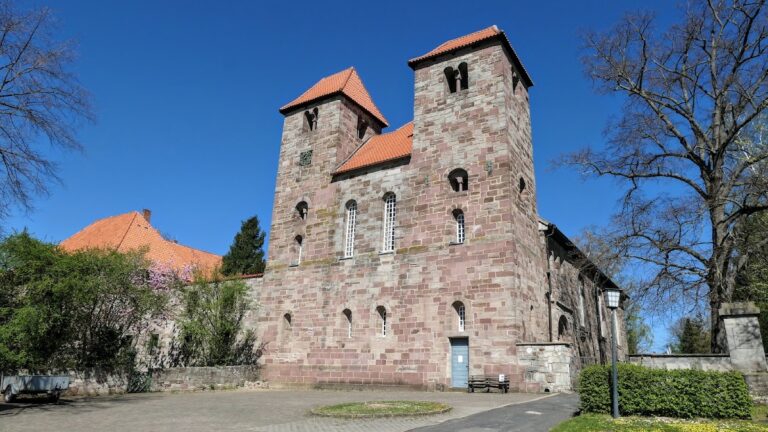
St. Nikolaikirche is built as a hall church, in which the nave and aisles share a broadly unified interior height rather than having a clearly raised central nave. The three-aisled structure is made of dressed red Weser sandstone and incorporates foundations from earlier buildings. A polygonal choir extends from the nave, while a sacristy projects from the choir’s southern side. The choir is as wide as the central nave and ends in five sides of an octagon.
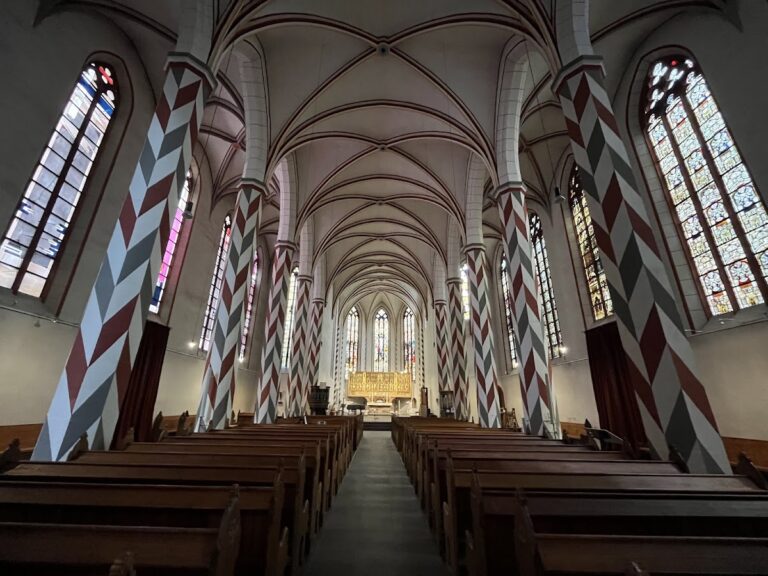
Each of the three aisles is covered by three bays of cross vaulting. A cross vault is formed by the intersection of two barrel vaults, and the choir also has a cross vault. Gothic window tracery, pointed arches divided by stone patterns, belongs to the church’s medieval architectural character.
Towers and entrances
The medieval church incorporated a Romanesque twin-tower arrangement. The date of the towers’ construction is unknown, although one tower may date from 1490. The southern tower collapsed in 1777, and the western addition built afterward is towerless. The northern side entrance has foliage carved into the hollows of its pointed arch.
Vault sculpture and choir decoration
The vault bosses preserve some of the church’s most notable Gothic sculpture. A vault boss is a sculpted or ornamented element placed where the ribs of a vault meet. The bosses include the traditional symbols of the four Evangelists: a winged human for Matthew, a lion for Mark, an ox for Luke, and an eagle for John. Other examples show the Lamb and the pelican as symbols of Christ, as well as Bishop Nicholas and Saint Lawrence. Their reliefs are elaborate and strongly articulated, with detailed carving.
The choir forms the decorative focus of the interior, and the sacristy is decorated with foliate masks. The church’s two bells date from 1402 and 1458. Most of the older furnishings were lost during secularization at the beginning of the nineteenth century, while the Gothic period remains represented by the sculptural vault bosses.
Later interior furnishings
An epitaph commemorating Johann Lorenz von Mosheim, an eighteenth-century Lutheran theologian and church historian who became the University of Göttingen’s first chancellor, was transferred from the Paulinerkirche to St. Nikolaikirche. From 1855, the interior was reshaped in a Neo-Gothic manner. This work included a wooden ornamental pulpit designed by the building official Kettler. From 1860, the Hanoverian architect Conrad Wilhelm Hase also participated in installing a new altar and gallery.
During the major renovation of 1984 to 1987, the church received a Late Gothic Crucifixion group from Bardowick Cathedral of St. Peter and Paul as a permanent loan from the Landesmuseum Hannover. A Crucifixion group is a sculptural representation of Christ’s Crucifixion, commonly accompanied by figures such as Mary and John.
Organ
Wilhelm Sauer of Frankfurt an der Oder built the university church’s organ in 1888. The instrument, Opus 495, has 23 stops, two manuals, and a pedal. It uses mechanical action and cone chests, a type of organ wind chest that operates with cone valves. The organ was altered in 1948 and 1959. Its stated arrangement includes II/I and I/P couplers operated by foot pedals, together with Forte and Tutti collective pedals.