Plesse Castle: A Medieval Hilltop Fortress in Germany

Site at a Glance
- Rating
- 4
- Popularity
- Low
- Country
- Germany
- Primary era
- Medieval
- External website
- Open
- Eras represented
- Iron Age, Medieval, Early Modern, Modern
- Civilizations
- German, Holy Roman Empire
- Site type
- Military
- Remains
- Castle
On this page14 sections
History
Early occupation and medieval origins
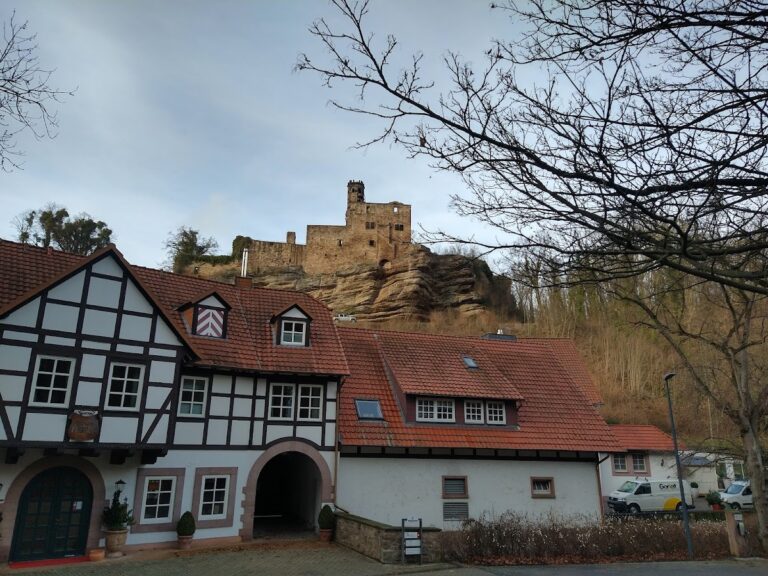
Plesse Castle is a medieval castle ruin in Germany, above Eddigehausen in Bovenden, southern Lower Saxony. The castle complex known today developed around 1200, although the foundation date of the fortress itself is not recorded. It occupies a site used from the older pre-Roman Iron Age, when a clay-set wall was constructed there between about the eighth and sixth centuries BC.
A biography of Meinwerk, bishop of Paderborn, written around 1160, states that on 15 September 1015 he transferred Plesse from his inherited Immedinger estates in the tribal duchy of Saxony to the church of Paderborn. This passage may indicate that a castle already stood on the site, or it may reflect an attempt to secure older legal claims held by Paderborn. The territory described in the alleged donation was probably represented on a much larger scale than its actual extent.
The counts of Winzenburg may have built the castle on Paderborn territory between 1122 and 1128. Another proposed construction phase places an earlier fortress around 1077 or 1078, during the opening phase of the Investiture Controversy, the conflict over the appointment of bishops and the division of authority between secular rulers and the papacy. The 1015 reference may instead concern a predecessor structure.
The Winzenburgs and the lords of Plesse
The Winzenburg family used Plesse as a strategic base in the upper Leine valley. Around 1138 Hermann II of Winzenburg was described as count of Plesse, while his brother Heinrich of Assel was called Heinrich of Plesse in 1144. Robert of Plesse, probably a member of the Eberschütz-Schöneberg family, served as castellan and probably commanded the fortress for the Winzenburgs until before 1150.
After the Winzenburg line became extinct in 1170, Plesse entered a direct feudal relationship with the bishopric of Paderborn, probably between 1173 and 1183. A fief was property granted by a superior lord in return for allegiance and service. Bernhard I and Gottschalk I of Höckelheim were recorded together as lords of Plesse in 1183, and by 1189 at the latest the Höckelheim family had adopted the name of Plesse. From 1150, the castle was the seat of the noble lords of Plesse, who took their name from it.
Emperor Henry VI exchanged Plesse for Desenberg Castle near Warburg in 1192, but the transaction was reversed in 1195. In 1447, the lords of Plesse transferred their allodial possession, meaning hereditary private property, to Landgrave Ludwig of Hesse and received it back as a fief. The arrangement sought protection amid the political fragmentation and conflicts of the duchy of Brunswick-Göttingen.
Reformation and Hessian rule
The Reformation was introduced in the dominion of Plesse in 1536. Petrus Noyen van Weert, a theologian who had fled the Netherlands, preached at the castle from 1536 to 1540 and initially gave the movement a Reformed character. After Martin Luther judged his teaching incorrect in an opinion requested by Dietrich III of Plesse, the territory came under predominantly Lutheran influence from Göttingen.
The resident branch of the lords of Plesse ended with the death of Dietrich IV in 1571. Landgrave Wilhelm IV of Hesse-Kassel then took possession of the dominion as the reverted fief. In 1614, Landgrave Moritz of Hesse-Kassel imposed the Reformed confession. Moritz and members of his family stayed at the castle several times in 1623 and 1624.
War, abandonment, and later history
During the Thirty Years’ War, the major European conflict of 1618 to 1648, Plesse was besieged in 1627. The castle and dominion were temporarily ceded to Landgrave Georg II of Hesse-Darmstadt. The fortress was finally abandoned in 1660, after which inhabitants of surrounding villages quarried it for building stone.
Following the French occupation in 1807, the former dominion became the Canton of Bovenden within the Kingdom of Westphalia. When that kingdom collapsed in 1813, the Electorate of Hesse-Kassel regained control. Under a treaty among Prussia, the Kingdom of Hanover, and Hesse-Kassel, the dominion passed to Hanover on 1 May 1817. Johann Wolfgang von Goethe visited Plesse Castle in 1801.
Initial restoration began in 1821. The ruling family of Hanover sponsored extensive work between 1853 and 1864, followed by further restoration in 1909. Since 1946, Plesse has belonged to the state of Lower Saxony, and it has been under monument protection since 1978. The Friends of Plesse Castle has supported research since that year. Excavation in the chapel in 1983 clarified the sequence from the Iron Age layout to a medieval predecessor and then to the castle complex of around 1200.
The former Hessian affiliation of the dominion still influences the region’s ecclesiastical organization. The Protestant congregations of Bovenden, Eddigehausen, Angerstein, Reyershausen, Spanbeck, Oberbillingshausen, and Holzerode belong to the Evangelical Reformed Church rather than the Evangelical Lutheran State Church of Hanover.
Remains
Setting, walls, and entrances
Plesse Castle occupies a rocky spur about 350 metres above sea level, the southwestern extension of the 386-metre Wittenberg in the northwestern Göttingen Forest. The castle stands on light-coloured shell limestone, a sedimentary stone formed from compacted marine shells and fossils. The Leine valley and the Leine lie several kilometres to the west, about 200 metres lower.
The hilltop fortress is built mainly of rubble stone. Its surviving layout includes a castle ditch, the lower outer gate, the middle gate with its gatehouse, substantial sections of the outer walls, the Caningarten wall in the outer ward, and parts of the Eichsfeld and Catzengarten corner bastions. The main castle also contains the Steinhaus and the ruin of the chapel dedicated to Saints Peter and Paul.
Towers
The keep
The older keep originally stood about 30 metres high, but it was reduced to 23 metres in 1542 because of fears that cannon fire could cause it to collapse. At courtyard level, it has a diameter of 15.26 metres and walls 4.24 metres thick. Its lower section consists of regular ashlar blocks from the twelfth century, while the irregular rubble masonry above and the battlement crown belong to nineteenth-century restoration. An interior staircase now leads through the keep, which functions as a viewing tower over Eddigehausen and the Leine valley.
The Small Tower
The 22-metre Small Tower stands beside the keep at the most exposed point of the spur. Its diameter is slightly more than 7 metres, and its lower walls are 2.25 metres thick. It was built as a lookout tower and is also known as the Sydekum, a name meaning “look around.” Both towers originally had entrances through doorways about 10 metres above ground level.
Water installations
The cistern and the Bornhaus
The structure beside the gatehouse is a tank cistern dating from the twelfth century or around 1200. A tank cistern is a sealed reservoir designed to collect and store water rather than reach groundwater. The Bornhaus, a separate building associated with the castle’s water supply, is inferred to have stood between the inner gatehouse wall and the cistern.
Written descriptions from the sixteenth century onward refer to an exceptionally deep well shaft, calculated at approximately 150 to 170 metres, and to the difficulty of raising water with a bucket, chain, and treadwheel. Under Landgrave Wilhelm IV of Hesse, a mechanical lifting device called the “Krummer Zapfen” was added in the seventeenth century. After the castle was abandoned, the well remained accessible through the Bornhaus. Nineteenth-century guidebooks placed that building in the middle court, behind and to the right of the gatehouse. The well and the Bornhaus disappeared from later written descriptions after restoration under King George V of Hanover between 1853 and 1862.
The supposed well is surrounded by legends, including a tradition of an underground passage linking it with the spring at Mariaspring. The reported passage is separate from a route mentioned in records from 1802, which ran below the castle in Eddigehausen and connected the fortress with the cellar of a domain estate. A 100-metre-deep well in the courtyard of the nearby Deppoldshausen estate, deepened to 130 metres in 1937, has also been incorrectly identified as the castle well.
Chapel and archaeological sequence
The chapel is dedicated to Saint Peter and Saint Paul. Excavation within it in 1983 showed that a medieval predecessor complex had been built over the earlier Iron Age arrangement and was later superseded by the castle complex dating from around 1200. This sequence links the surviving medieval ruin with the earlier occupation of the rocky spur.
Heraldic evidence
The first known representation of the arms of the lords of Plesse appears on a reliquary from Quedlinburg dated 1209. It shows a silver wall anchor placed horizontally on a red shield, with four ends curled inward like scrolls. Later versions reversed the colours, displaying a red wall anchor on silver, and some examples used gold.
Nearby sites