St. Nicholas Church: A Neo-Romanesque Lutheran Church in Hannover


Site at a Glance
- Rating
- 4.3
- Popularity
- Very Low
- Country
- Germany
- Primary era
- Modern
- External website
- Open
- Eras represented
- Medieval, Early Modern, Modern
- Civilizations
- German, Holy Roman Empire, Kingdom of Prussia
- Site type
- Religious
- Remains
- Church
On this page10 sections
History
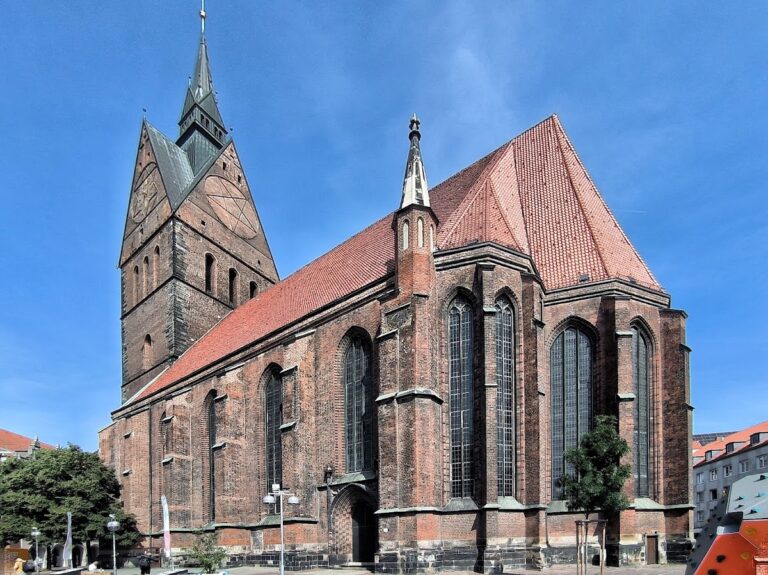
St. Nicholas Church is an Evangelical Lutheran church in Hannover, Germany, whose present Neo-Romanesque building was constructed between 1910 and 1911 around a medieval tower dating from the fourteenth century. Dedicated to St. Nicholas, a fourth-century Christian bishop traditionally associated with charitable acts, the church stands at the historic center of Bothfeld and has served the local congregation for centuries.
Medieval origins and the Baroque church
An Evangelical Lutheran church dedicated to St. Nicholas has been documented at Bothfeld since 1288. Its medieval bell tower survived major rebuilding and remains the oldest part of the complex. The earlier nave was demolished in 1776 and replaced with a Baroque hall church, reflecting a later phase in the congregation’s architectural history.
The churchyard once served not only Bothfeld but also the incorporated villages of Klein-Buchholz, Groß-Buchholz, and Lahe. As the population grew, the medieval burial ground was replaced by the Old Bothfeld Cemetery on Ebelingstraße.
The rebuilding of 1910–1911
From 1910, the Baroque church was replaced by the present building, while the medieval tower was retained. Eduard Wendebourg designed the new church; he had been a pupil of the architect Conrad Wilhelm Hase. The building was dedicated in October 1911. Pastor Carl Schütte initiated the rebuilding and served the congregation for 37 years. He died on 17 August 1930 and was buried in the cemetery on Ebelingstraße. Construction cost approximately 100,000 marks in contemporary currency.
The new church combined a Neo-Romanesque exterior with a Jugendstil, or Art Nouveau, interior scheme. The nave was painted fully by Karl Bohmann up to 1918 and was later worked on by Hubert Kattentidt. In 1959, the interior was redesigned, the paintings were covered, and new colored windows were installed. For the church’s 700th anniversary in 1988, the earlier interior appearance was restored.
War memorials and the peace garden
The south side of the tower carries a First World War memorial created by Friedrich Goy, Heinrich Reinecke, and Wilhelm Huhn. It lists the names of Bothfeld’s fallen soldiers and includes an oversized soldier figure. After 1945, a separate stone commemorating those who died in the Second World War was placed at ground level. Unlike the First World War memorial, it does not list names. The First World War memorial was repositioned in 2019 during a redesign of the area.
Beside the church, the redesigned peace garden, “GEH DENK GARTEN FRIEDEN!”, was inaugurated in 2019. Designed by Winni Schaak, its paved route links stations of remembrance and commemoration, joining reflections on the past and present with a warning directed toward the future.
Commemorative trees and surveying history
Two oaks in the southern part of the former churchyard were planted in 1941 to mark the centenary of the German national anthem. They commemorate Heinrich Hoffmann von Fallersleben, a nineteenth-century German poet and writer of patriotic songs, including the text of the “Deutschlandlied.” He established his family in Bothfeld in 1849 and wrote several of his “Heidelieder” there. He married Ida vom Berge, the 18-year-old niece of the pastor of St. Nicholas Church, and the graves of her parents are in the Old Bothfeld Cemetery.
The tower also played a role in nineteenth-century land surveying. On 17 August 1890 and in subsequent years, it served as a trigonometrical high point, a surveyed station from which angles to other known points were measured for triangulation. Temporary balcony-like observation platforms were installed at the east, west, and south windows. Surveyors measured toward the towers of St. Aegidien in Hannover and St. Mary in Isernhagen, as well as ground points on the Kronsberg and in Stelingen. The line of sight toward Isernhagen was later blocked by the higher nave roof constructed in 1911.
In 1891, a leveling survey connected the tower’s height mark with benchmark 1649 on the Hannover–Celle line of the original leveling survey. The connection point was at the present Podbielskistraße near Klingerplatz. The church is a listed historic building.
Remains
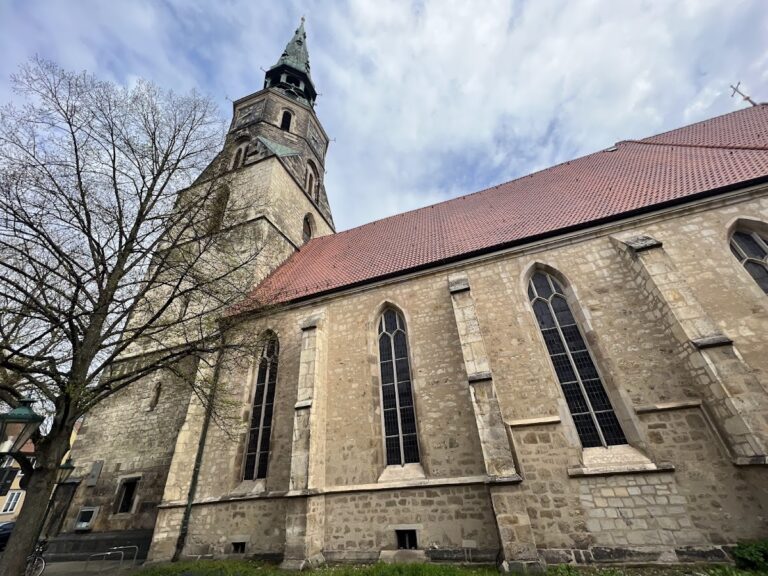
St. Nicholas Church stands at the highest point of the historic village of Bothfeld and marks the entrance to the old village center. The present limestone church was built with stone from the Süntel hills in Neo-Romanesque forms, while the retained bell tower is a separate medieval structure. A grassy churchyard surrounds the building and preserves gravestones, memorials, commemorative trees, bells, and a surveying mark.
The Neo-Romanesque church
The 1911 church is a limestone building whose interior decoration follows the Jugendstil, the German form of Art Nouveau. Five colored-glass windows occupy the nave. The central window shows the risen Christ, flanked by the four Evangelists, the traditional authors associated with the four canonical Gospels. Matthew appears with a winged human figure, Mark with a lion, John with an eagle, and Luke with a bull.
Four further windows depict Old Testament prophets. Isaiah is shown with a star, Jeremiah with a scroll, Daniel with the judgment inscription “MENE TEKEL UPHARSIN,” and Ezekiel with a letter. The baptismal font came from the predecessor church, linking the present interior with the earlier building.
The medieval bell tower
The fourteenth-century bell tower rises 35 meters and has walls up to 1.7 meters thick. Its principal building material is bog ironstone, an iron-rich stone formed in wet ground and used locally as a durable construction material. The tower’s medieval fabric remains physically distinct from the 1911 nave.
Three bells named “Justice,” “Peace,” and “Joy” hang in the tower. The oldest was cast in 1639 and came from the former Lutheran Church in Insterburg, East Prussia. During the Second World War, it was taken to a bell collection depot for melting into armaments. The war ended before that happened, and after 1945 the bell was brought to Bothfeld rather than returned to Insterburg, which was then under Soviet occupation.
Churchyard monuments and memorials
The churchyard contains gravestones dating from the seventeenth through the nineteenth centuries. Some have been moved inside the church, and five were illustrated in Carl Wolff’s 1899 survey of the art monuments of the Province of Hanover. The Hanoverian sculptors Peter Köster and Jürgen Gerhart Schrader, who were active around 1700, were among the stonecutters and sculptors associated with the monuments.
On the tower’s south side, the First World War memorial combines the oversized soldier figure with an inscription naming Bothfeld’s dead. The separate Second World War memorial is a stone laid at ground level. The two commemorative oaks are identified by a stone explaining their planting in 1941 and their connection with Hoffmann von Fallersleben.
Organ and surveying mark
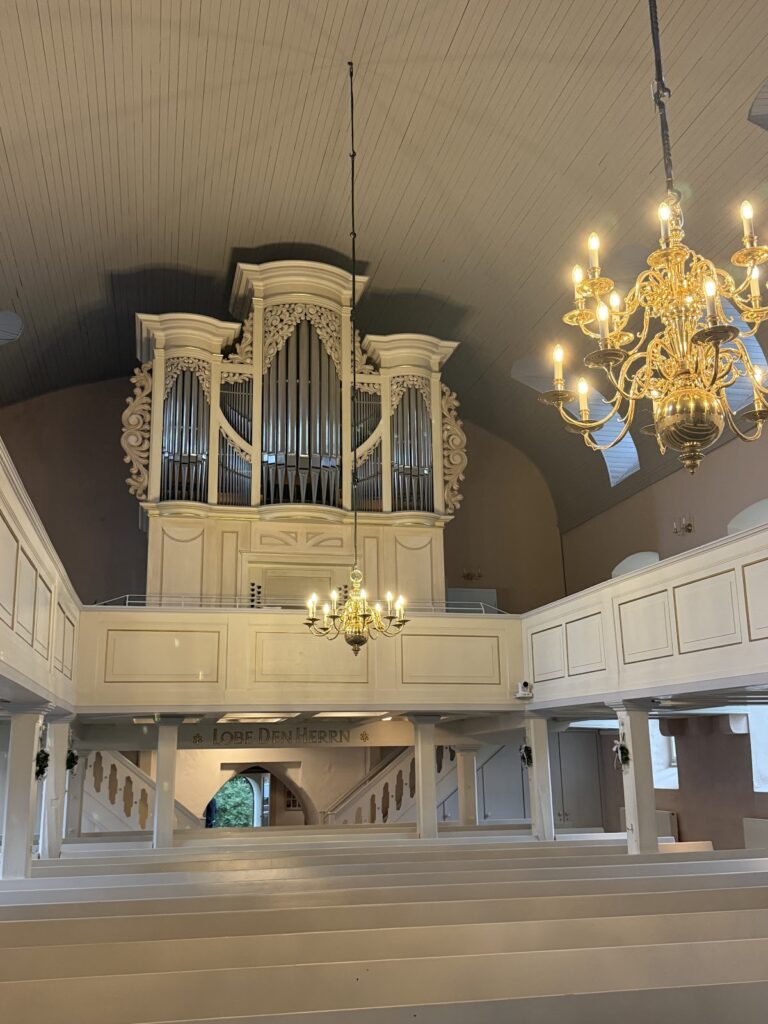
The organ was made in 1977 by the Rensch firm of Lauffen am Neckar. It retains its 1911 case, has 27 stops and 1,344 pipes, and is arranged over two manuals and a pedal with an additional coupler manual. Its key and stop actions are mechanical, while the couplers are II/I, III/I, II/P, and III/P. When the organ was rebuilt, the historical case was preserved and a Rückpositiv, a small organ division in a case behind the organist facing the congregation, was added in the same style.
A survey benchmark on the tower’s south wall records an elevation of 56.289 meters above Normal Null, the historical German vertical datum. Together with the tower’s earlier role in triangulation and leveling, this mark preserves the building’s connection with the development of systematic land measurement in the region.