Aegidienkirche: A Gothic Church and War Memorial in Hanover


Site at a Glance
- Rating
- 4.6
- Popularity
- Medium
- Country
- Germany
- Primary era
- Medieval
- External website
- Open
- Eras represented
- Medieval, Early Modern, Modern
- Civilizations
- German, Holy Roman Empire
- Site type
- Religious
- Remains
- Church
On this page13 sections
History
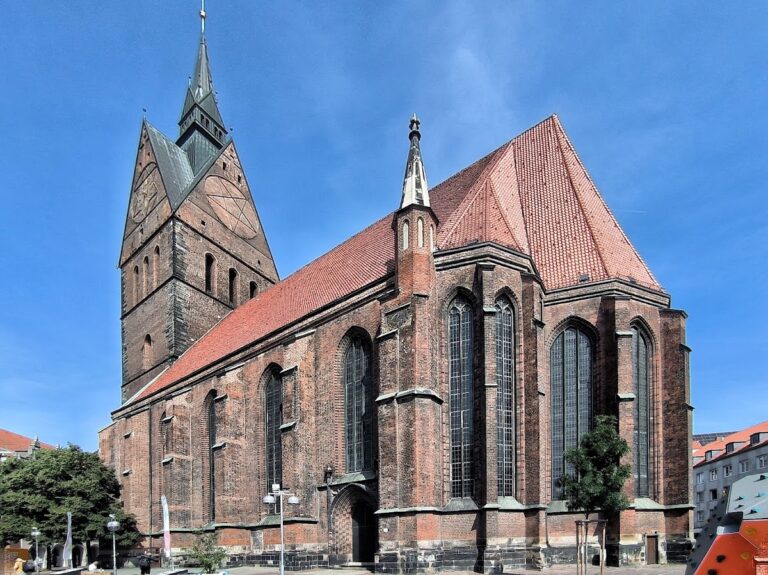
Aegidienkirche is a historic church in Hanover, Germany, built in the Gothic period in 1347. It was dedicated to Saint Giles, also known as Saint Aegidius, a Christian hermit traditionally counted among the Fourteen Holy Helpers, a group of saints associated with protection from particular dangers and illnesses. The church is one of Hanover’s three historic old-town churches and the easternmost of them, alongside the Market Church and the Church of the Holy Cross.
Early foundations and Gothic rebuilding
A chapel stood on the site before the medieval church. A settlement may also have occupied the location in the tenth century. This possibility is linked to the boundary designation “Tigislehe,” recorded before 1007, which Helmut Plath interpreted as one of the three settlement nuclei that later formed Hanover. Archaeological excavations have not confirmed that settlement.
In 1163, the earlier chapel was replaced by a three-aisled Romanesque church. The present Gothic church followed in 1347. It was originally Catholic and later became Lutheran. Since 1982, Aegidienkirche has belonged to the Market Church parish, created through the union of Hanover’s previously independent old-town parishes, including the Market Church, Aegidienkirche, the Church of the Holy Cross, and the Castle Church.
Alterations and wartime destruction
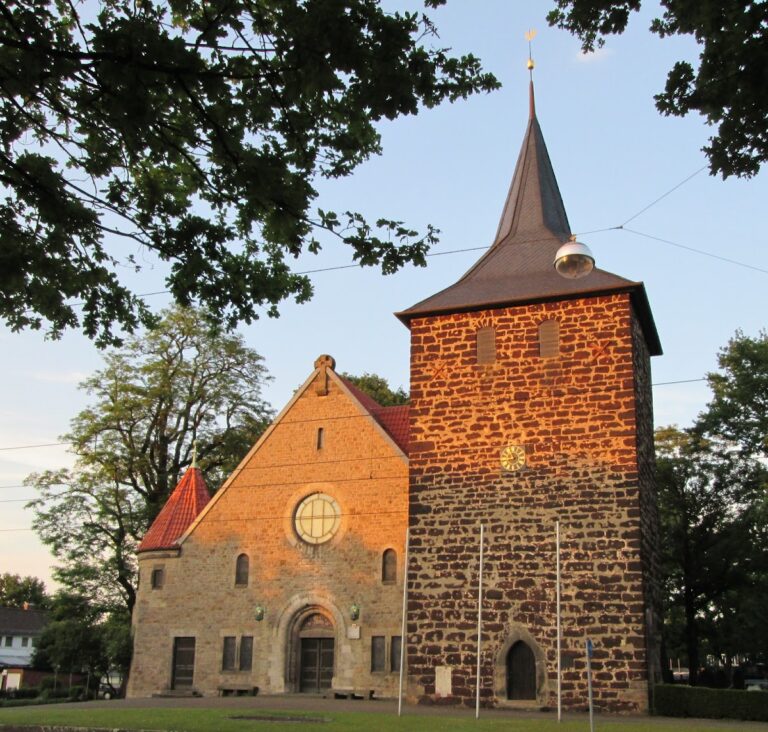
The tower received a Baroque facade between 1703 and 1711, associated with the architect Sudfeld Vick. Georg Ludwig Friedrich Laves remodeled the interior in 1826–1828, introducing cast-iron columns, and Conrad Wilhelm Hase carried out further interior alterations in 1886.
During the night beginning 8 October 1943, aerial bombing destroyed Aegidienkirche along with much of Hanover’s old town. The church was not rebuilt. Since 1952, its surviving ruins have served as a memorial to the victims of war and violence. A carillon was installed in the remaining tower stump in 1958. In 1985, Hiroshima, Hanover’s twin city since 1983, donated a peace bell, which is rung during the annual 6 August memorial service for the victims of the atomic bombing of Hiroshima. The ruins continue to host the annual Hiroshima Day observance.
Remains
Church structure and tower
Gothic hall church
Aegidienkirche stands in Hanover’s old town near Aegidientorplatz, at the corner of Breite Strasse and Osterstrasse. It is a three-aisled Gothic hall church, a design in which the nave and side aisles form a unified interior, with a choir and nave built from sandstone quarried in the nearby Deister hills. The surviving fabric presents the church as a ruin and preserves the relationship between its principal architectural parts.
Baroque tower
The tower retains its Baroque facade, created between 1703 and 1711. After the wartime destruction, the tower stump remained and was fitted with a carillon in 1958. A carillon is a set of tuned bells played mechanically or from a keyboard. The peace bell donated by Hiroshima in 1985 hangs at the tower entrance, while the carillon sounds regularly. A ground plan of the church is displayed inside the tower.
Artworks and commemorative features
Sculpture and floor installation
The church room contains Kurt Lehmann’s shell-limestone sculpture Humility, dated 1959. Dorothee von Windheim’s 1993 installation Shadow Line runs in a zigzag across the floor. It represents the shadow cast at a particular hour by the pointed gables, which are covered with ivy and grapevine.
Seven Men’s Stone
The so-called Seven Men’s Stone is a relief plaque depicting seven praying men. The present stone is a copy mounted on a supporting pier of the southeastern exterior wall, while the original is held by the Hanover Historical Museum. The relief is linked to a legend about seven defenders of Hanover who died at Döhren Tower while defending the city during a late-fifteenth-century attack by Duke Heinrich.
Funerary monuments and survey marker
Baroque memorials
Numerous Baroque funerary monuments from the seventeenth and eighteenth centuries are mounted on the exterior walls. Their imagery includes angels, hourglasses, and skulls. On the south wall, a 1648 monument commemorates the child Susanna Magdalena Oldekop and shows the girl with an angel.
Elevation marker
A marker from the Prussian Royal Land Survey’s original leveling survey of 1868–1918 is attached to the church tower. Its historical elevation was recorded as 56.817 meters above normal zero, the former German vertical reference used for stating elevations.