St. Matthias’ Abbey: Benedictine Monastery and Pilgrimage Church in Trier


Site at a Glance
- Rating
- 4.7
- Popularity
- Low
- Country
- Germany
- Primary era
- Medieval
- External website
- Open
- Eras represented
- Medieval, Modern
- Civilizations
- Holy Roman Empire
- Site type
- Religious
- Remains
- Monastery
On this page12 sections
History
St. Matthias’ Abbey is a Benedictine monastery in Trier, Germany, whose origins lie in a late-antique Christian burial and worship center outside the city’s walls. In the fifth century, Bishop Cyrillus of Trier established an oratory or burial church for the early bishops Eucharius and Valerius. A foundation inscription dates from the middle of that century, during Cyrillus’s episcopate, and Cyrillus himself was buried there.
From Episcopal Burial Center to Benedictine Abbey
The institution was first dedicated to St. Eucharius, traditionally regarded as Trier’s first bishop. Around 977, the community adopted the Rule of St. Benedict, the monastic code governing communal prayer, work, discipline, and obedience, with support from an abbot of Ghent. Since the tenth century, the remains of Eucharius and Valerius, regarded as founders of the Trier archbishopric, have been preserved at the site.
A Norman raid destroyed the complex in 882. During the episcopate of Bishop Egbert, a new church was built in the late tenth century, and part of its western crypt survives. The crypt is a space within or beneath a church used for burials, relics, and commemorative worship.
The Discovery of Matthias’s Relics
In 1127, human bones found during the demolition of the predecessor church were identified as the relics of the Apostle Matthias, one of the figures traditionally understood to have replaced Judas Iscariot among the Twelve Apostles. A tradition holds that Empress Helena, the mother of Constantine I, had earlier ordered the apostle’s remains to be sought in Palestine and brought to Trier.
The discovery transformed the institution into a major pilgrimage center, and it subsequently became known as St. Matthias. The new abbey church, still unfinished, was consecrated on 13 January 1148 by Pope Eugene III in the presence of Bernard of Clairvaux and numerous cardinals. The apostle’s tomb is described as the only apostolic burial in Germany and north of the Alps.
St. Matthias also became a center of learning. In the twelfth century, the manuscript now known as Kues 52 was copied there. It is an important witness to the Collectaneum of Sedulius Scottus and the Proverbia Grecorum.
Reform and Medieval Economy
Reform efforts following the Council of Basel were led by Johannes Rode, a Carthusian prior appointed by the local bishop. The changes brought spiritual and economic renewal and made St. Matthias an example for other monasteries. By 1458, the abbey had entered the Bursfelde Congregation, a Benedictine reform grouping whose monasteries shared disciplinary and spiritual practices. St. Matthias also supplied two monks to help maintain the reformed discipline at Bursfelde Abbey.
The abbey’s medieval responsibilities extended beyond monastic worship. It supervised and partly financed a leper house documented from 1283, while other institutions connected with its charitable and economic activity included St. Nicholas’s Hospital and the Estricher Hof leper house. Its economic base also included farmhouses and estate buildings, particularly along the Moselle, which were often called Mattheiser Hof. The large Roscheider Hof near Merzlich, now Konz-Karthaus, survives as part of the Roscheider Hof local-history and open-air museum.
Wars, Secularization, and Revival
The Reformation affected the abbey only slightly, but warfare, looting, and conflicts with bishops and abbots repeatedly disrupted its development. St. Matthias suffered during the 1552 invasion by Margrave Albert Alcibiades, during the Thirty Years’ War, a European conflict that brought widespread military destruction between 1618 and 1648, and during later wars with France.
The last abbot was removed from office in 1783, after which a prior administered the community. During the upheavals of the French Revolution, French forces requisitioned the buildings and the monks left temporarily. From 1794 to 1802 they lived in the Mattheiser parish house.
In 1802, the abbey was nationalized and secularized. Christoph Philipp Nell acquired the cloister and adjoining buildings, using them as a residence and for agricultural purposes. This use helped preserve the complex from demolition or extensive industrial alteration. The last monk died in 1837.
After several nineteenth-century attempts to revive the monastery, monks from Seckau Abbey, a member of the Beuron Congregation, moved into the Mattheiser parish house after the First World War. On 22 October 1922, the complex was rededicated as a Benedictine abbey and resettled, and the new community joined the Beuron Congregation, another Benedictine reform grouping.
Twentieth-Century Community
The church received the title of minor basilica through an apostolic letter of Pope Benedict XV dated 20 March 1920. A minor basilica is a church granted a special papal title while remaining distinct from a major basilica. In 1927, the relic of Matthias’s head was transferred from Trier Cathedral to the abbey, and between 1931 and 1932 the remaining former monastic buildings also returned to Benedictine ownership.
In 1938, Nazi troops were housed at the complex. The National Socialist government dissolved the monastic community in 1941, and the monks moved to Maria Laach Abbey. Fathers Maurus and Martin were deported to Dachau for alleged subversive dealings with prisoners of war and hostility toward the state. Both returned to St. Matthias after the war and remained there until their deaths.
The monks returned to Trier in 1945. Disputes over responsibility for the now-independent parish of St. Matthias led to a proposed move to Tholey Abbey and divided the community in 1949. One group moved to Tholey with Abbot Petrus Borne, while the Trier community became directly subordinate to the Benedictine abbot-primate, the senior coordinating officer of the Benedictine Confederation. It remained independent of a congregation until 1981, when it joined the Congregation of the Annunciation of the Blessed Virgin Mary.
Since 1991, the Trier community has maintained a close connection with Huysburg Priory, which was refounded in 1972. In September 2004, the two communities joined as one. From 1981 to 2005, Ansgar Schmidt was abbot. After his election as president-abbot of the congregation, Ignatius Maaß succeeded him in 2005, with Matthias Vogt as prior. Bishop Reinhard Marx administered the abbatial benediction on 22 October 2005.
The community undertakes parish, hospital, and pilgrimage pastoral work, receives guests, conducts ecumenical discussions, and supports the neighboring Schammatdorf. The abbey helped plan Schammatdorf in the 1970s with Trier’s social welfare department and the housing company gbt. Built in three phases between 1979 and 1994, the development contains 118 apartments intended to promote intergenerational and inclusive living, including the integration of people with disabilities.
In spring 2011, the abbey publicly disclosed that a priest who had served as a parish vicar and had committed abuse since the 1970s had sexually abused children and adolescents. He admitted the offenses, was prohibited from exercising priestly duties, and the victims received financial compensation. As of December 2025, the community consisted of 15 monks, ten living in Trier and five at Huysburg.
Remains
The Basilica and Crypt
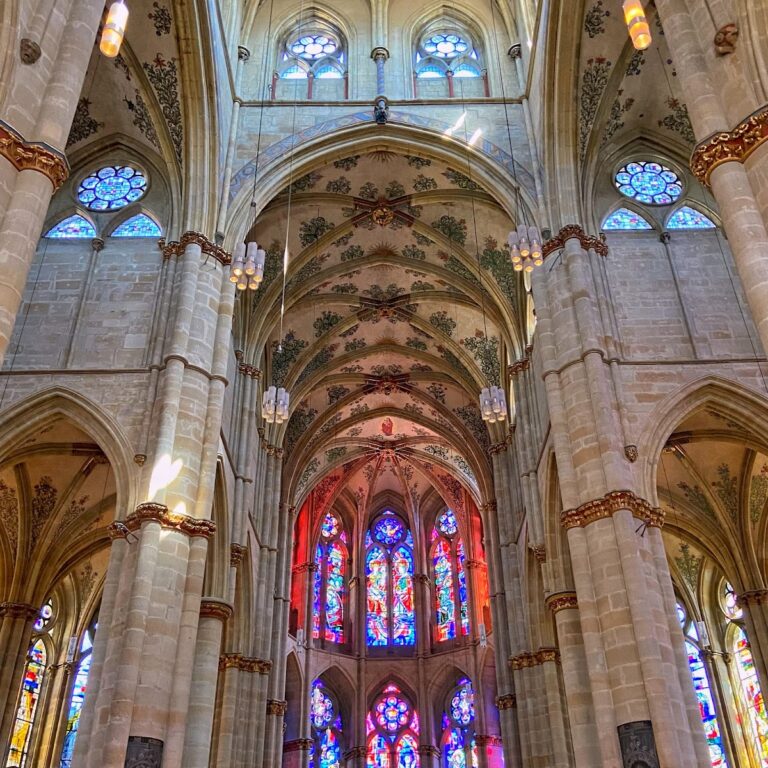
The abbey church is a Romanesque basilica with three aisles supported by piers. Romanesque architecture commonly uses massive masonry, rounded arches, and substantial supports. Later work introduced Gothic vaults and window tracery, Baroque facade portals, and a Classical completion to the tower. The high altar and pulpit stand at the crossing of the nave and transept. The church functions as the parish church, monastic church, pilgrimage church of St. Matthias, and burial church of Eucharius and Valerius.
The crypt contains the tomb of St. Eucharius and the burial place of Valerius. Its eastern section was added around 1500. In the late fifteenth or early sixteenth century, the earlier Romanesque vaults were replaced by a Gothic net vault, the choir was lengthened, and tracery windows were installed. Nineteenth-century alterations shortened the crypt by two bays. Later conservation restored its original length by extending it by two bays and adding new entrances.
The Matthias shrine and altar area were adapted for contemporary liturgical use, with fixed choir stalls and a lift connecting the levels. On 10 December 2007, the shrine containing the apostle’s bones was moved to its final position in the crypt, and the altar was consecrated on 24 February 2008. The basilica is also a Marian shrine because it contains a devotional image of the pregnant Virgin Mary contemplating the child she carries.
Chapels and Sacred Objects
The Chapel of the Cross occupies the basilica’s northern side tower. It houses a thirteenth-century gold reliquary, or container for sacred remains, known as a staurotheca. The reliquary centers on a golden cross set with precious stones and is said to contain fragments of the True Cross, the Christian term for wood believed to derive from the cross of Jesus.
A single-aisled early Gothic Marian Chapel stands east of the basilica beside the cemetery and is closed by apses at both ends. The cemetery also contains the Chapel of St. Quirinus, consecrated in 1287.
Windows, Organ, and Bells
The choir-window cycle created by Wilhelm von der Eifel between 1510 and 1514 survives in the upper half of the central window, where the Crucifixion group remains. This fragment was restored between 1990 and 1993. New non-figurative glass-painting panels were completed in the three choir windows in 1995. Designed by Günter Grohs and produced by the Kaschenbach glass workshops, they were installed inside the existing protective glazing. Two additional windows designed by Grohs were installed in the crypt in 2014.
An organ was documented at the basilica from the sixteenth century. A larger instrument by the Dutch master Florentius Hocque replaced it and was moved to a newly built gallery in 1699; a choir organ was also present at that time. The large organ was damaged during secularization and replaced in 1868 by an instrument built by Heinrich Wilhelm Breidenfeld. That organ had 34 stops on three manuals and pedal and was removed in 1960.
The present organ was built by the Karl Schuke Berlin Organ Workshop in 1977 and dedicated on 10 September of that year. It stands on the end wall of the southern transept and has 39 speaking stops on three manuals and pedal, mechanical action, electrical stop action, a swell box for the Brustpositiv, and a swellable third manual. Its nearly 3,000 pipes are mainly made of a lead-tin alloy, with a smaller wooden component.
Five bells cast by the Mabilon foundry in Saarburg were installed in 1965. Their pitches form a Salve Regina motif, c’, d’, e’, g’, and a’. They are named Christus, Maria, Matthias, Eucharius, and Benedikt. A sixth bell, placed in a roof turret, was also cast in 1965.
Cloister and Former Monastic Buildings
The cloister was built around 1220 against the south side of the basilica and encloses a courtyard. After secularization, it and the adjacent open area were used for about a century as animal stalls, storage spaces, and a distillery before falling into neglect. This agricultural reuse helped prevent demolition, although the north wing deteriorated especially severely. The north wing later received a new roof made with a lightweight steel structure and timber elements. Earlier conservation work in the 1950s included capitals carved with biblical scenes by the Trier sculptor Willi Hahn. The cloister’s long restoration campaign was completed in spring 2025.
The former monastery buildings include a parish house forming the abbey’s northwestern boundary. Its exterior wall facing the Moselle bears the forged-iron letter sequence N.T.A.S.M. Popular interpretation gives the letters two contrasting meanings, but they are more probably an abbreviation of Nicolaus Trinkler Abbas Sancti Matthiae, identifying Abbot Nikolaus Trinkler as the presumed builder.
A building referred to as the Anglican Institute was begun in 1964 within the former monastic complex. It ultimately accommodated, among other facilities, administrative rooms and a library.
The Mattheiser Venus
The Mattheiser Venus was a Roman marble statue of Venus of the Capua type, once kept beside the abbey cemetery wall. From the Middle Ages, it was chained there and displayed with an inscription claiming that St. Eucharius had destroyed its pagan honor. Visitors traditionally threw stones at the statue as a ritual affirmation of Christianity’s victory over paganism.
First documented in 1551, the statue had been reduced almost entirely to a torso by 1811, when the French town commander transferred it to a historical society. The surviving remains are now in the Rheinisches Landesmuseum Trier.
Nearby sites