St. Mary’s Church Wittstock: A Brick Gothic Episcopal Parish Church


Site at a Glance
- Rating
- 4.6
- Popularity
- Very Low
- Country
- Germany
- Primary era
- Medieval
- External website
- Open
- Eras represented
- Medieval, Early Modern, Modern
- Civilizations
- Holy Roman Empire
- Site type
- Religious
- Remains
- Church
On this page17 sections
History
St. Mary’s Church Wittstock is an Evangelical parish church in Germany, begun in the Brick Gothic period during Wittstock’s planned urban expansion around 1240. It was originally dedicated to St. Martin and received the patronage of St. Mary in 1453, when devotion to the Virgin was spreading. From 1271 to 1548, the church and the neighboring Old Bishop’s Castle formed part of the preferred residence and episcopal seat of the bishops of Havelberg, giving the building an important place in the medieval history of the town.
Thirteenth-century foundation and episcopal residence
Building researchers attribute the western section of the church, including its monumental tower, to the urban expansion of about 1240. From the end of the thirteenth century, the building was enlarged into a three-aisled hall church, initially with four bays. A hall church has a nave and side aisles of approximately equal height, creating a unified interior rather than a strongly raised central nave.
The bishops of Havelberg, the senior ecclesiastical officials of the medieval Diocese of Havelberg, favored Wittstock as their residence from 1271. Their connection with the church and the Old Bishop’s Castle helps explain the building’s later enlargement and its substantial late-medieval furnishings.
Late medieval expansion
A major eastern extension was commissioned by the bishops of Havelberg from 1471. The earlier polygonal eastern choir was removed, and the present straight-ended choir was built in its place. The north chapel, originally the Marienkapelle, was added to the nave in 1484, followed by the south chapel in 1498. The church thus acquired much of the form associated with its late Gothic phase.
The church’s changing dedication reflected its religious development. It had first been placed under the protection of St. Martin, a Christian saint, before St. Mary, the Virgin Mary and mother of Jesus, became its principal patron in 1453. A sandstone Madonna in the church probably originated in a Marienkapelle built in 1389 by Bishop Johannes Woepelitz.
Fire, Reformation, and later repairs
A city fire brought extensive repairs between 1512 and 1519. Christoph von Lüneburg designed and carried out the work, including the pointed tower structure. The tower originally carried a pointed spire, which was shown in Matthäus Merian the Younger’s view of Wittstock from 1652. After the spire was destroyed by fire in 1698, it was replaced in 1704 with a Baroque roof carrying superimposed lanterns.
The Reformation reached Wittstock around 1550, following the death in 1548 of Busso II, the last bishop of Havelberg. Around that time, the lower section of the present altar ensemble came from the Church of the Holy Spirit. After the Thirty Years’ War, the upper retable was transferred from the private Marienkapelle of the Havelberg bishops in the neighboring Old Bishop’s Castle, whose buildings were increasingly deteriorating.
Further major renovation took place between 1843 and 1846. The roof over the eastern part of the nave and the choir was renewed in 2009. Since the 1970s, the church has been legally protected as a historic monument. The parish belongs to the Wittstock-Ruppin church district within the Potsdam ecclesiastical district of the Evangelical Church of Berlin-Brandenburg-Silesian Upper Lusatia.
Remains
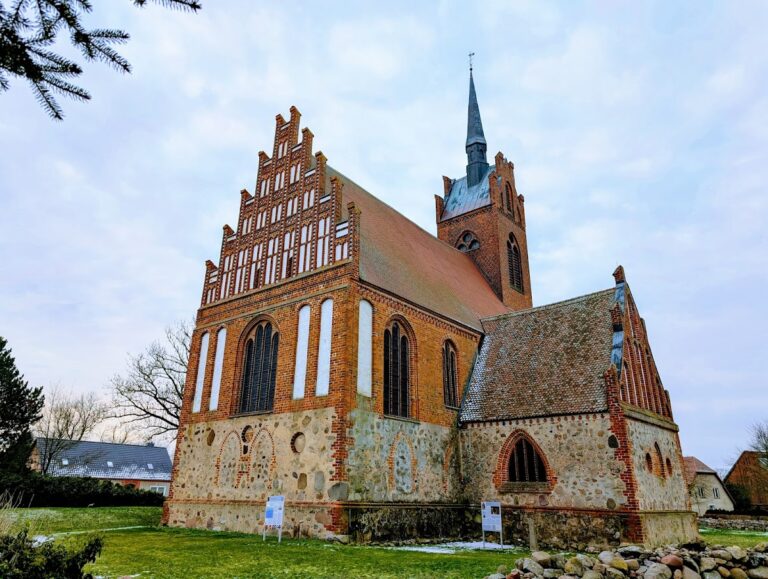
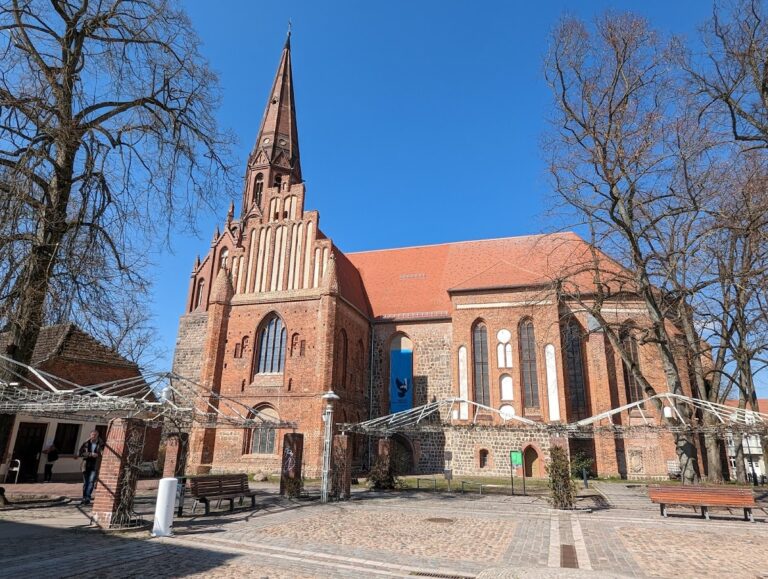
St. Mary’s Church is a precisely east-aligned, three-aisled Brick Gothic hall church. The church precinct extends between St. Marienstraße on the east and Kirchgasse on the west, while the church square forms its northern boundary. The building, including the choir, is about 65 meters long. Its square tower has sides measuring approximately 13 meters and rises 68 meters, while its lower section is as wide as the nave, about 23 meters. Red tiles cover the roofs, and copper covers the tower roof and lanterns.
Church exterior and interior arrangement
Tower and west portal
The monumental square tower forms the western part of the medieval building. A richly articulated and decorated west portal opens into the church hall. The tower’s present roof and lanterns belong to the post-fire form created after the pointed spire was lost in 1698, although the church had earlier possessed a pointed tower structure.
Nave, choir, and chapels
The interior is covered by a rib vault. U-shaped galleries run around the space, with the galleries along the long walls inserted between the ribs of the vaulting. The choir is raised six steps above the main floor, and the altar and pulpit stand within it. The north chapel, originally the Marienkapelle, was fitted out as a chapel in 1814. The southern chapel is marked externally by two stepped gables erected in 1498.
The windows are elongated, three-light pointed-arch openings divided by stone or wooden muntins. Wooden nave pews with carved ends date from 1846 and remain largely in their original form. Together with the gallery seating, they provide approximately 300 places.
Altarpiece and liturgical furnishings
Late Gothic altar ensemble
The late Gothic altar ensemble was probably assembled from two retables during the interior renovation of 1846. The lower retable is a late work from around 1530, associated with the workshop of the Lübeck sculptor Claus Berg. Its carved central shrine shows the Coronation of the Virgin by God the Father, Christ, and the Holy Spirit. An Anna Selbdritt, an image of Saint Anne with Mary and the Christ Child, and a female saint interpreted as St. Dorothy stand beside it. The wings contain the twelve Apostles in four animated groups of three.
The painted predella, the lower section of an altarpiece, shows half-length figures of Christ and the four Church Fathers. When the Apostle reliefs are closed, four painted panels appear: the Trinity as the Throne of Grace, the Virgin of the Crescent Moon, St. George killing the dragon, and St. Christopher. The outer saint panels are stylistically close to the school associated with Lucas Cranach the Elder and Lucas Cranach the Younger.
The upper retable is a North German work, possibly influenced by the Rhineland, made by an unknown woodcarver active around 1520. Its central figure is a Madonna surrounded by rays, accompanied by the two Saint Johns. Eight further saints appear in relief on the wings. The painted predella contains the Man of Sorrows, the Nativity, and St. Andrew.
Pulpit and sacrament house
The carved pulpit is dated 1608. It has been restored and supplemented several times, including the addition of a staircase in 1846. The maker of the Moses figure supporting it and of the Apostle reliefs on the pulpit basket, the main preaching platform, is unknown.
Beside the altar stands a late Gothic sacrament house, a fixed enclosure for the consecrated Eucharistic host, dating from 1516. Its support and case were carved as one piece. Copper doors were installed in the same year, although their inscriptions are no longer complete. The finely carved crown has a keel-arch form and contains angels holding the Instruments of the Passion, objects associated with Christ’s suffering and crucifixion. The original painted finish has disappeared.
Sculpture and other works of art
Madonna at the choir entrance
A 1.15-meter-high standing Madonna of light sandstone stands at the entrance to the choir. Dating from the end of the fourteenth century, it is regarded as an early example of the Beautiful Madonna type, a late medieval form characterized by an elegant standing Virgin, refined drapery, and an idealized appearance. The statue has a scroll and five angels on its unusually high crown, while the Christ Child plays with a bird. Small remnants of its colored finish survive.
The sculpture has been associated stylistically with the rood screen at Havelberg and with artistic influence linked to the Parler family of architects and sculptors, although its precise artistic interpretation remains unresolved. It probably came from the Marienkapelle built in 1389 by Bishop Johannes Woepelitz.
Bishop statue and choir-wall figures
The oldest artwork in the church is a significant High Gothic statue of a bishop. The original was placed on permanent loan to the Märkisches Museum in 1890, and a copy is now displayed in the lower tower. Tree-ring analysis dates the felling of the oak used for the statue to 1293, plus or minus ten years. The figure is thought to represent St. Martin and is probably from around 1300.
Several isolated seated figures, including examples from the middle of the fifteenth century, remain on the eastern choir wall. They may have belonged to larger sculptural groups, such as a Mount of Olives scene or a Coronation of the Virgin. Wooden sculptures of Adam and Eve by the Berlin sculptor Hans Scheib have stood on the pillars of the choir arch since 2018.
Organ and bells
Organ
The organ case comes from the instrument built by Friedrich Hermann Lütkemüller between 1843 and 1847. That instrument was destroyed by the installation and operation of central heating in 1927. In 1935, the Alexander Schuke firm of Potsdam installed the present organ in Lütkemüller’s Neo-Gothic case. It has 45 stops and 3,575 pipes on three manuals and pedals. Technical maintenance was carried out in 2002.
Bells
After the tower fire of 1698, the church possessed as many as seven bells. In 1942, the bells were surrendered for their bronze, which was needed for the war effort. The first six had been cast in Berlin in 1700 by the bell founder Otto Elers. Three, including the Apostles’ Bell, were recovered in Berlin in 1948. The Nine O’Clock Bell was later found in the bell cemetery in Hamburg and returned to Wittstock in 1952. The Apostles’ Bell cracked while ringing on Good Friday in 2000 and had been repaired by 2021.