St. Mary’s Cathedral: Tallinn’s Lutheran Episcopal Cathedral


Site at a Glance
- Rating
- 4.5
- Popularity
- Medium
- Country
- Estonia
- Primary era
- Medieval
- External website
- Open
- Eras represented
- Medieval, Early Modern, Modern
- Civilizations
- Danish, Russian, Swedish
- Site type
- Religious
- Remains
- Cathedral
On this page13 sections
History
St. Mary’s Cathedral is a Lutheran cathedral in Tallinn, Estonia, founded by the Danes in the thirteenth century and developed from a medieval Gothic church on Toompea. Dedicated to the Virgin Mary, it is the episcopal church of the Estonian Evangelical Lutheran Church and was historically the cathedral of the Catholic Bishopric of Reval, the medieval diocese centred on Tallinn. It is regarded as Tallinn’s oldest church and the oldest church on the Estonian mainland.
Danish foundation and medieval cathedral
A wooden church probably stood on the site by 1219, shortly after the Danish conquest of Toompea in the Battle of Lyndanisse. It may have been the first Christian church on the Estonian mainland. In 1229, Dominican monks from the Danish monastery of Ribe arrived, and the wooden building was replaced by a stone church. The monks were killed in 1233 during fighting between Danish vassals and the Brotherhood of the Sword. A letter to Rome requesting the church’s reconsecration provides the earliest written record of a church on Toompea.
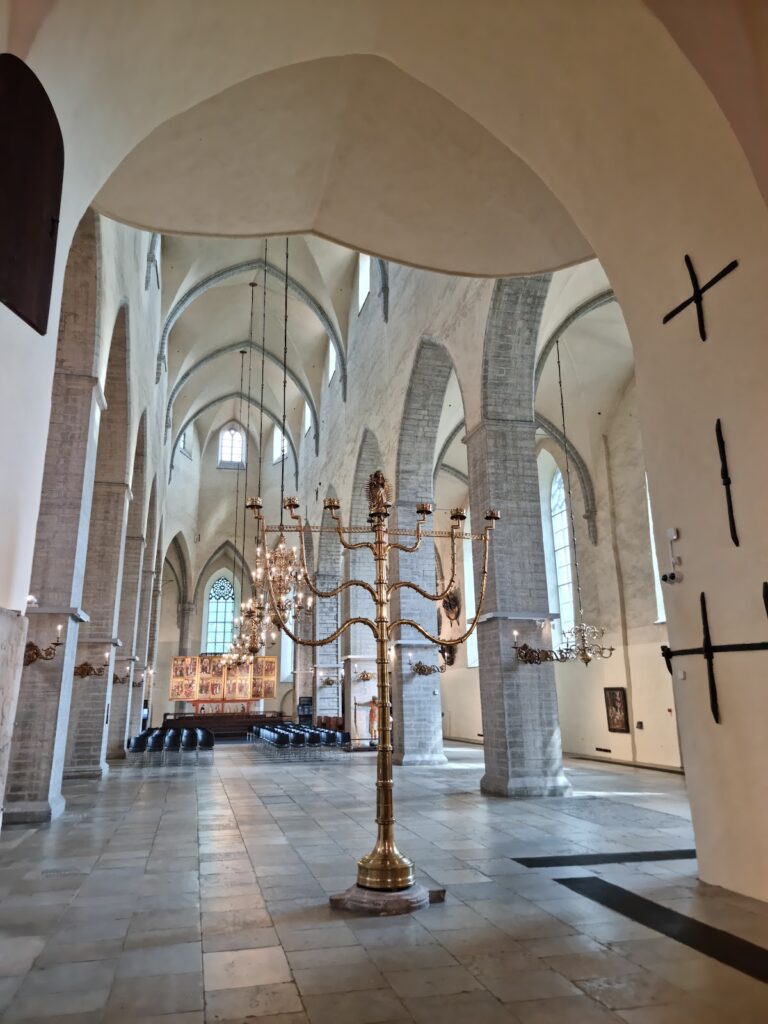
The stone church was completed and consecrated to the Virgin Mary in 1240, when it became the cathedral of the Bishopric of Reval. A cathedral school probably operated beside it from the thirteenth century and is first recorded in 1319. The first reconstruction took place in the second half of the thirteenth century. Major rebuilding began in the fourteenth century, enlarging the church and transforming it into a three-nave Gothic basilica, a church with a tall central nave and lower side aisles. This work was completed about a century later.
Reformation and later reconstruction
The cathedral became Lutheran in 1561 as a consequence of the Reformation, the sixteenth-century religious movement that produced Protestant churches and transformed Western Catholic practice. It remains an active Lutheran cathedral and serves as the episcopal church of the archbishop of the Estonian Evangelical Lutheran Church.
A major fire on Toompea on 6 June 1684 severely damaged the building. Several arches and the altar area collapsed, while much of the stone-carved decoration, sculpture, and interior furnishings was destroyed, including the tower over the central nave. The cathedral was largely restored soon afterward under the direction of the builder and master carpenter Daniel Bickel. Johann Gustav Stockenberg carried out the stone carving, and Christian Ackermann’s workshop supplied much of the new Baroque interior, including heraldic epitaphs, the high altar, and the pulpit decorated with figures of the Apostles.
In 1685, the bell-founder Detlof Riedeweg cast the Marian Bell and the smaller Salvator Bell. The Salvator Bell later entered Estonia’s national register of cultural monuments as an individual monument. A new Baroque western tower was added in 1778 and 1779 to designs by the architect K. L. Geist. The cathedral’s present appearance reflects these interventions and numerous other reconstructions. The parish began conducting burials at the Toomkiriku cemetery in 1774; that cemetery is now known as Mõigu Cemetery. The cathedral is listed in Estonia’s Register of Cultural Monuments as both an architectural monument and a historical monument.
Remains
Medieval structure and later additions
Medieval church
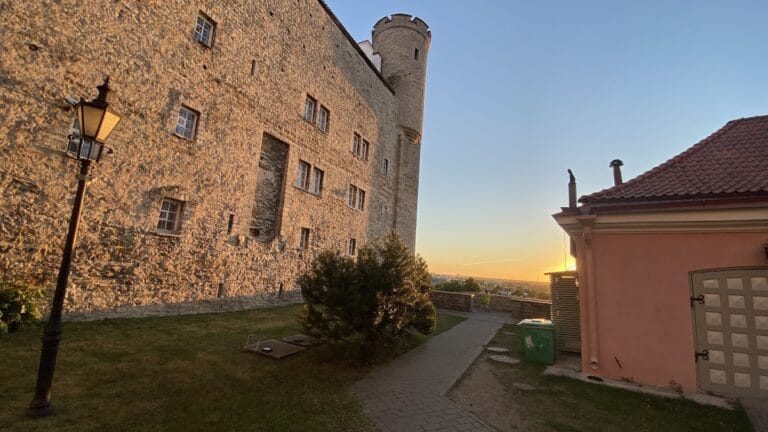
The surviving walls of the original building are limited to the square choir area, and the exact form of the first church is uncertain. A three-nave, four-bay longitudinal section with buttresses, external supports built against the walls, may have been constructed in the last quarter of the thirteenth century. The church was broad and short and was probably planned as a hall church, in which the aisles are approximately as high as the central space. Its interior included consoles for supporting the vaults, built in a manner associated with Cistercian architecture, and portals were constructed during the same phase.
During the first half of the fourteenth century, the longitudinal section received a western gallery, probably set within a solid wall, and four-sided pillars were apparently built at that time. Vaults were added to the side aisles in the second half of the century. The central nave acquired its basilican form and was vaulted only in the fifteenth century. The shapes of its transverse arches resemble those of the monastery church at Padise.
Tower and chapels
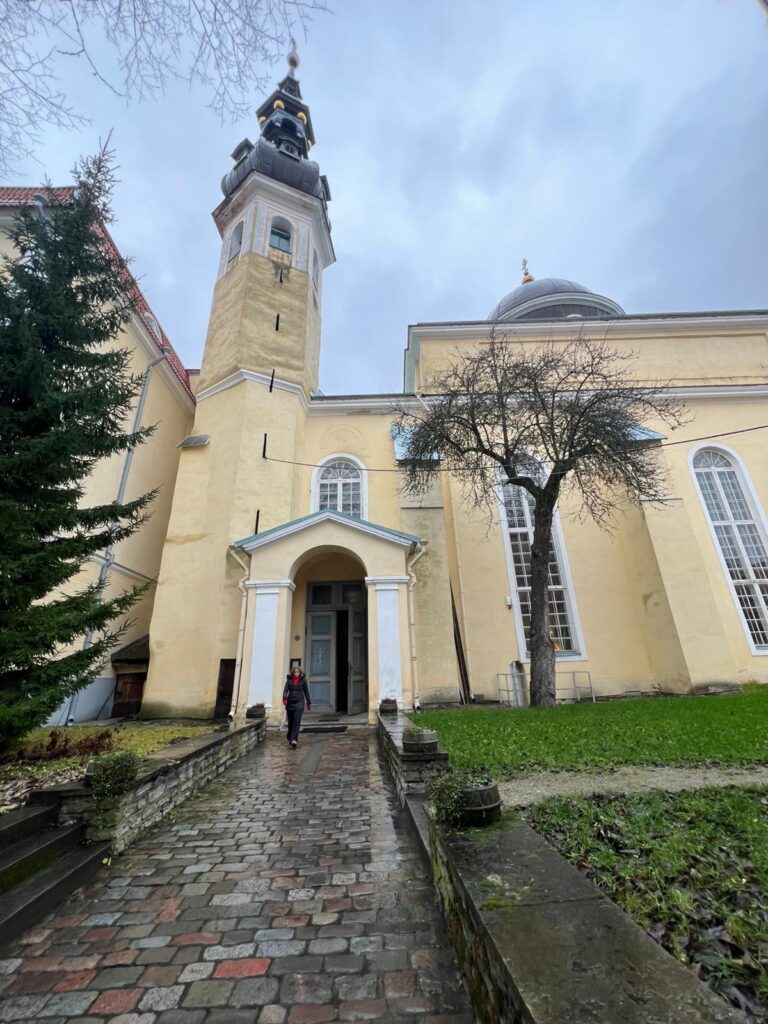
A bell tower was built in the fifteenth century in the external angle between the choir and the south aisle, together with several chapels. The present building retains additions from different periods and later architectural styles. Its principal body remains Gothic, while the western tower is Baroque, an architectural style known for dramatic forms and elaborate ornament. The tower added in 1778 and 1779 has a Baroque roof. Two of the cathedral’s four bells date from the seventeenth century and the other two from the eighteenth century.
Interior furnishings and organ
Baroque furnishings
Christian Ackermann’s pulpit, dated 1686, is supported by a wooden Moses bearing the Ten Commandments. The cathedral also has an elevated gallery or tribune, known as an empore, from 1730. Ackermann made the high altar in 1696 from drawings by Nicodemus Tessin the Younger. It is accompanied by Christ on the Cross, an altar painting made in 1866 by the German artist Eduard Gebhardt.
A Baroque triumphal-arch group with a crucifixion of Christ is preserved inside the cathedral. The classical-style gallery of the Patkul family dates from the beginning of the eighteenth century, while the Manteuffel family’s Baroque gallery dates from the seventeenth century and stands in the south aisle. An obelisk commemorating F. von Tiesenhausen, made in 1806 by Demuth-Malinovsky, stands in the choir to the left of the altar.
Organ
The cathedral’s organ was built in Berlin in 1878 by Friedrich Ladegast with 49 registers. The W. Sauer organ-building company of Frankfurt an der Oder modernized, rebuilt, and enlarged it in 1913 and 1914. The Scheffler organ workshop extensively restored the instrument in 1998. It now has 73 registers distributed across three manuals and a pedal and is regarded as an important example of German Romantic organ building.
Tombs and memorials
Renaissance and noble monuments
A tomb monument to the military commander Pontus de la Gardie stands against the south wall of the altar area. Created between 1589 and 1595 by the sculptor and architect Arent Passer, it consists of a sarcophagus and a wall epitaph and is regarded as a major achievement of Renaissance art in Estonia. Passer also created the tomb monument of Caspar von Tiesenhausen in 1599 and that of Carl Huringson Horn in 1601.
The north aisle contains burial monuments to Adam Johann von Krusenstern and his wife and to Samuel Greigh. Krusenstern was a Russian naval officer and explorer who led the first Russian circumnavigation expedition, while Greigh was a Russian admiral who took part in the Battle of Chesma. Greigh’s monument is made of Carrara marble and was designed by Giacomo Quarenghi; the Krusenstern monument is attributed to Exner. A monument to Pontus de la Gardie and his wife stands to the right of the altar in the choir.
Grave slabs and epitaphs
The cathedral contains tombs and grave slabs dating from the thirteenth to the nineteenth centuries, including seventeenth-century stone sarcophagi. The oldest tomb slab is that of Voldemar Sorssever, dated 1370, and lies in the north aisle. Grave slabs for the butchers’ and shoemakers’ guilds of the cathedral guild date from 1708 and 1716 and are located beneath the organ. Other commemorated individuals include Hermann Rahr, Reinhold Otto von Taube, and Otto von Uexküll.
The walls display 107 heraldic epitaphs, predominantly Baroque memorials incorporating coats of arms and commemorating German-Baltic nobles of Estonia. A depiction of Christ bearing the invitation “Come to me” is also preserved inside. Near the main entrance, a stone slab marks the grave of Otto Johann Thuve and is dated 1696. A local legend says that Thuve requested burial at the church threshold so that kneeling worshippers might aid his soul. Popular satire instead claimed that he wished to look beneath the skirts of young women even after death.
Nearby sites