St. Nicholas’ Church: A Gothic Church and Museum in Tallinn, Estonia


Site at a Glance
- Rating
- 4.6
- Popularity
- Medium
- Country
- Estonia
- Primary era
- Medieval
- External website
- Open
- Eras represented
- Medieval, Early Modern
- Civilizations
- Danish, Livonian Order, Russian, Swedish
- Site type
- Religious
- Remains
- Church
On this page17 sections
History
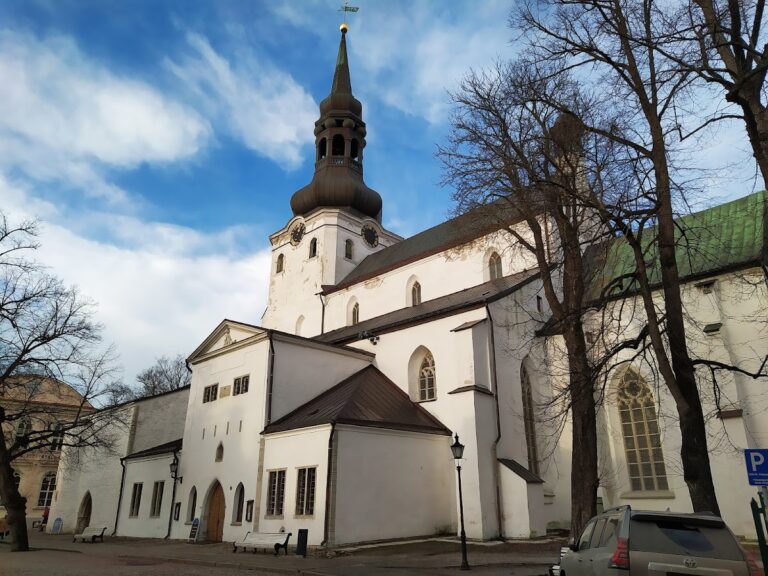
St. Nicholas’ Church is a Gothic stone church in Tallinn, Estonia, founded in the mid-thirteenth century by Westphalian merchants who had come from Gotland. Established southwest of Tallinn’s Town Hall Square, the settlement occupied a broad area east of present-day Rataskaevu Street. Dedicated to Saint Nicholas, the Christian patron traditionally associated with sailors, fishermen, travellers, and charity, the church served both a religious community and a maritime trading population.
Foundation and medieval development
The church was founded around 1230–1275, and its first recorded mention dates from 1315. An early tombstone inside the building bears the date 1309. Before Tallinn was fully enclosed by defensive walls, St. Nicholas’ also functioned as a warehouse and a place for concluding commercial transactions. Heavy entrance bars, loopholes, and concealed refuge spaces gave it the character of a fortified trading church, where people could shelter during danger.
That defensive role changed in 1310, when Tallinn’s town wall enclosed the church and its settlement. St. Nicholas’ then developed into a conventional medieval parish church. Construction continued in stages. A square choir was built first, followed by a three-aisled hall church with four bays, a large square choir, and a massive, relatively low western tower. Chapels dedicated to Saint Barbara, Saint Matthew, and Saint George were added from the mid-fourteenth century onward.
Rebuilding and expansion
Probably in the early fifteenth century, the low-vaulted hall church was rebuilt as a taller basilica, a layout in which the central nave rises above the side aisles and has windows in its raised wall. A sacristy was added on the north side of the choir. The principal rebuilding took place from 1405 to 1420, when the church acquired its clerestory and largely reached its present medieval form.
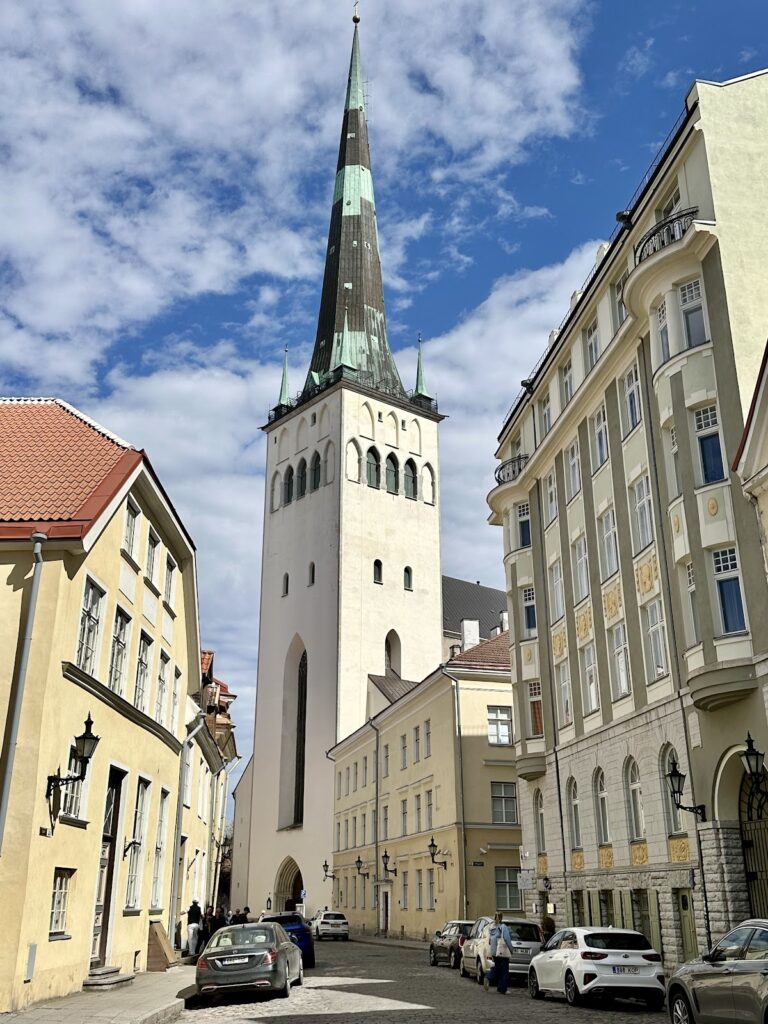
The western tower was raised in stages from the early fifteenth century. Under the master Andreas Mor, it received a Gothic spire by 1515. In the late fifteenth century, the former Saint Matthew’s Chapel was rebuilt under Andreas Kama as a spacious central-plan chapel and later became known as Saint Anthony’s Chapel. By 1673, a chapel for the Livonian field marshal Gustav Adolf Clodt had been built on the site of the former western vault of Saint George’s Chapel.
Reformation and later alterations
During the Reformation, St. Nicholas’ was the only church in Tallinn’s Lower Town whose interior was not looted by Protestant iconoclasts. On the night of 14 September 1524, an attacking crowd reportedly failed to enter after the door locks had been sealed with molten lead, a tradition associated with the church’s head. The church later became Lutheran, while its rich interior decoration was preserved.
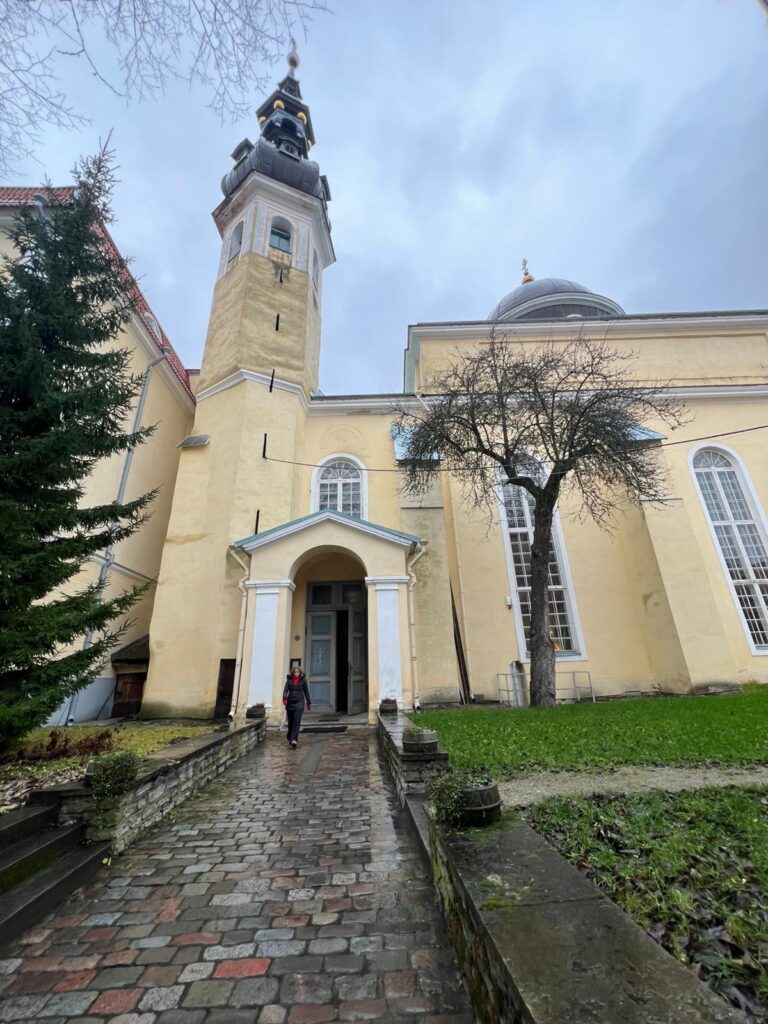
During the seventeenth century, the vestibule acquired a Baroque facade and carved portal. The tower was raised by another storey, and its Gothic spire was replaced by a Baroque cupola or spire with open galleries. The later spire reached 105 metres. The last major addition was the early Neoclassical mausoleum of Field Marshal P. A. von Holstein-Beck, built in 1773.
War damage and museum use
On 9 March 1944, Soviet bombing during the Second World War severely damaged St. Nicholas’ and caused a fire that left much of the building in ruins. Most of the interior was destroyed. The Saint Anthony Chapel survived, and many valuable works of art were saved, partly because they had been evacuated in time. The tower reportedly continued to smoke for about a month.
Postwar renovation began in 1953 and continued until 1981. The lost spire was reconstructed during the 1970s, but a major fire on the night of 12 October 1982 destroyed it again and damaged the tower, the nave roofs, and the roof of Saint Anthony’s Chapel. Restoration directed by the conservator-restorer Villem Raam followed. In January 1984, the former church reopened as the Niguliste Museum and a concert hall. It became a branch of the Art Museum of Estonia and has not served a regular congregation since the Second World War.
The museum brings together medieval and later ecclesiastical artworks preserved in Estonia, including works formerly associated with churches and monasteries in Tallinn and the surrounding area. St. Nicholas’ Church is protected in Estonia’s State Register of Cultural Monuments as both an architectural and a historical monument, with the designation recorded in 1995. As of 5 August 2025, the building was undergoing restoration, while its excellent acoustics continued to support organ and other concerts.
Remains
Medieval church fabric
Longitudinal body and tower
The surviving medieval core includes the longitudinal body, early Gothic carved portals on both the north and south sides, and the lower part of the western tower. Only limited portions of the original thirteenth-century church remain. The building’s main body developed from a three-aisled, four-bay hall church into a basilica. Its central nave rises above the side aisles, and the clerestory belongs largely to the rebuilding of 1405–1420.
The western tower began as a low, massive structure and was raised from the early fifteenth century. Its later spire brought the tower to a height of 105 metres. The tower and nave roofs were damaged in the 1982 fire, and the spire reconstructed in the 1970s was destroyed in that same event.
Saint Anthony’s Chapel
The former Saint Matthew’s Chapel, later dedicated to Saint Anthony, was rebuilt in the late fifteenth century as a central-plan space. Four vaults rest on a central octagonal pier, and a high arched opening connects the chapel with the longitudinal body. Its stepped Tallinn-style gable contains false niches, while its perspective portal is formed from a series of recessed openings.
Saint Anthony’s Chapel retained much of its interior through the 1944 fire, although its roof was damaged in 1982. A fragment of Bernt Notke’s late-fifteenth-century Dance of Death is preserved and displayed there. The surviving painting shows people from different levels of society, including the pope, peasants, and an infant, being drawn into a dance by skeletal figures. This late-medieval motif presents Death leading all social ranks in a symbolic dance.
Sacristy and vestibule
The sacristy on the north side of the choir contains a stone vault and a fireplace. The seventeenth-century vestibule has a Baroque carved portal and sculptures attributed to Hans Kindt and Winant Nack. The Baroque portal of Gustav Adolf Clodt’s chapel opens into the vestibule.
Altars and devotional works
High altar retable
The former high altar was made between 1478 and 1481 in the workshop of the Lübeck painter Hermen Rode. Its elaborate retable, an altar structure with painted and sculpted panels and movable wings, presents scenes from the lives of Saint Nicholas and Saint Victor on its exterior. The central section and opened wings contain more than thirty wooden sculptures arranged as a gallery of saints.
The outer wings display the emblems of Tallinn’s Great Guild and the Brotherhood of Blackheads, a Baltic association of unmarried merchants and shipowners. The lower section, or predella, shows Church Fathers and founders of religious orders. Other painted wings contain the Annunciation in grisaille, a monochrome technique that imitates the appearance of sculpture. The opened view includes the Virgin Mary with donors, Christ displaying the wound in his chest, God the Father enthroned, and John the Baptist with donors. Additional panels show the Virgin Mary with Saints George and Victor, Saint Francis of Assisi, and Saint Gertrude of Nivelles. The retable remained in the house of the Brotherhood of Blackheads from 1534 to 1943.
Other medieval altars
An early-sixteenth-century altar of Saint Anthony is associated with the painters Adrian Isenbrandt and Michel Sittow. The church also contains an altar of Saint Mary and the Brotherhood of Blackheads, made in Bruges around 1500 by the anonymous Master of the Legend of Saint Lucy.
Other preserved works include the altar of the Holy Kin, made around 1490 in Jan Borman’s Brussels workshop. The Holy Kin is a devotional subject depicting Saint Anne, the Virgin Mary, the Christ Child, and members of their extended family. An altar of Christ’s Passion was made in the early sixteenth century by the workshop of the Bruges master Adrian Isenbrandt. The panel Presentation of Christ in the Temple was painted around 1430–1440 by the Master of Schloss Lichtenstein.
Sculpture, memorials, and church furnishings
Carvings and later memorial art
Medieval woodcarvings by Henning von der Heide, dating approximately from 1510–1520, depict Saint Nicholas, the Virgin Mary, and John the Evangelist. Later works include Tobias Heinze’s figure of Saint Christopher from 1624, a decorative screen from Bogislaus Rosen’s chapel carved by Frans Hoppenstätt, and Arent Passer’s 1608 epitaph for Antonius von der Busch.
Seventeenth-century tomb effigies of Berndt Reinhold von Delwig and Hermann Nieroth are arranged around the nave. Both figures are represented in full armour. The museum also has a silver chamber containing treasures belonging to guilds, craft corporations, and the Brotherhood of Blackheads.
Brass candelabrum
A four-metre-high, seven-branched brass candelabrum dated 1519 is among the largest of its kind in Europe. A double-sided figure of the enthroned Virgin and Child stands on its central branch. The Tallinn merchant Hans Bouwer donated the candelabrum.
Burials and memorial structures
The church precinct contains surviving tombstones and several burials. North of the church stands the yellow mausoleum of Prince P. A. von Holstein-Beck. Nearby is the chapel associated with the Russian field marshal Charles Eugène de Croÿ, a duke and military commander who served in the Russian army.
After de Croÿ died in 1702, his body was kept in the side chapel. Its ventilation conditions prevented rapid decay, and the body remained publicly exposed until the authorities buried it in 1897. His clothing and wig were reportedly still preserved at that time.
Pastor Christian Kelch is buried beneath the lime tree south of the church. A tombstone inside the church commemorates the municipal physician Johannes Balivi, who arrived in Tallinn in 1519 and died with his entire family during the plague on 22 August 1520.
Nearby sites