Church of St Catherine in Wronki: A Roman Catholic Parish Church


Site at a Glance
- Rating
- 4.2
- Popularity
- Low
- Country
- Poland
- Primary era
- Early Modern
- External website
- Open
- Eras represented
- Early Modern, Modern
- Civilizations
- Polish–Lithuanian Commonwealth
- Site type
- Religious
- Remains
- Church
On this page10 sections
History
Medieval parish origins
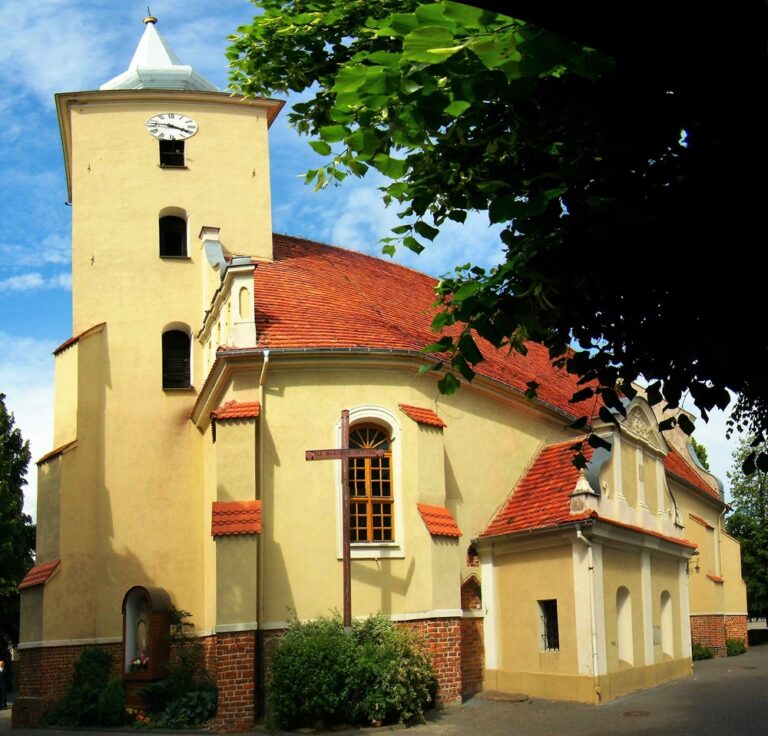
The Church of St Catherine in Wronki, Poland, is a Roman Catholic parish church dedicated to Saint Catherine, traditionally identified as Catherine of Alexandria, an early Christian martyr. The parish was first mentioned in 1298, when Bishop Andrzej Zaremba assigned the church at Wronki to the Archdeaconry of Pszczew during the organization of the Diocese of Poznań. This archdeaconry was a medieval administrative district overseen by an archdeacon.
Construction and eighteenth-century changes
The present church was built in 1660 by Łukasz Górka, then the owner of Wronki, and was consecrated by Bishop Maciej Kurski. The building replaced a church that had been Protestant during the sixteenth century. A fire that devastated Wronki in 1780 damaged the interior. Henryk Dzieduszycki, the subsequent owner of the town, financed three late-classicist altars after the fire.
Rearrangement and wartime closure
Between 1934 and 1936, the interior was substantially rearranged. The late-classicist high altar, including its painting of Saint Catherine and four sculptures, was dismantled. Two former Dominican side altars dedicated to Our Lady of the Rosary and Saint Joseph were also removed. A new high altar was assembled from elements taken from the three dismantled altars.
During the German occupation from 1941 to 1945, the church was closed and used as a warehouse for radio components. In 1954 and 1955, the presbytery was restored in an effort to recover its Gothic character. A new star vault and a triptych altar were installed, with reliefs and paintings by the local artist Witold Siwiński.
Recent conservation
Major repairs in 2012 and 2013 included replacing the roof and pews, restoring historic sculptures, and installing four stained-glass windows. The church remains a parish church within the Wronki deanery.
Remains
Late-Gothic brick structure
The church is a late-Gothic building made of fired brick. Its interior is arranged in three aisles, while buttresses reinforce the walls. This combination of brick construction, divided interior space, and external supports defines the surviving architectural framework of the church.
Presbytery and high altar
The presbytery, the part of the church surrounding the main altar and traditionally reserved for clergy, has a star vault restored in a Gothic style. Its triptych altar is composed of three connected panels and contains reliefs and paintings by Witold Siwiński. At the center stands a sculpture of Christ as Vir Dolorum, an image of the suffering Christ shown after the Passion with emphasis on his wounds. The sculpture dates from around 1500.
Side aisles and historic furnishings
The side aisles retain nineteenth-century altars whose central images represent Our Lady of the Snows and Saint Catherine. Other historic furnishings include a sixteenth-century Pietà, a seventeenth-century sculpture of the Blessing Christ, an eighteenth-century sculpture of Christ the Saviour, and a seventeenth-century painting of the Virgin and Child. The church has three altars in total.
Stained-glass windows
The four stained-glass windows installed in 2012 and 2013 depict Saint Michael the Archangel, Saint John Paul II, Blessed Father Jerzy Popiełuszko, and Blessed Karolina Kózkówna.