St John’s Hospital, Bath: A Medieval Almshouse
Site at a Glance
- Rating
- 4.7
- Popularity
- Low
- Country
- United Kingdom
- Primary era
- Early Modern
- Eras represented
- Early Modern
- Civilizations
- British
- Site type
- Civic
- Remains
- Hospital
On this page6 sections
History
St John’s Hospital is an almshouse, a charitable home for poor or infirm people, in Bath, United Kingdom. Founded in 1174 by Bishop Reginald Fitz Jocelin, it is among England’s oldest almshouses and was rebuilt during the Georgian period (1714–1830).
Medieval foundation and support
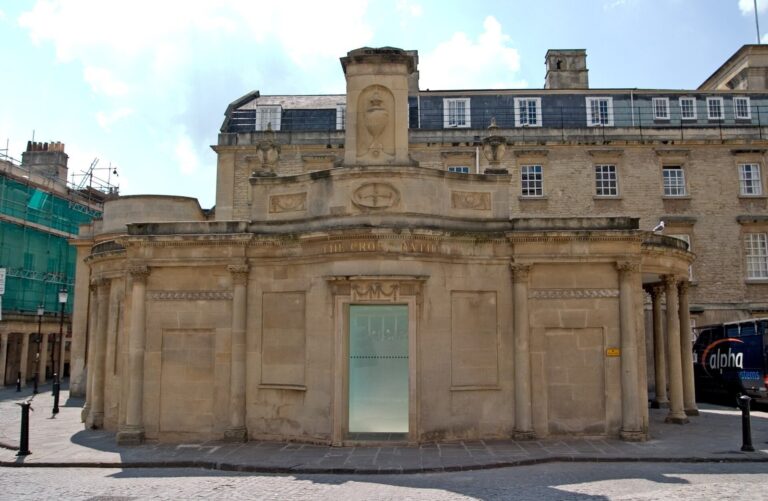
Known as the “hospital of the baths,” the institution sheltered poor and infirm people. Its association with Cross Bath’s hot springs reflected the perceived health benefits of the waters. Bath Cathedral Priory, a religious house governed by a prior that later became Bath Abbey, controlled the hospital. Canon William of Wheathampstead, a cleric attached to a cathedral, gave it substantial areas of land.
In 1400, the pope encouraged visitors to donate on certain days in return for remission of sins, a spiritual benefit associated with forgiveness or reduced penance.
Reformation and early modern changes
A proposal in 1527 to merge the hospital with the Priory, giving it greater access to the Priory’s wealth, was not carried out. In 1535, the hospital was valued at £22 16s. 9d. It remained independent after the Dissolution of the Monasteries, Henry VIII’s suppression of monastic institutions in England. William Crouch’s attempt to make the hospital private property was defeated after local civic leaders petitioned Queen Elizabeth I. During the remainder of her reign, the almshouse also lodged wealthy visitors to Bath’s spa.
Georgian rebuilding
William Killigrew was commissioned to rebuild the hospital in 1716. Construction continued after 1727 under John Wood the Elder, then aged 23; this was Wood’s first work in Bath. He later designed many buildings that shaped the city’s Georgian character. The writer and politician Horace Walpole stayed at the hospital in 1765.
Continuing charitable work
The institution continues to provide homes for more than 100 local older people in poverty, while its charity makes grants to individuals and organisations in and around Bath. In 2017, the charity adopted the name St John’s Foundation; it is also identified by the formal title “The Hospital of St John the Baptist with the Chapel of St Michael annexed with St Catherine’s Hospital.” The hospital was listed at Grade I, England’s highest category of listed-building protection, on 12 June 1950.
Remains
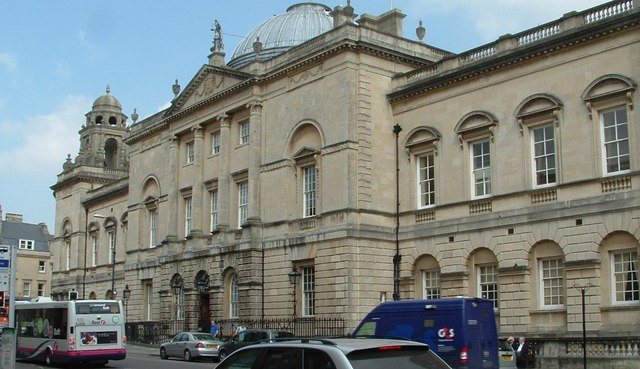
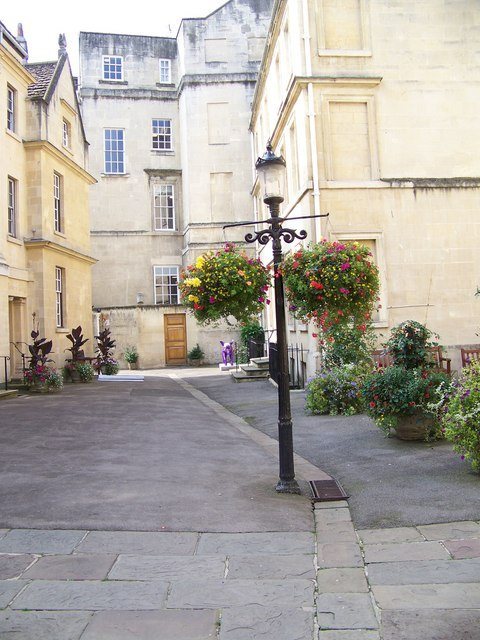
The original hospital stood beside Cross Bath’s hot springs, and the site includes Chapel Court and Chapel Court House. The present hospital is a two-storey building of Bath stone, a type of limestone, in Palladian style, which draws on classical forms associated with Andrea Palladio. A substantial arcade, or row of arches, spans the ground floor, with round-headed arches supported by pillars. The building retains its original window mouldings and sash windows.