Guildhall: Bath’s Eighteenth-Century Municipal Building
Site at a Glance
- Rating
- 4.6
- Popularity
- Low
- Country
- United Kingdom
- Primary era
- Early Modern
- External website
- Open
- Eras represented
- Early Modern, Modern
- Civilizations
- British
- Site type
- Civic
- Remains
- Town Hall
On this page8 sections
History
Guildhall is an eighteenth-century municipal building in Bath, United Kingdom, whose present form was constructed between 1775 and 1778 in locally quarried Bath stone. Its history reaches back to 1359, when a guildhall on the site served as a meeting place for Bath’s influential trade guilds, organized associations of craftspeople and merchants with economic and civic roles in medieval towns.
Medieval and Jacobean Guildhall
The medieval building was replaced by a Jacobean structure in 1625. Jacobean design belonged to the architectural and artistic period associated with the reign of James I of England. The replacement included a council chamber and a first-floor armoury, where weapons were stored before the English Civil War, the seventeenth-century conflict between supporters of the monarchy and Parliament. By the end of the seventeenth century, the armoury had become a setting for social gatherings, concerts, and plays.
The building was enlarged considerably in 1725 to designs by William Killigrew. Paintings commissioned from Jan Baptist van Diest were later displayed within the Guildhall, adding to its civic and cultural role.
Baldwin’s Guildhall and Later Enlargement
Thomas Baldwin designed the present Guildhall, which was built between 1775 and 1778. John McKean Brydon extended it in 1893 by adding the central dome and the north and south wings. These works created the contiguous building associated with the Victoria Art Gallery, Bath’s public art museum, which was constructed at approximately the same time.
Municipal and Cultural Use
Guildhall now accommodates the council chamber and register office of Bath and North East Somerset Council. It also houses Bath and North East Somerset Archives and Local Studies services, provides a setting for weddings, and hosts the Bath International Music Festival and other cultural events. The building was designated a Grade I listed building on 12 June 1950. In England, this category identifies structures of exceptional national architectural or historic interest. The rear archway on Orange Grove is separately listed at Grade II and connects Guildhall with the Old Police Station.
Bath Guildhall Market occupies the site of the medieval marketplace behind Guildhall on High Street. A single-storey market house was built there in 1552 and later demolished when the market and Jacobean guildhall were combined in a complex completed in 1627. The market has continued operating on the site for approximately 800 years and now accommodates about 20 stallholders. A fire on 25 April 1972 caused considerable damage.
Remains
Exterior and Connected Buildings
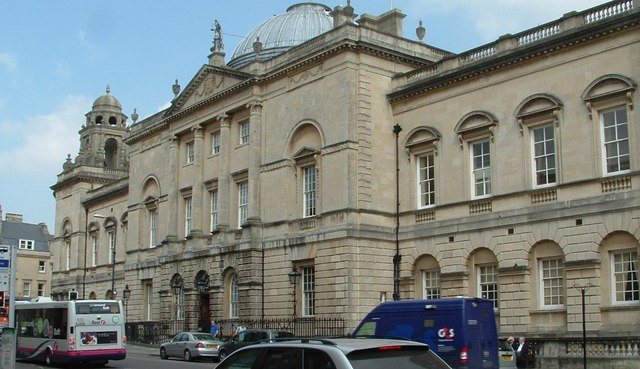
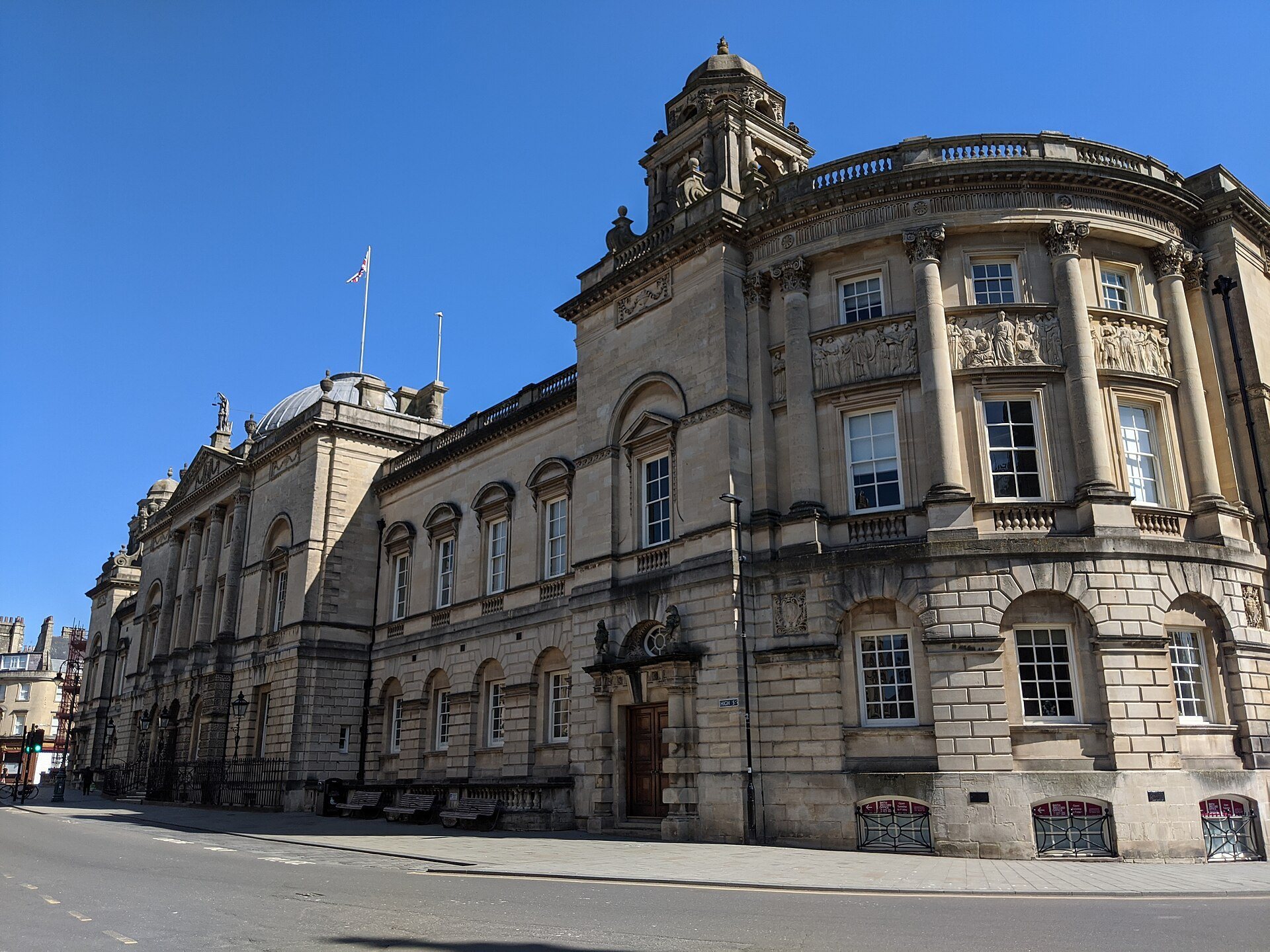
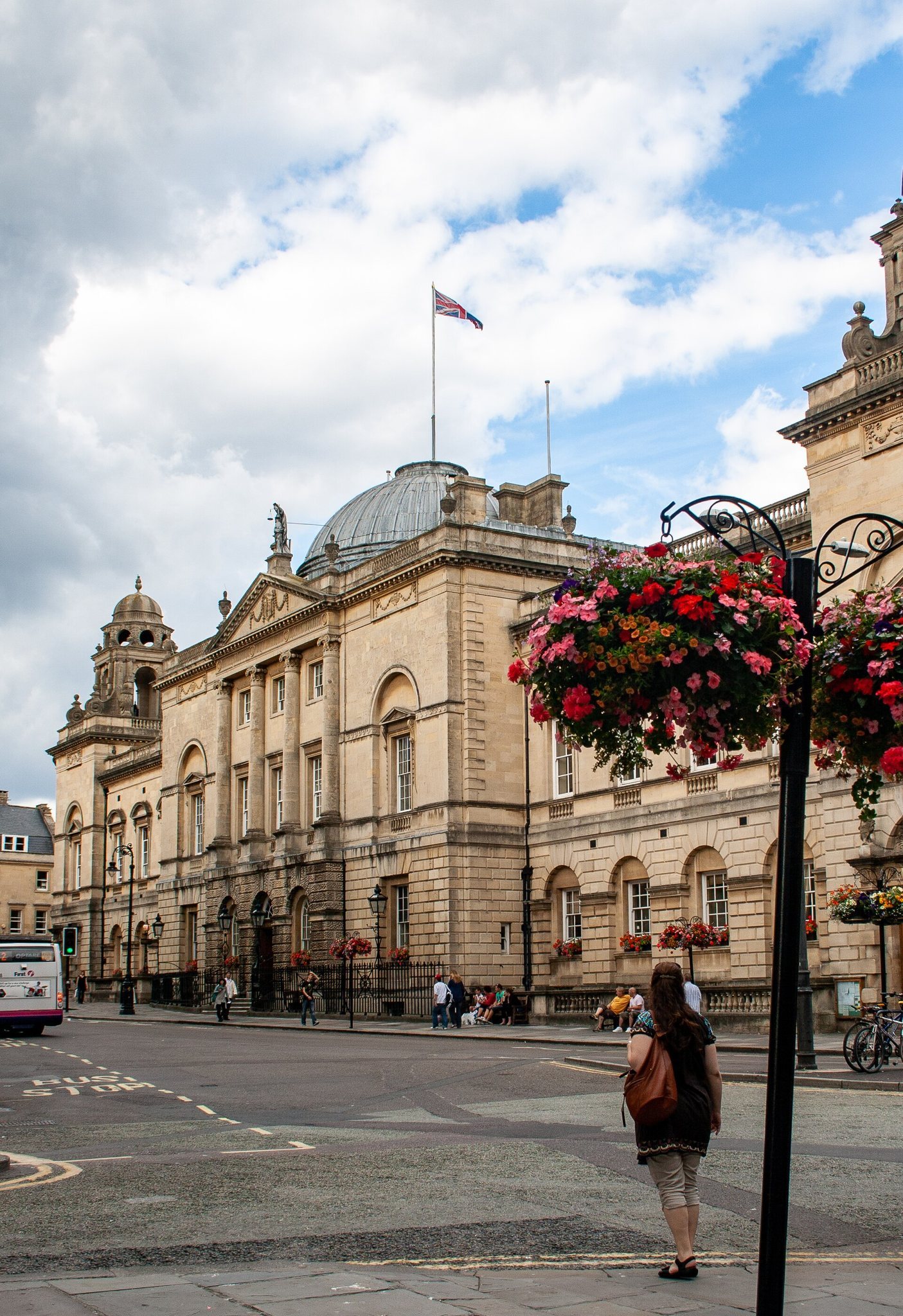
Guildhall’s central facade is faced in Bath stone and has four Ionic columns, whose capitals are marked by scroll-shaped forms. A figure of Justice surmounts the facade. The central dome and the north and south wings, added in the nineteenth century, form a continuous building with the Victoria Art Gallery. At the rear, a nineteenth-century archway on Orange Grove links Guildhall to the Old Police Station.
Interior
The banqueting hall contains engaged Corinthian columns, which have the elaborate capitals traditionally associated with acanthus leaves. Eighteenth-century chandeliers and royal portraits form part of the interior. The hall has also been used during royal visits, including a lunch held there by Queen Elizabeth II in May 2002.
Guildhall Market
The market lies behind Guildhall and is reached through a separate entrance tunnel running through the building. Its present arrangement occupies the historic marketplace site, where the market house and Jacobean guildhall once formed a combined complex. The market continues to function as a commercial interior with about 20 stallholders, while the fabric bears the effects of the substantial fire damage sustained in 1972.