St. George’s Churches on Navolok: An Orthodox Church Complex in Vologda
Site at a Glance
- Popularity
- Very Low
- Country
- Russia
- Primary era
- Early Modern
- Eras represented
- Early Modern
- Civilizations
- Russian
- Site type
- Religious
- Remains
- Church
On this page9 sections
History
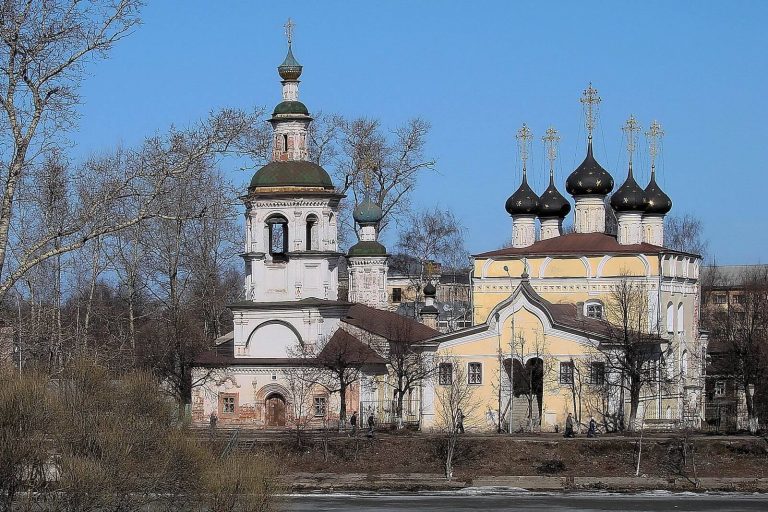
St. George’s Churches on Navolok was an Orthodox church complex in Vologda, Russia. Its foundation dates to the seventeenth century, and its paired warm church, meaning a heated church, and cold church, meaning an unheated one, belong to the second half of that century and the beginning of the eighteenth. The complex was formerly affiliated with the Diocese of Vologda and Veliky Ustyug, an area administered by a bishop.
Parish use and later changes
In 1844, declining parish numbers led to the cold church becoming a house church at the Skulyabin Almshouse, an institution providing care and lodging for people in need. The cold church’s documents were transferred to Sretensky Church.
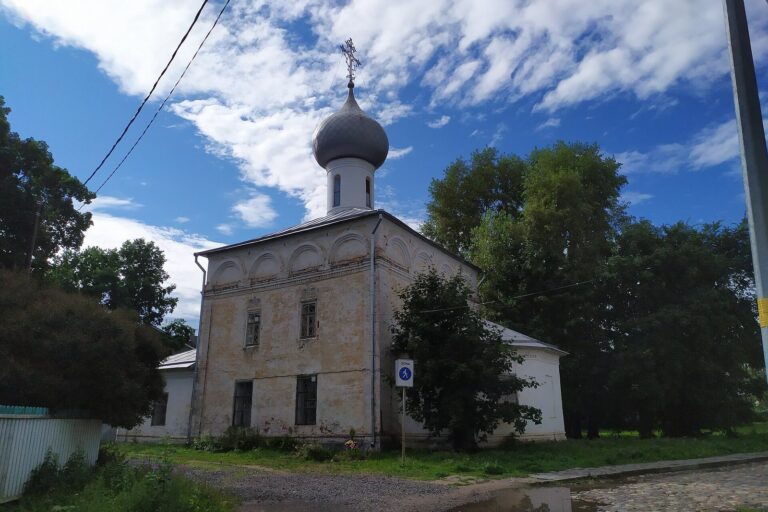
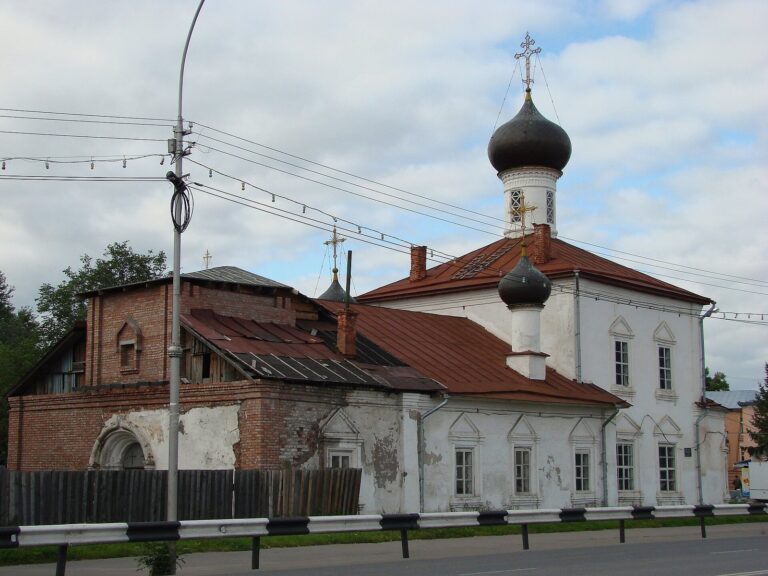
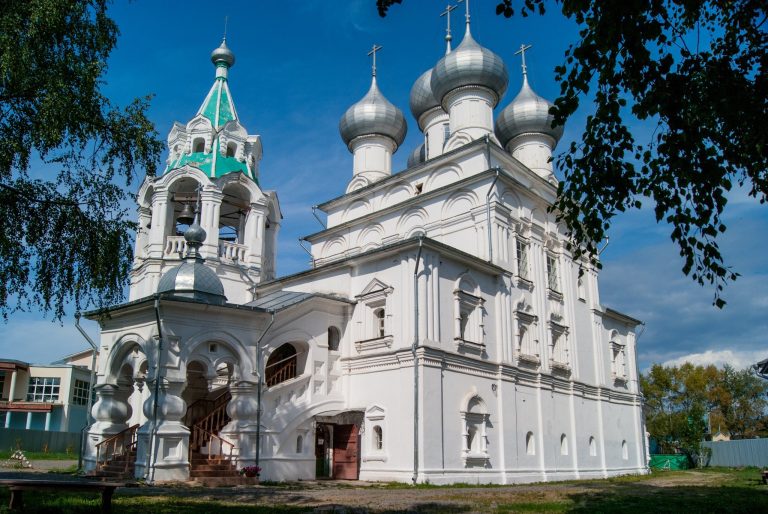
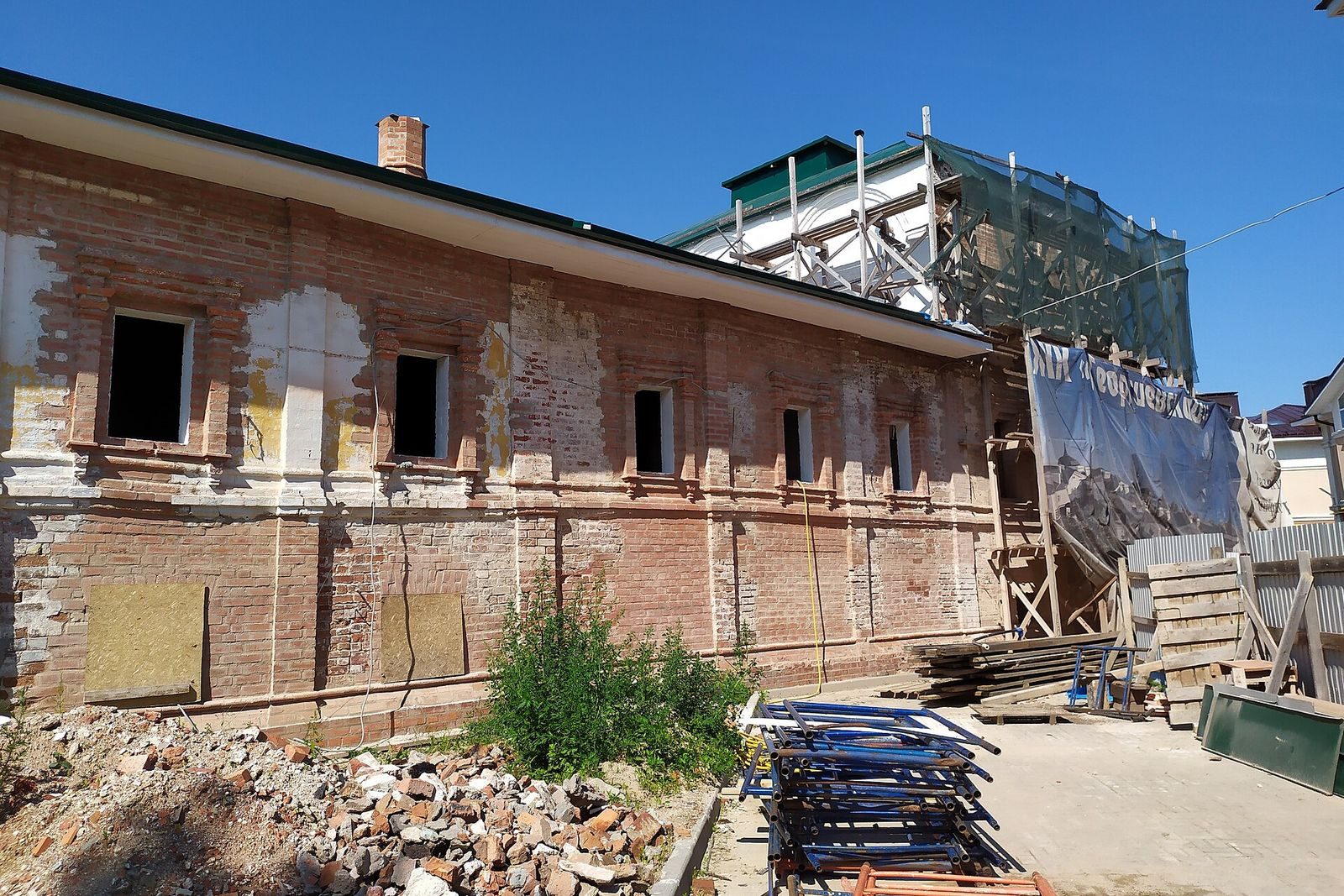
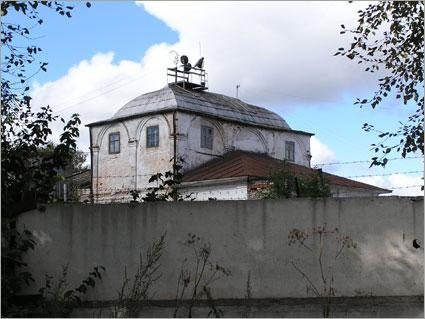
The cold church and its bell tower were later destroyed, while the warm church was extensively rebuilt. The complex is designated a regional cultural heritage site, and the surviving remains of the warm church are also identified as an architectural monument.
Remains
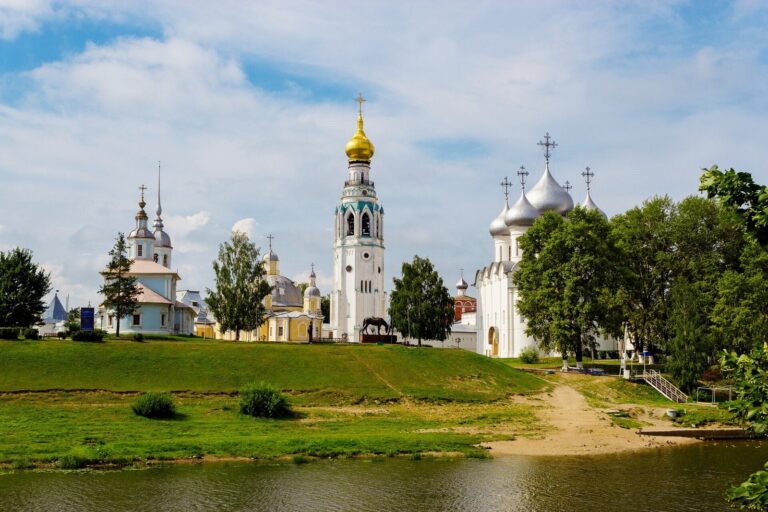
The complex stood in Vologda’s historic Zarechye district beside a bend in the Vologda River. Navolok is a term for low ground beside a river where floodwaters deposit silt. The two churches differed in form: the cold church had a cubic main building with a surrounding gallery, while the warm church joined a broad, short room to a long refectory, or communal dining hall.
Cold church and bell tower
Cold church
The cold church’s gallery was almost entirely bricked up during later alterations. Shallow wall projections divided the façades into four bays and rose to semicircular upper wall endings; by the nineteenth century, the building had a hipped roof. Frescoes once covered its walls in a continuous expanse, in a scheme compared with the paintings of Sophia Cathedral, Vologda’s principal Orthodox cathedral. Full-length saints appeared on the church’s four pillars. P. A. Belozerov destroyed the wall paintings between 1882 and 1887, and many of the church’s icons were retouched and repainted late in the nineteenth century.
A richly furnished iconostasis, the screen separating the sanctuary from the main worship space, included an icon of John the Baptist, the prophet who baptized Jesus, to the right of the Royal Doors, the central doors in the screen. Another notable image was the Smolensk Mother of God, an icon type depicting Mary and the Christ Child. An icon case, a housing for an icon, beside the right pillar held images of Zosima and Savvaty, Russian Orthodox monastic saints associated with Solovetsky Monastery. These icons came from Belozersky Monastery.
Bell tower
The bell tower adjoined the cold church. Its square lower stage supported two enclosed octagonal levels, the upper one pierced by small hexagonal and oval windows, above which stood an open octagonal level. A dome with roof windows and an elaborate lantern crowned the structure. The lower stories were probably built at the same time as the cold church, while the upper levels and dome may have been later Baroque additions, in an ornate European style. A clock with a striking mechanism had been dismantled by the beginning of the twentieth century.
Warm church
Building and decoration
The warm church had a broad, short main room joined to a long refectory. Its façades featured Baroque arches, shallow wall projections, and decorated window surrounds. The domed roof had a Baroque profile and ended in a closed lantern resembling a miniature church with five domes. An exterior painting of St George the Victorious, a Christian martyr revered in Orthodox Christianity, was destroyed by a merchant.
Inside, a small Baroque iconostasis held an image of the Nativity of Christ, noted for its color tones and rocky setting. An icon of St George the Great Martyr stood in a case near the iconostasis beneath a newer fitted cover; the Smolensk Mother of God icon also had a new cover. Other images depicted the Transfiguration, Christ’s Entry into Jerusalem, and the Resurrection. The church also had early nineteenth-century Empire-style icon cases, reflecting a neoclassical style, and ornamental stucco on recessed vault surfaces. An icon of All Saints was noted for its strong red color.
Icons now in the Vologda museum
Two icons from the warm church are now in the Vologda State Historical, Architectural and Art Museum-Reserve. One, an image of Sophia, Wisdom of God, dates to the last third of the sixteenth century and is distinguished by its composition and vivid colors. Sophia represents Divine Wisdom in Christian iconography. The other, a sixteenth-century icon of the Praise of the Mother of God, is noted for its composition and detailed plant forms.