St. Georg: A Gothic Jesuit Parish Church in Amberg, Germany


Site at a Glance
- Rating
- 4.5
- Popularity
- Low
- Country
- Germany
- Primary era
- Medieval
- External website
- Open
- Eras represented
- Medieval, Early Modern
- Civilizations
- Holy Roman Empire
- Site type
- Religious
- Remains
- Church
On this page16 sections
History
St. Georg is a Roman Catholic parish church in Amberg, Germany, built by the medieval Christian community of the town and dedicated to Saint George, the widely venerated Christian martyr and warrior saint. The present church was begun in 1359 as a High Gothic, three-aisled basilica with a single-aisled choir. It stands beside the large Jesuit College complex and developed through medieval, Jesuit, Maltese, and modern parish phases.
Early parish church and Gothic rebuilding
St. Georg was first mentioned in 1094 as a parish church outside the settlement. Excavations in 1977 identified the foundations of an earlier hall church with a recessed apse, built in the years after 1034. The surviving church therefore occupies a site with an established ecclesiastical history predating the present Gothic building.
The present church was started in 1359, according to an inscription in the choir. Heinrich Hirsel is recorded as its master builder in 1379. The interior was completed around 1407, while the west tower was finished in the early sixteenth century. This long building period produced the church’s main Gothic form, including its three aisles and extended choir.
Jesuit and Maltese administration
The church was closed between 1599 and 1619. In 1622 it was transferred to the Jesuits, the Catholic Society of Jesus, whose neighboring college combined religious and educational functions. Its parish rights were transferred to St. Martin in 1629, changing St. Georg’s role within Amberg’s ecclesiastical organization.
After the suppression of the Jesuits in 1773, the church came under the Order of Malta from 1782 to 1808. This Catholic religious order had medieval origins in caring for pilgrims and defending the Holy Land. From 1808 St. Georg served as a garrison and study church. It became a parish church again in 1923.
Baroque transformation and restoration
Baroque alterations reshaped the appearance of the medieval church. Francesco Garbanini directed an initial transformation in 1652, the sacristy was enlarged in 1672, and side chapels were added between 1675 and 1754. A more comprehensive campaign followed from 1718 to 1723, with stucco work by Johann Baptist Zimmermann, a German Baroque painter and stucco artist. Around the middle of the eighteenth century, Zimmermann’s nephew Anton Landes decorated the side chapels, while Johann Adam Müller painted the interior.
Much of the church’s furnishing was conceived by the Jesuit Father Johann Hörmann. The interior decoration and furnishings thus reflect the building’s Jesuit period even though the structure itself retains its Gothic proportions. The side-aisle paintings were overpainted in 1895. That layer was removed between 1980 and 1983, when damaged and missing areas were supplemented. A complete restoration took place from 1977 to 1984.
Changing organs
The church’s organ history reaches back to a swallow’s-nest organ, a projecting gallery for an organ, documented from about 1430. Its bellows were repaired by Friedrich Pfannmüller in 1535. The damaged instrument was removed in 1604, and its pipes were melted down, yielding 261 pounds of tin that was sold.
Johann Konrad Funtsch built a new organ in 1767 during the church’s Baroque transformation. It was his largest instrument, with 22 stops on two manuals and a pedal. Ludwig Edenhofer recorded its stop arrangement in 1902 and supplied a new pneumatic organ the following year. That instrument had 14 stops, two manuals, and a pedal. Michael Weise added 17 stops in 1941 and three more in 1961, creating an organ with 34 stops, three manuals, and a pedal.
As functional problems increased, Orgelbau Oberlinger built another organ in 1981. It used mechanical slider chests, in which movable sliders admit air to selected ranks of pipes, and had 48 stops, three manuals, and a pedal. Thomas Jann electrified its stop action in 1998, but the instrument remained unsatisfactory because its many stops exceeded the available space.
A support association for the organ was founded in 2012. On 8 December 2022, the church administration commissioned Johannes Klais Orgelbau of Bonn to build a new gallery organ in the historic Funtsch case. The instrument was consecrated on 26 April 2026 by Bishop Rudolf Voderholzer, with Martin Sturm performing at the ceremony. It has 34 stops on two manuals and a pedal, with mechanical playing and stop actions, and incorporates traditions associated with Funtsch, Hepp, Gabler, and Holzhay.
Remains
Gothic structure and exterior
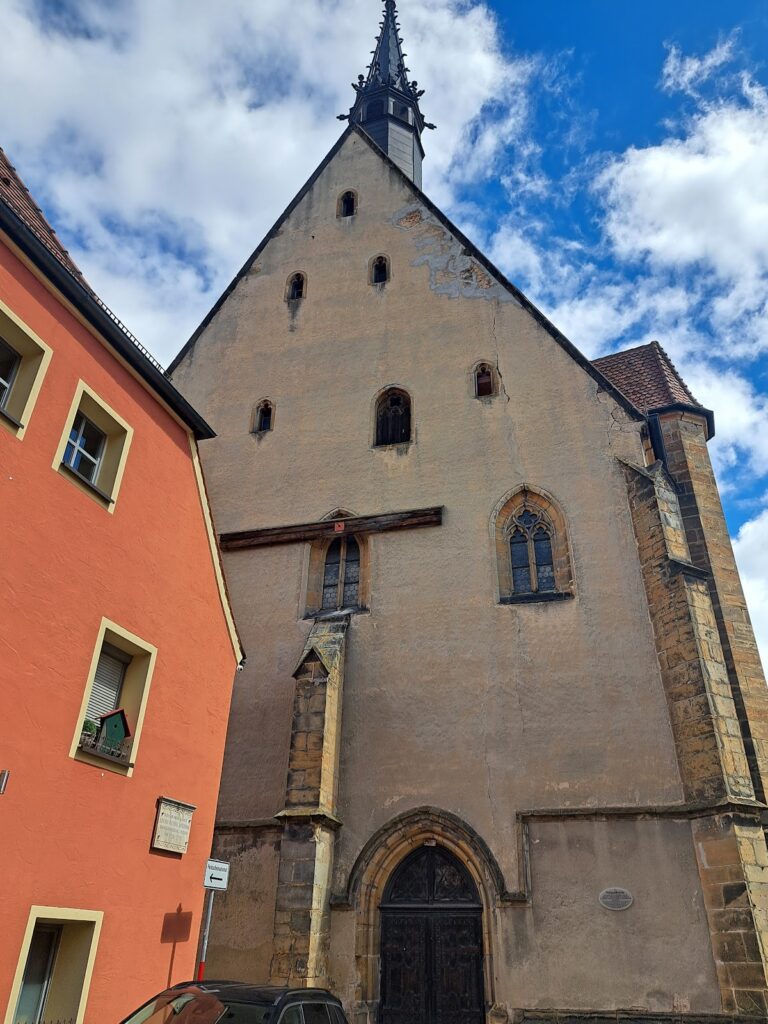
St. Georg is organized as a Gothic, three-aisled basilica, meaning that a central nave is flanked by lower side aisles. Round piers support the interior arcades, while the long choir ends in a seven-sided section of a decagon. Lancet windows light the side aisles and choir. Above them, the clerestory, the upper windowed part of the nave, contains Baroque round windows.
Choir, tower, and stair towers
The choir has strongly developed buttresses. At the west end, the tower is integrated into the nave and occupies the full width of the central nave, with substantial buttresses spanning the side aisles. It narrows upward to a square plan and ends in an octagonal stage carrying a bulbous dome and lantern. Three polygonal stair towers are attached to the building. The tower and the emphasized exterior portions are constructed from sandstone blocks.
Portals and exterior colors
The west portal has moulded jambs, a steep gable, crockets, and a two-part tracery opening. Its moulding is divided by pear-shaped profiles into four deep hollows, while the former figure canopies are now empty. A Baroque main portal stands between the two southern side chapels. In 1977, remains of the original exterior color scheme were found on the south side of the choir. They show figures set before a row of houses, accompanied by inscriptions.
Baroque interior decoration
The interior preserves the proportions of the Gothic building, but Baroque stucco dominates its visual effect. The decoration was applied over the original piers, arcade arches, consoles, ribs, and vault compartments. The choir and central nave share the same height and width. The central nave is twice as high as it is wide and six times as long as it is wide.
Zimmermann distinguished the two principal spaces through the arrangement of the stucco. The choir has vertically oriented pilasters, while the nave uses horizontally organized decoration and painted panels. The central-nave vault rests on strongly profiled, segment-arched consoles. The side-aisle vaults are carried by Ionic pilasters, shallow wall supports with spiral capitals. In the choir, fluted Corinthian pilasters with projecting entablature sections support the vault.
Apostles and fresco cycle
Twelve Apostles created by Johann Baptist Zimmermann around 1720 hang above the arcade arches on banks of clouds. Their lively and individualized characterization gives each figure a distinct presence. Johann Adam Müller’s frescoes on the choir and central-nave vaults depict the martyrdom of Saint George, ending with his beheading above the high altar. The clerestory walls show George’s intercession and protection.
The north side-aisle vault contains three scenes from the life of Ignatius of Loyola, founder of the Society of Jesus. The south side-aisle vault presents scenes from the life of Francis Xavier, an early Jesuit missionary and principal saint of the order. Müller’s 1772 fresco on the lower west gallery shows Saint George confessing his faith in the Cross.
Chapels, altars, and furnishings
Four Baroque side chapels are arranged symmetrically, each ending in three sides. The monumental high altar dates from 1695 and has a projecting base zone. Its painting, the Glory of Saint George, was produced in 1766 by Johann Nepomuk Schöpf, a Munich court painter.
Principal side altars
The two side altars from 1669 each have two columns. The northern altarpiece depicts Saint Ignatius, while the southern one depicts Saint Francis Xavier. Both paintings were created by Caspar de Crayer. In the northeastern chapel, the Cross Altar shows the Descent from the Cross and was probably made by de Crayer at approximately the same time as the high altar.
Marian and rear altars
Opposite the Cross Altar, the Marian altar dates from 1695 and depicts the Immaculate Conception. Johann Andreas Wolff created its image between 1695 and 1697. The tabernacle contains a half-length image of the Virgin from Kastl Abbey, a Dutch panel painting from the second half of the fifteenth century. Its survival during Calvinist iconoclasm gave it the name Mary, the Thorn Bush Unscathed in the Flames.
The rear side altars were made in 1754. Their wooden structures, with columns and volute pilasters, came from the Bacher carpentry workshop in Amberg. Georg Andreas Zellner and Franz Xaver Zellner painted the finish. The northern altarpiece depicts the Guardian Angel, and the southern one Saint Aloysius, a sixteenth-century Italian Jesuit venerated as a Catholic saint. Johann Georg Wolcker of Augsburg painted both works.
Pulpit, stalls, and memorial
The pulpit was installed in 1702 between the northern side aisle and the central nave, probably following a design by Johann Hörmann. Its sounding board carries a figure of Fama with a globe. The nave and choir stalls date from 1701 to 1702. Other furnishings connected largely with Hörmann’s designs include the oldest confessionals on the west wall, cabinets decorated with cartilage ornament, and the sacristy’s coffered ceiling, made after the sacristy was enlarged in 1672.
A limestone epitaph for the Maltese commander Baron von Weichs, who died in 1801, stands in the north side aisle. The memorial is signed by Friedrich Wagner.
Organ gallery
The present gallery organ is installed in the historic Funtsch case. It has two manuals, a pedal, 34 stops, and the couplers II/I, I/P, and II/P, which connect the organ divisions and pedal. Its mechanical playing and stop actions continue the design chosen for the new instrument. Two effect stops, the Cymbelstern and nightingale, add distinctive sounds to the organ’s resources.