Old Synagogue (Erfurt): A Medieval Jewish Synagogue and Museum in Germany


Site at a Glance
- Rating
- 4.4
- Popularity
- Low
- Country
- Germany
- Primary era
- Medieval
- External website
- Open
- Eras represented
- Medieval, Modern
- Civilizations
- Holy Roman Empire
- Site type
- Religious
- Remains
- Synagogue
On this page13 sections
History
The Old Synagogue (Erfurt) is a medieval Jewish synagogue in Germany, founded by Erfurt’s Jewish community in 1094 in the Romanesque period and later altered with Gothic elements. Built along the Via Regia, a major medieval trade route linking Kiev with Santiago de Compostela, it developed as the community grew and prospered.
Medieval synagogue and community
Dendrochronology, which dates wooden building components through their tree rings, places the oldest parts of the building in 1094. A further construction phase in the twelfth century is represented by part of the western wall, which contains a sandstone window with two arches. Around 1270, a larger synagogue incorporated sections of the earlier structure. Its western facade included five lancet windows and a large rosette window.
In the early fourteenth century, the synagogue was extended several metres northward and received an additional storey. This space may have served as a women’s section, traditionally separated from the men’s prayer hall, or as a Talmud Torah school for boys. The building’s successive alterations reflect the development of Erfurt’s Jewish community during a period of prosperity, although that community also faced recurring unrest and persecution.
Massacre and later reuse
On 21 March 1349, during the Erfurt Massacre, Jews were murdered or expelled amid accusations that Jewish people were responsible for the Black Death. The synagogue was damaged during the violence. The city of Erfurt took ownership of the building afterward and later sold it to a local merchant.
The profaned synagogue became a warehouse, a use that continued for approximately five centuries. From the nineteenth century, the former religious building was adapted for entertainment. It contained a ballroom, restaurant, and kitchen, and later held two bowling alleys. Because its synagogue history had been forgotten and it stood at the rear of a narrow alley, the building appears to have escaped destruction during the Nazi period.
Rediscovery and preservation
Interest in the building returned in the late 1980s. The German architectural historian Elmar Altwasser began investigating it in 1992, and Erfurt City Council purchased the property in 1998 after negotiations aimed at securing its preservation. Research carried out in 2007 and published in 2009 helped guide the building’s rehabilitation.
Conservation sought to preserve evidence of both the synagogue and its later alterations, leaving the medieval and subsequent phases readable in the building. The Old Synagogue opened as a museum of local Jewish history on 27 October 2009. Since then, its institutional role has been that of a Jewish museum rather than an active synagogue.
The building was placed on UNESCO’s Tentative World Heritage List in 2015. In 2023, the Old Synagogue, the medieval mikveh, and the Stone House became part of the Jewish-Medieval Heritage of Erfurt World Heritage property under criterion (iv).
Remains
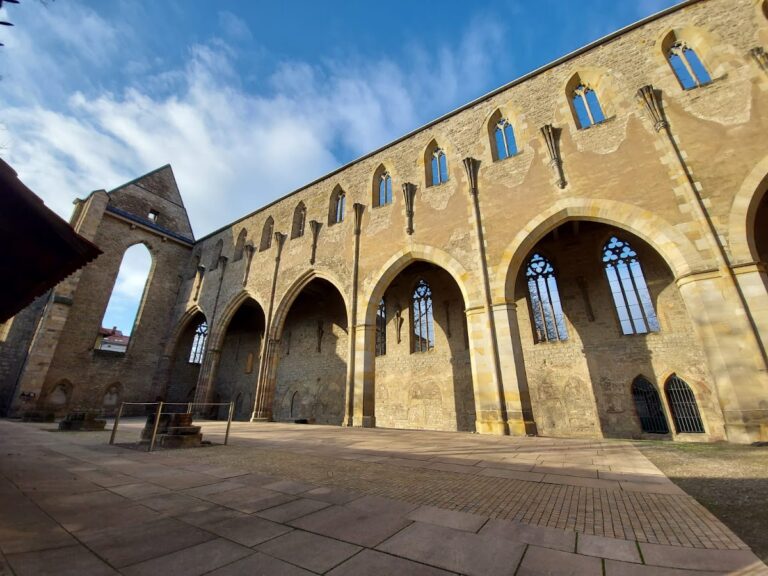
The surviving building is a Romanesque medieval synagogue with later Gothic elements. Most of its fabric dates from approximately 1250 to 1320, while its roof remains intact. It is therefore regarded as possibly the world’s oldest intact synagogue building and as one of the best-preserved medieval synagogues in Europe. Its physical form also preserves traces of the centuries when it served as a warehouse and entertainment venue.
The synagogue building
Medieval structure
The original floor lay below street level, requiring worshippers to descend several steps to enter. The western wall retains the twelfth-century sandstone double-arched window. The larger synagogue constructed around 1270 incorporated parts of the earlier building and presented a western facade with five lancet windows and a large rosette window. The early fourteenth-century northern extension added several metres to the building and another storey.
Warehouse and entertainment alterations
When the building was converted into a warehouse from 1350, the prayer hall was divided into several storeys and a vaulted cellar was created beneath it. Windows were reduced to the size needed for inserting storage floors, using earlier jambs and arches. The large doors were broken, while the octagonal bimah, the raised platform for reading the Torah, and the Torah shrine, the cabinet containing Torah scrolls, were destroyed.
Later entertainment conversions replaced the ceiling of the warehouse’s uppermost floor with a circular gallery. The interior received partly nude stucco caryatids, sculpted figures used as architectural supports or decoration.
Associated medieval remains and collections
Medieval mikveh
The medieval mikveh near the Krämerbrücke is a Jewish ritual bath used for religious purification. It measures approximately 9 metres in length and slightly less than 3 metres in internal width. Dating from around 1250, it may have been built over an earlier twelfth-century ritual bath. A small crowned stone sculpture, possibly representing King David, was found in connection with the earlier mikveh.
The bath is unusually well preserved. Archaeologists discovered it in 2007, excavation took place in 2010, and a protective building was constructed to conserve and display it. It has been accessible on guided tours since September 2011.
Erfurt Treasure
The Erfurt Treasure was found in 1998 within the wall of a house at Michaelisstraße 43, in the medieval Jewish quarter near the synagogue. The deposit is understood as valuables hidden before the 1349 massacre. It contains 3,141 silver coins weighing approximately 24 kilograms, more than 700 pieces of goldsmiths’ work and jewellery, and a total collection weighing almost 30 kilograms. The treasure is permanently displayed in the museum and has also been exhibited in Berlin, Paris, London, New York, and Tel Aviv.
Erfurt Hebrew Manuscripts
The museum presents facsimiles of the Erfurt Hebrew Manuscripts, religious texts from the twelfth to fourteenth centuries that belonged to Erfurt’s medieval Jewish community. After the 1349 massacre, the manuscripts passed into the possession of Erfurt City Council, later entered the library of the Lutheran Evangelical Ministry at the former Augustinian Monastery, and were sold in 1880 to Berlin’s Royal Library, now the Berlin State Library. The original manuscripts are kept there.
Among the collection is the twelfth-century Erfurt Tosefta. A Tosefta is a compilation of Jewish oral law traditionally associated with scholars active mainly in Palestine and Babylonia from approximately the first to the early third century CE. The Erfurt Tosefta is the oldest of three known Tosefta manuscripts and the second-most complete. The nineteenth-century Jewish scholar Moses Samuel Zuckermandl first emphasized its importance in a German-language study published in 1876.
Stone House
The World Heritage property also includes the Stone House, a secular building dating from approximately 1250 in Erfurt’s medieval city centre. Its owners were Jewish, linking the building to the material history of the city’s medieval Jewish community.