St Botolph’s Aldgate: A Georgian Parish Church in London
Site at a Glance
- Popularity
- High
- Country
- United Kingdom
- Primary era
- Early Modern
- Eras represented
- Early Modern, Modern
- Civilizations
- British, English
- Site type
- Religious
- Remains
- Church
On this page14 sections
History
Medieval parish and dedication
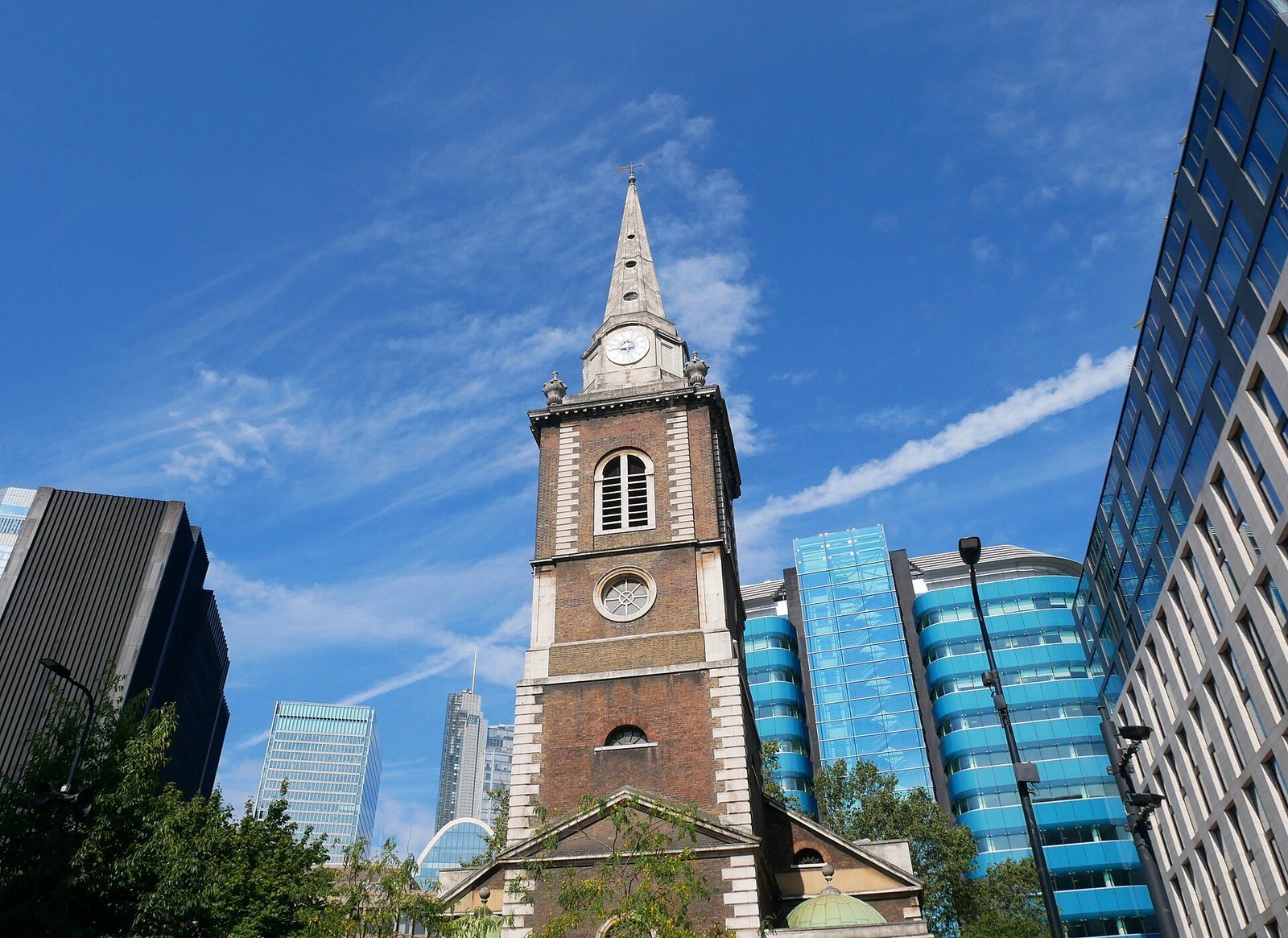
St Botolph’s Aldgate, also called St Botolph without Aldgate and Holy Trinity Minories, is an active Church of England parish church in the City of London, United Kingdom. Its present building was designed by George Dance the Elder and constructed between 1741 and 1744 in the Georgian architectural period, associated in Britain with the reigns of George I through George IV. The parish historically covered Portsoken, an administrative ward, and East Smithfield.
The parish may have existed before 1066. Its earliest known written record dates to 1115, when the church was in the possession of Holy Trinity Priory, a monastic community governed by a prior and recently founded by Matilda, wife of Henry I. Clergy from St Botolph’s Priory in Colchester had established a priory just inside Aldgate. The priors who held land in Portsoken are thought to have built and dedicated the church to serve the area.
By the late 11th century, Botolph, a seventh-century East Anglian Christian saint, was associated with boundaries and, through them, with trade and travel. These associations may help explain why four medieval London churches dedicated to him stood beside City gates. St Botolph’s Aldgate is believed to have received the first of these London dedications, with others following soon after. The other churches were St Botolph-without-Bishopsgate, St Botolph’s Aldersgate, and St Botolph’s Billingsgate. The Billingsgate church was destroyed in the Great Fire of London in 1666 and was not rebuilt.
Rebuilding and parish life
The church’s Roman Catholic affiliation ended in 1534. The priors of Holy Trinity paid for a rebuilding in the 16th century, and the church was renovated in 1621. Its medieval predecessor was a Gothic building, a medieval style commonly marked by pointed arches and ribbed vaults. Built of brick, rubble, and stone beneath a layer of render, it measured 78 feet long by 53 feet wide. Its tower stood about 100 feet high and held six bells. The church escaped the Great Fire of 1666.
Dance’s replacement church was completed between 1741 and 1744. Daniel Defoe married at St Botolph’s in 1683. Thomas Bray served as rector from 1706 to 1730. He founded the Society for Promoting Christian Knowledge, an Anglican organization that advanced Christian knowledge, and the Society for the Propagation of the Gospel, an Anglican missionary organization.
Nineteenth-century changes
In the late 19th century, the church became notorious as a meeting place for prostitutes and their clients and was sometimes called the Church of Prostitutes. Its position on an island surrounded by roadways allowed women to walk around it to evade police arrest. The traditional rhyme Oranges and Lemons refers to the slow bells at Aldgate. Old Father Baldpate is understood to refer to Botolph’s tonsure, the shaved crown of a cleric, and may also have carried a sexual allusion.
When Holy Trinity, Minories closed in 1899, its parish joined St Botolph’s. The church inherited a preserved head reputed to be that of Henry Grey, first Duke of Suffolk, who was executed for treason under Mary I in 1554. The head was found again during an archaeological investigation of the church’s underground crypt in 1990 and was buried in the churchyard.
War damage and restoration
St Botolph’s received Grade I listing on 4 January 1950, England’s highest listed-building category. It suffered severe bombing at intervals during the Second World War. An unexplained fire in 1965 caused further damage, after which the church underwent restoration. The Bishop of London rededicated it on 8 November 1966 in the presence of Queen Elizabeth The Queen Mother and the Lord Mayor of London.
In the early 1970s, the crypt served as a night shelter for homeless people and as a daytime youth club for Asian boys. St Botolph’s remains an active Church of England parish with Liberal/Modern Catholic churchmanship, combining a liberal theological outlook with Catholic traditions of worship.
Remains
Setting and exterior
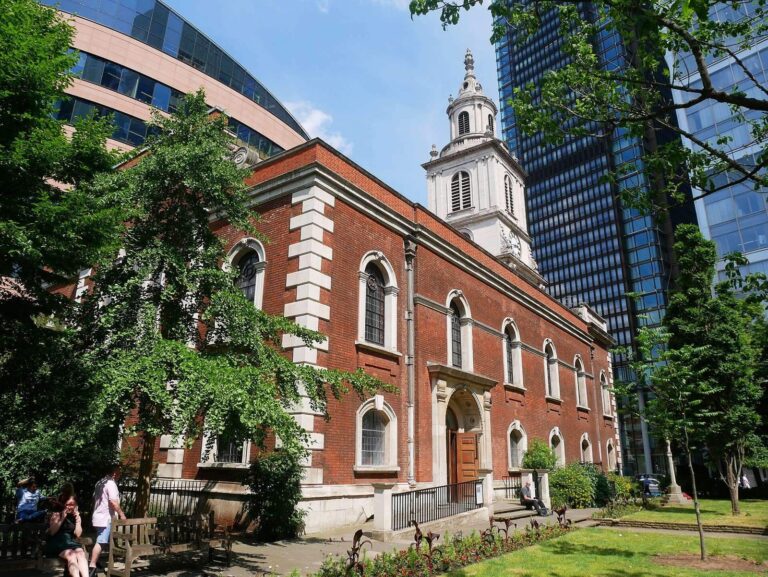
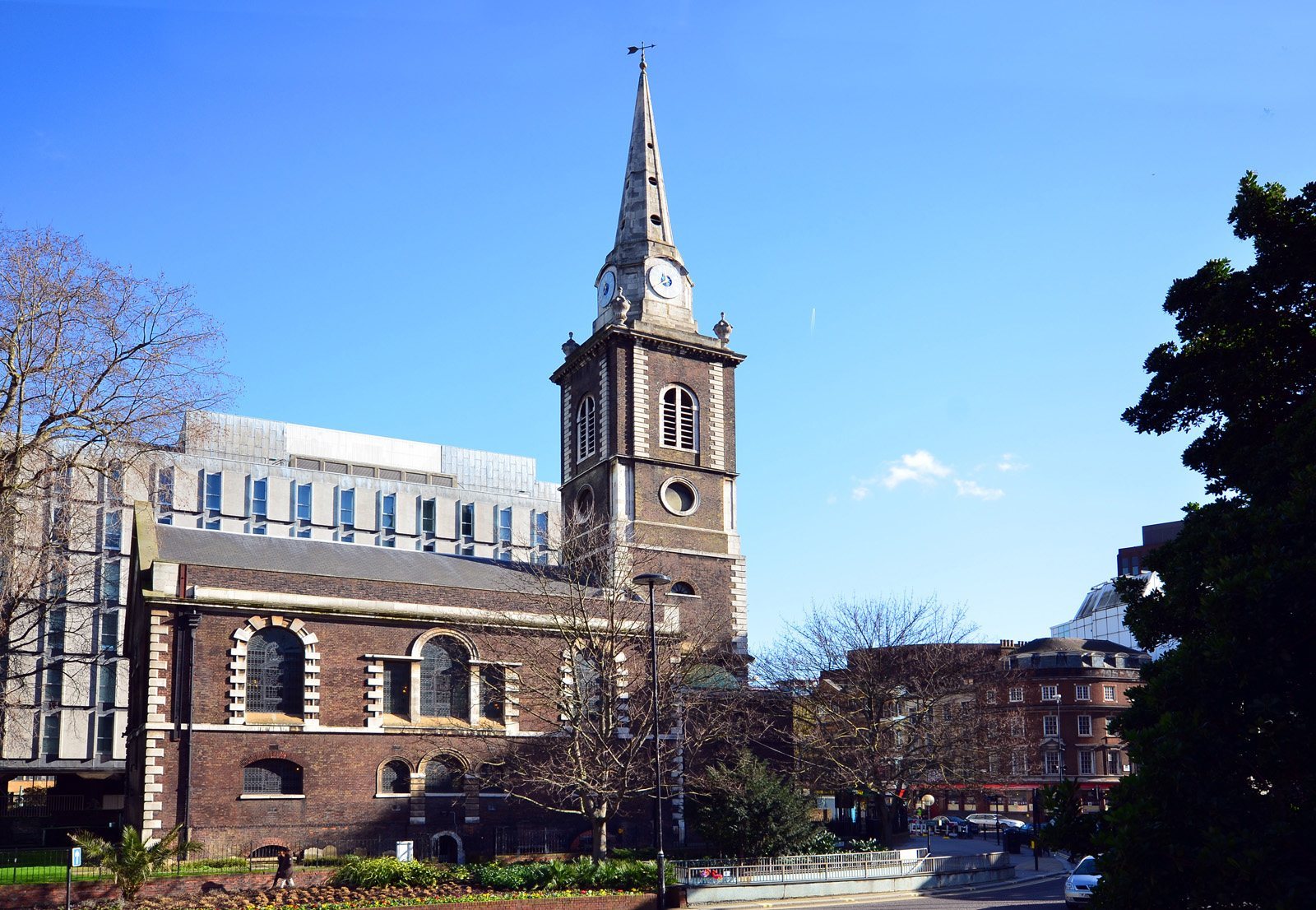
The church stands at the junction of Houndsditch and Aldgate High Street, about 30 yards beyond the former position of Aldgate, a gate in the London Wall. It occupies a traffic island that also contains Aldgate tube station. The Georgian building is constructed of brick, with projecting stone corner blocks, stone surrounds around the windows, and a projecting stone molding at the top of the walls. Its brick tower has rough-finished corner blocks and a stone spire shaped like an obelisk.
Interior and memorial features
Layout and decoration
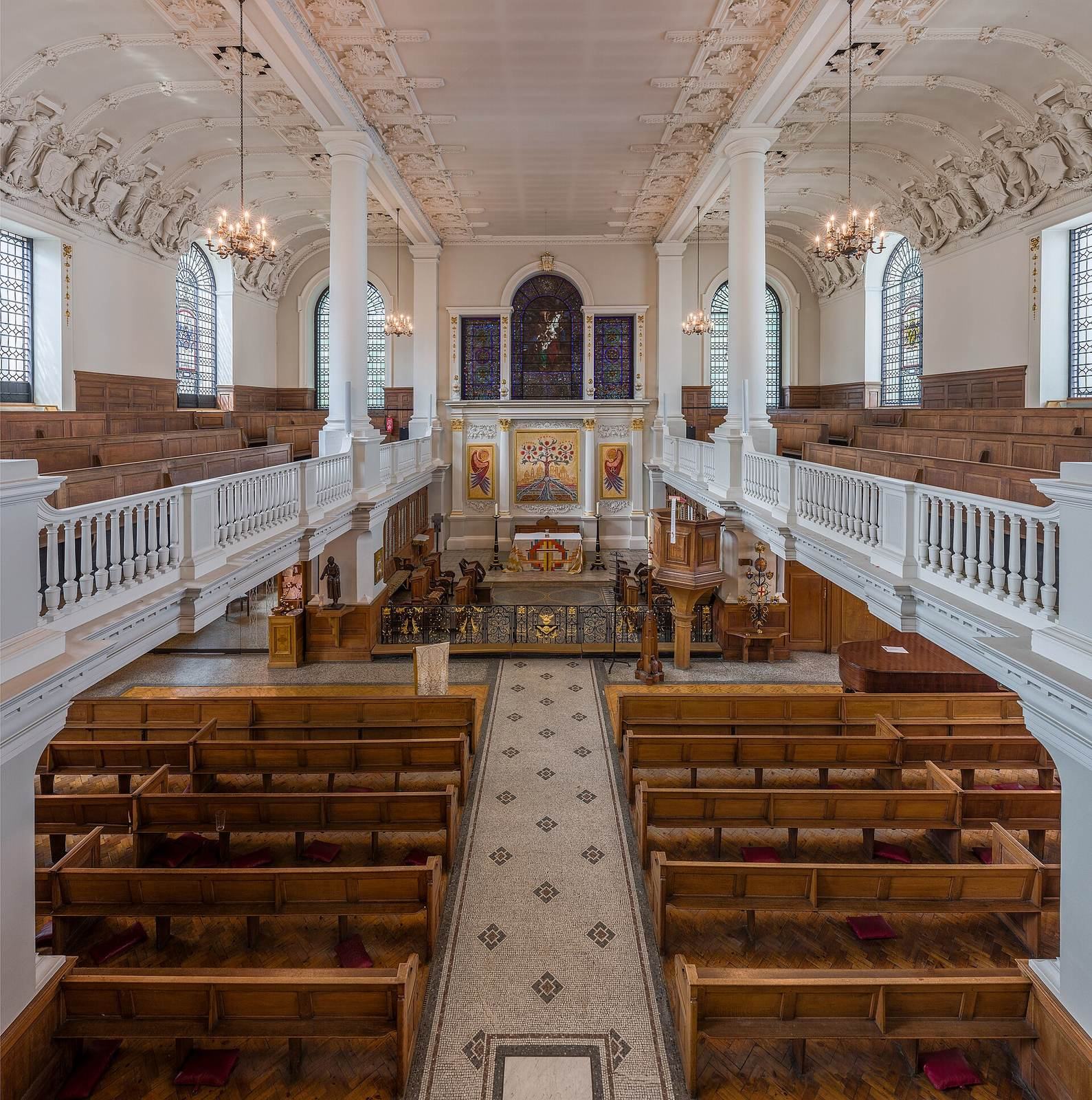
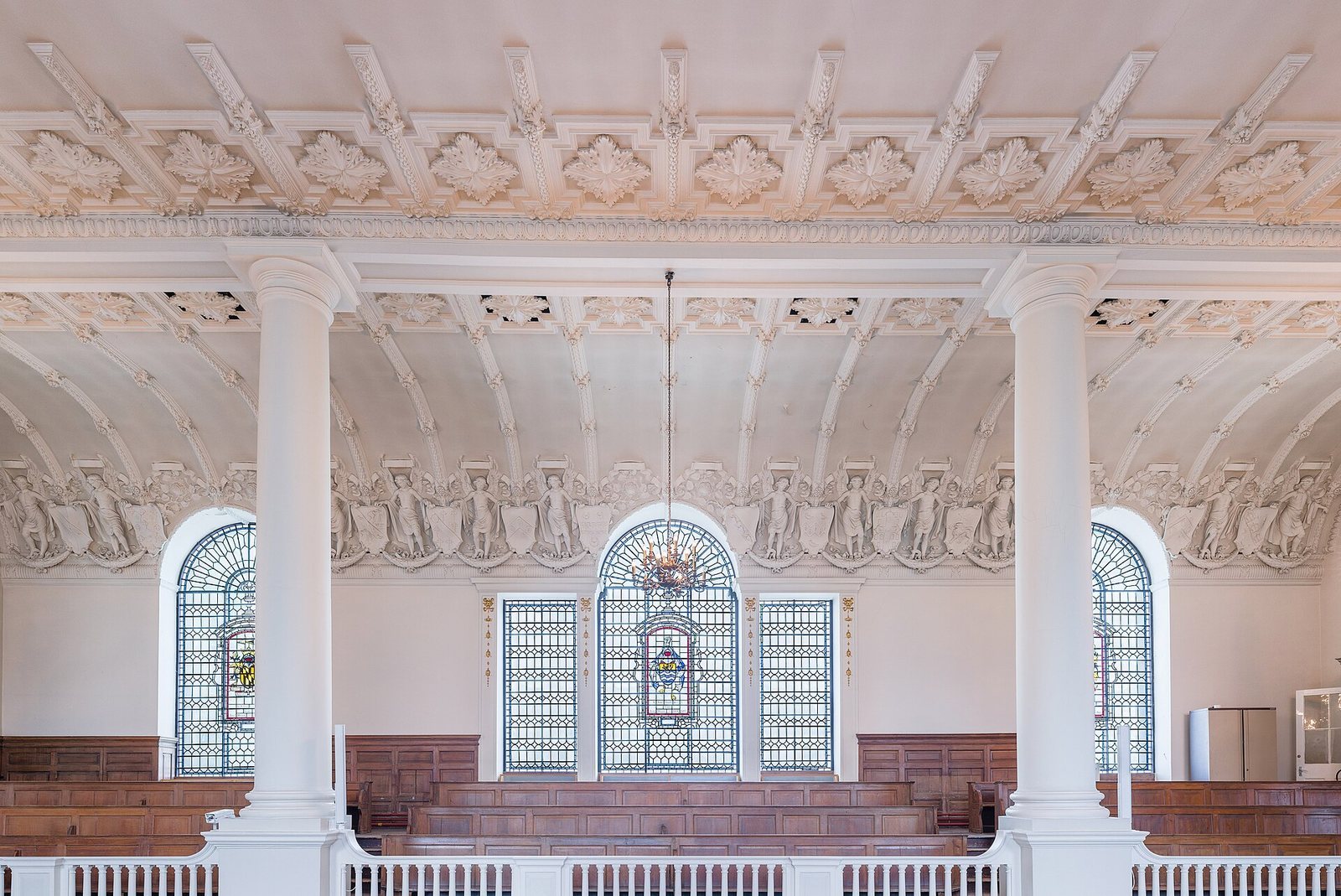
Four widely spaced supporting columns divide the nave, the church’s central space, from its side aisles and support a flat ceiling. Galleries run along three sides of the interior. On each side wall, one row of windows sits above the gallery and another below it. In the late 19th century, John Francis Bentley redecorated the interior. Work carried out from 1888 to 1893 added a plaster-like stucco ceiling decorated with angels and galleries with white balustrades.
Memorials
Monuments from the earlier church were transferred into the present building. A memorial to Sir Arthur Darcy commemorates his father, Thomas Darcy, and his father-in-law, Nicholas Carew, both executed for rebellion by Henry VIII. Thomas Darcy, first Baron Darcy de Darcy, is also among those buried at the church. A wall tablet commemorates Thomas Bray.
Stained glass
A large window behind the altar, dating to 1857, is based on Rubens’s Descent from the Cross. Most of the church’s stained glass dates from 1969 to 1972 and commemorates former Portsoken aldermen, elected representatives of the ward, who became Lord Mayor of London.
Wartime floor tablet
A tablet in the floor marks the spot where a fragment of a bomb fell through the roof and became embedded. It commemorates the 1941 “longest night” of the London Blitz, the wartime bombing of the city, and records that 1,486 people were killed in London.
Churchyard
The earliest record of the churchyard dates to 1230. By 1875 it was in use as a public open space, and Fanny Wilkinson laid it out as a public garden in 1892. A drinking fountain installed in 1906 in memory of philanthropist Frederic Mocatta remains there.
Organ
Thomas Whiting donated the organ in 1676. It was built between 1702 and 1704, with Renatus Harris credited as its builder, although others may also have contributed. John Byfield enhanced it in 1740 for the new church. During the rebuilding, the organ was stored and then restored by John Byfield the Elder, who made a small alteration to its stops, controls that select sets of pipes. William Hill & Sons altered it in 1866, and J. C. Bishop & Son did so in 1898. Mander Organs rebuilt it in 1966.
The organ has 21 stops, three manuals, or hand-played keyboards, and a pedal keyboard. Most of its pipework and one air-supplying wind chest survive, and its pipes remain in their original positions on their original wind chests. A decision to restore the instrument was made in 2002. Goetze and Gwynn carried out the nine-month restoration under Ian Bell’s consultancy, returning it to its 1744 specification with many original components. The organ was reinstalled in May 2006 and is among England’s oldest functioning church organs.