Leadenhall Market: A Historic Covered Market in London
Site at a Glance
- Rating
- 4.4
- Popularity
- Very High
- Country
- United Kingdom
- Primary era
- Modern
- External website
- Open
- Eras represented
- Modern
- Civilizations
- British
- Site type
- Economic
- Remains
- Market
On this page9 sections
History
Leadenhall Market is a historic market in the United Kingdom, located in London’s City of London, whose present iron-and-glass structure dates from 1881 and includes a principal entrance in seventeenth-century Dutch style. Its origins reach back to a poultry market near Leadenhall manor, mentioned in 1321, and its long development reflects the changing commercial life of the City, London’s historic municipal and financial core.
Medieval foundation and expansion
By 1397, sellers of cheese and butter were required to trade at Leadenhall. In 1408, the manor’s lease was entrusted to Richard Whittington, a London merchant who served several times as Lord Mayor, together with other citizens. The Corporation of the City of London acquired full ownership in 1411. The property had previously belonged to Sir Hugh Neville, a medieval landowner, and was also described as having been given to the City through Whittington.
A foundation date of 1440 is recorded. In 1445, Lord Mayor Simon Eyre, a London merchant, definitively converted the manor into a permanent market. He added a public granary, a school, and a chapel, while the market expanded its food trade to include poultry, dairy products, grain, herbs, and other provisions. Wool, leather, and cutlery were later sold there as well.
Market life from the seventeenth to nineteenth centuries
During the reign of Charles II, the restored Stuart king who ruled England, Scotland, and Ireland from 1660 to 1685, Leadenhall was regarded as a wonder. A Spanish ambassador reportedly told the king that the market sold more meat than the whole kingdom of Spain. The Great Fire of London in 1666, the urban fire that destroyed much of the City, affected Leadenhall only slightly. Afterward, it was converted into a covered market divided into clearly separate sections.
For many years, Leadenhall was London’s principal market for poultry and game. It was also associated with wholesale trade in meat, fish, vegetables, leather, skins, and bacon. Women, often elderly, carried heavy consignments of meat from the market to nearby butchers’ carts. The chapel survived until June 1812, when it was demolished. By the nineteenth century, Leadenhall was no longer chiefly associated with beef and was regarded as London’s largest and best poultry market.
A celebrated market animal was Old Tom, a gander that escaped the butcher in the late eighteenth century. Traders cared for and fed him until his death in 1835 at the age of 38. He was buried at the market, where a commemorative plaque was installed.
The Victorian market and later commerce
In 1881, City architect Sir Horace Jones replaced the earlier stone building with the present market structure. Jones was also responsible for Smithfield Market and Old Billingsgate Market, and intended Leadenhall to function as a tourist attraction as well as a commercial building. During the twentieth century, its trade gradually diversified and moved increasingly from wholesale commerce toward retail business.
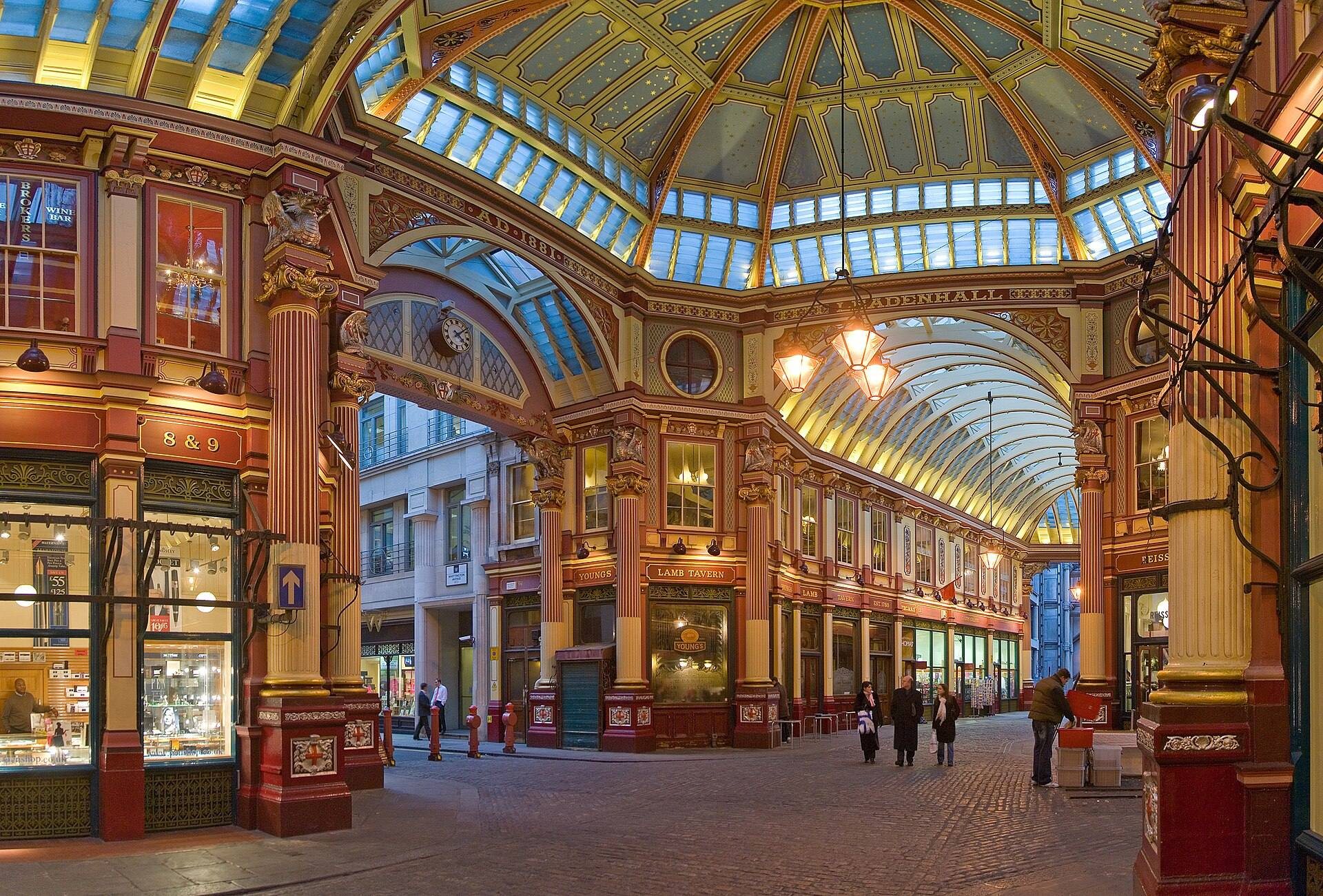
Leadenhall Market now combines food retail with specialist shops, restaurants, bars, and other businesses. Its food trade includes fish, meat, cheese, and delicatessen goods, while its commercial occupants include cheesemongers, butchers, florists, hairdressers, and clothing retailers. The Lamb Tavern, which dates from 1780, remains a traditional meeting place for insurance-industry workers, including many employed at the adjacent Lloyd’s of London insurance marketplace. Leadenhall Market has been a Grade II* listed building since 1972, a designation providing a high level of statutory protection to buildings of particular importance. Redecoration in 1990–1991 enhanced its architectural character and detail, and the scheme received a special mention in the 1994 Civic Trust Awards.
Remains
Leadenhall Market occupies the historic centre of the City of London, on a site associated with Roman London, the settlement established in the area during Roman rule in Britain. The covered market stands between Gracechurch Street and Lime Street, south of Leadenhall Street. Its present buildings form a spacious covered complex of arcades, wrought iron, and glass roofing, with paved or cobbled walkways and several narrow pedestrian passages.
The covered market structure
Gracechurch Street entrance
The principal entrance on Gracechurch Street is a tall, double-height composition made from red brick, narrow gables, and Portland-stone blocks. Its design follows a seventeenth-century Dutch style, giving the entrance a distinct architectural identity within the market complex.
Southern retail frontage
The buildings adjoining the southern side have a continuous retail frontage. Narrow entrances interrupt this frontage and lead into pedestrian passages running through the market.
Arcades and roof
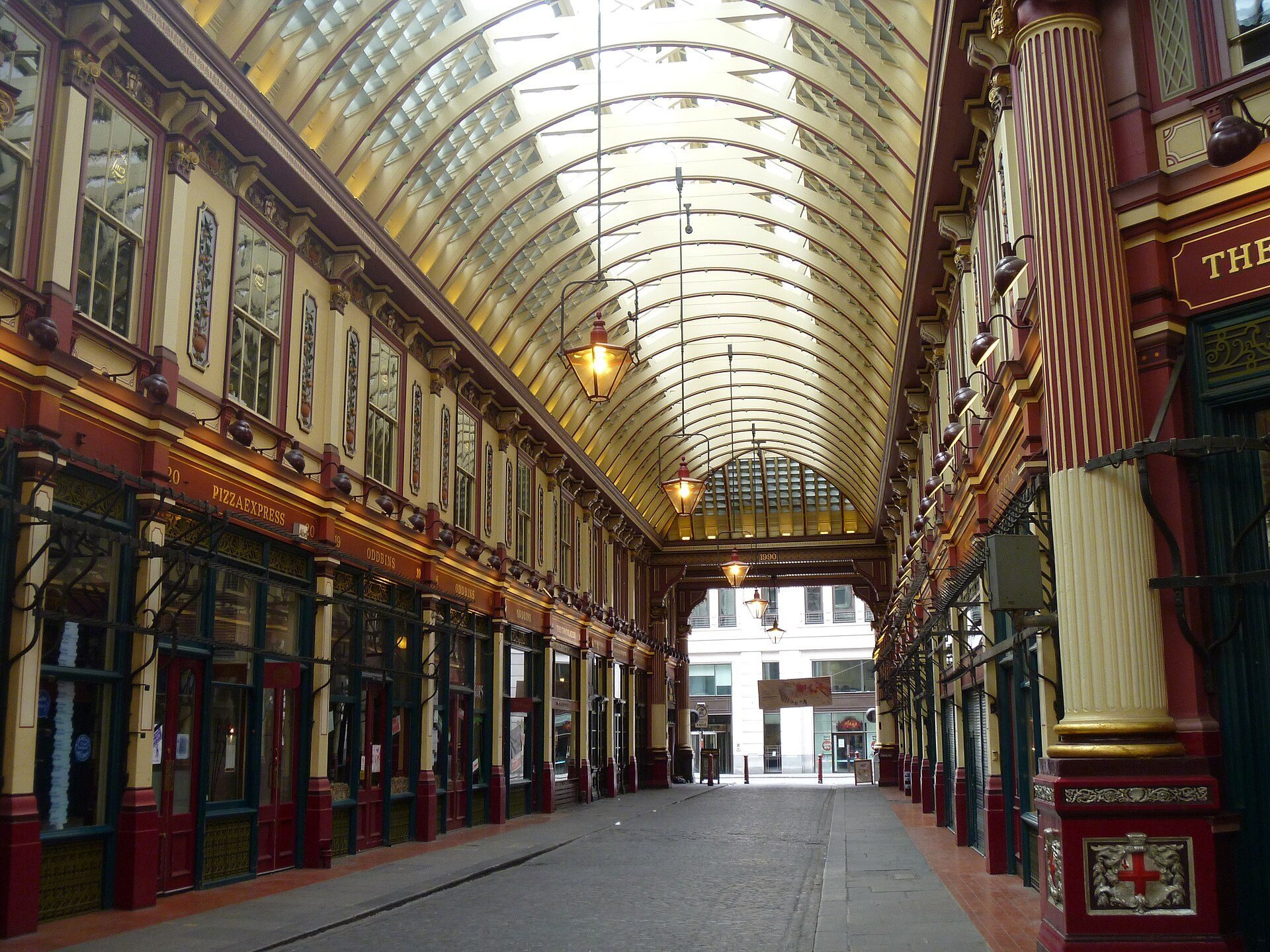
Inside, arcades support the market’s wrought-iron framework and glass roof. The ornate roof structure is painted green, maroon, and cream, while the paving and other visible elements are described in brown and cream tones. Together, these materials form the surviving architectural setting for the market’s shops and commercial spaces.