St Bartholomew’s Church: Themar’s Late Gothic Protestant Parish Church
Site at a Glance
- Rating
- 4.4
- Popularity
- Very Low
- Country
- Germany
- Primary era
- Medieval
- External website
- Open
- Eras represented
- Medieval, Early Modern, Modern
- Civilizations
- Holy Roman Empire
- Site type
- Religious
- Remains
- Church
On this page10 sections
History
St Bartholomew’s Church is a listed Protestant Lutheran parish church in Themar, Germany, completed in 1502 as a late Gothic hall church with a choir. Dedicated to St Bartholomew, one of the Twelve Apostles, it is one of the few buildings in the town to have survived the major upheavals of Themar’s history. The church also reflects the town’s long association with clothmaking, tanning, and rafting, and is regarded as one of the most richly furnished churches in the upper Werra valley.
Medieval Foundations and Construction
Themar was first documented in 796. Its earliest places of worship were the Oberkirche at the upper gate and the Unterkirche near the Werra. The present church replaced this earlier religious setting, while parts of the Romanesque Unterkirche remained incorporated into the vestry and the lower portion of the tower.
Pope Sixtus IV authorized a new church on 14 May 1484 through the mediation of Countess Margaretha of Henneberg. On 3 May 1488, Antonius König, a canon of the Premonstratensian monastery at Veßra and parish priest of Themar, laid the foundation stone. The late Gothic church and its choir were completed in 1502.
Reformation and Later Development
The Reformation, the sixteenth-century movement that brought major changes to Western Christianity and established Protestant churches, was introduced in Themar on 5 October 1544 by Count Ernst von Henneberg. From 1541 onward, the church received a barrel vault and double galleries. During the decades that followed, several smaller carved altars from other churches were brought into the building, and its interior was repeatedly altered.
During the Thirty Years’ War, the European conflict of 1618 to 1648 that devastated many towns and churches in central Germany, Croatian troops plundered and burned Themar on 16 October 1634 after the Swedish defeat at the Battle of Nördlingen. The town church was set on fire as well. A devout Italian officer ordered the flames extinguished when they approached the Marian altar, sparing the church from destruction.
Musical and Modern History
Georg Christoph Bach, the oldest uncle of Johann Sebastian Bach, served as cantor at St Bartholomew’s Church and taught at Themar’s Latin school from 1668 to 1684. He then moved to Schweinfurt, where he became the ancestor of the Schweinfurt branch of the Bach family.
The interior was renovated in 1972. The organ received fundamental renewal and restoration in 1999 and 2000 from Rösel & Hercher Orgelbau. The church and its historical fabric are protected as a listed monument and form part of Thuringia’s cultural heritage.
Remains
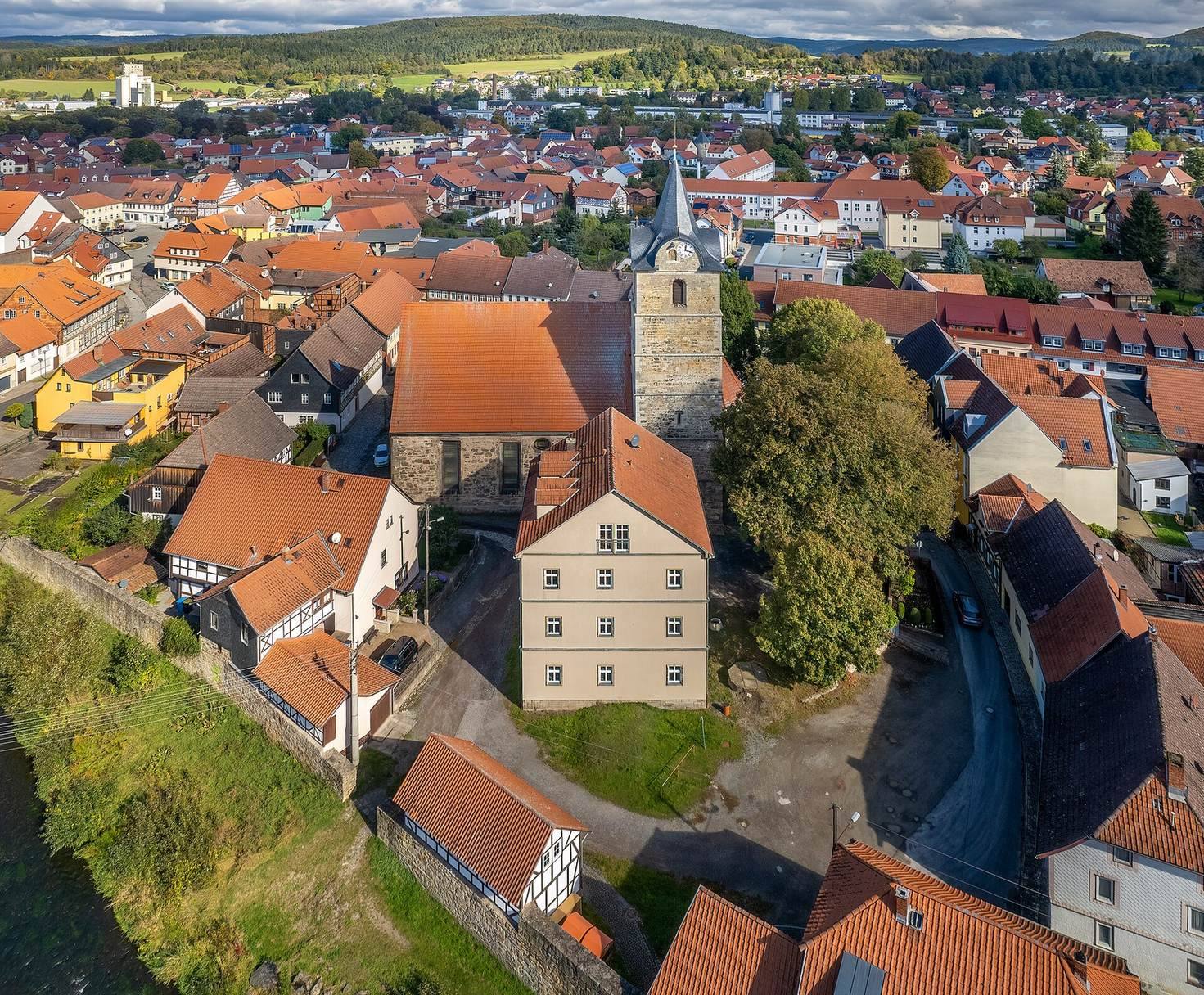
St Bartholomew’s Church is organized as a late Gothic hall church, with the nave and side aisles forming a broad interior of approximately equal height, a choir, and a Renaissance-style tower. Earlier Romanesque fabric survives in the vestry and in the tower’s two lowest floors, linking the present building to the Unterkirche that preceded it.
Vault, Galleries, and Interior Sculpture
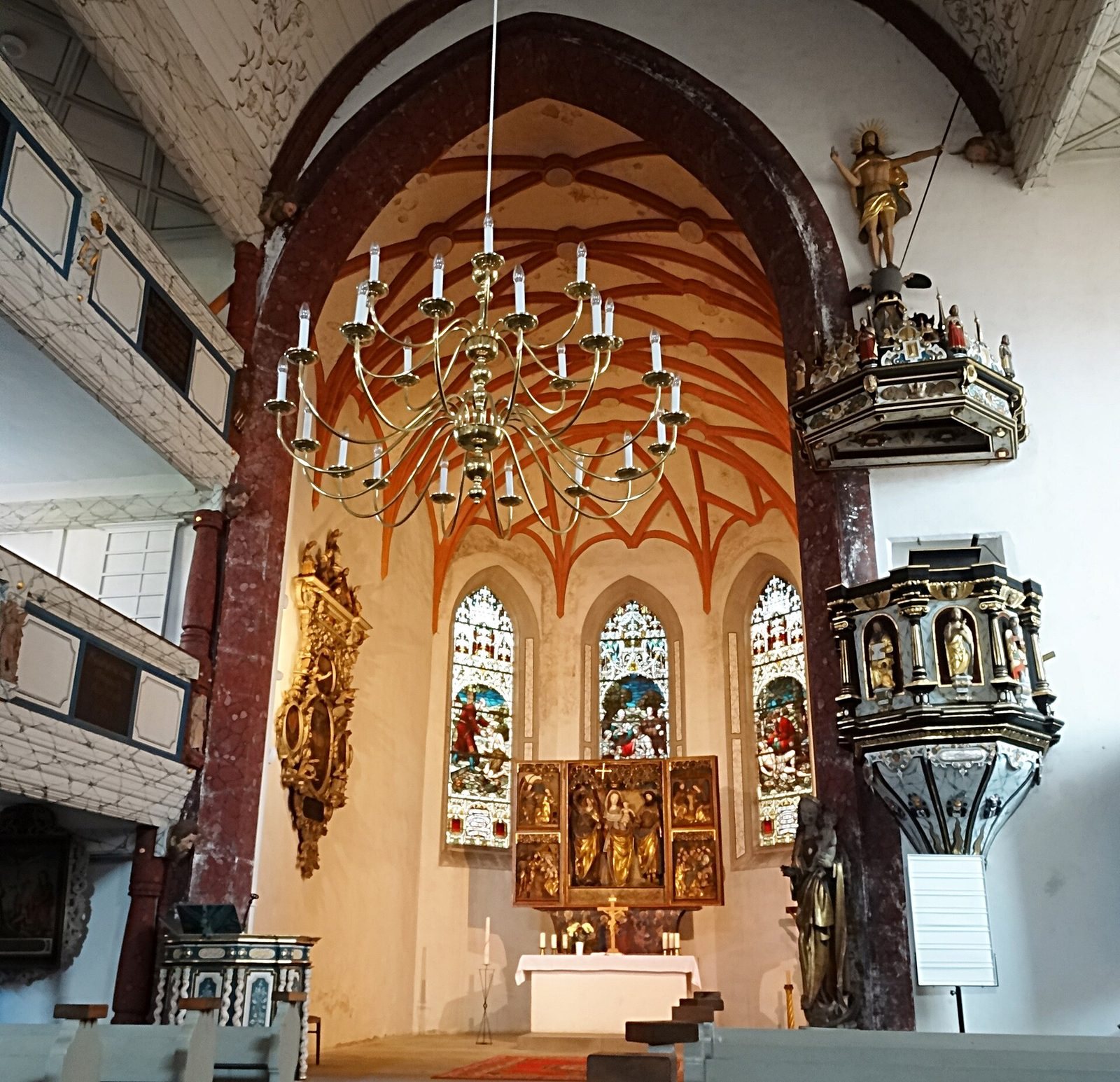
The barrel vault and double galleries are supported by beams decorated with Bartmann heads, carved representations of bearded male faces. Similar sculptures occur in the churches of Rohr and Herpf near Meiningen. Reliefs of saints and apostles decorate the gallery columns, with some of the carvings reused from older Gothic altarpieces. Biblical quotations are attached to the galleries, including a passage from Romans 10:16–17 opposite the pulpit.
Choir Altars and Painted Wings
The Marian altar in the choir was created around 1510 by Hans Nußbaum of Bamberg. Its central panel presents Mary with the Christ Child, the Archangel Michael killing the dragon with his lance, and St Bartholomew. The wings show the Annunciation, the Nativity, the Adoration of the Magi, and the Apostles’ Lamentation of Mary. On their reverse sides are painted female saints, Barbara, Dorothy, Margaret, and Catherine. The predella, the lower section of an altarpiece, depicts the Holy Kinship, a subject concerned with the family relationships of Jesus and Mary.
An Apostles’ shrine dating from around 1500 is popularly called the “Nose Altar” because its figures have strongly expressive noses and mouths. Paintings on the reverse of its wings show the Apostles’ Farewell. A pilgrimage altar stands on the north wall, where the reverse of one wing depicts the “Chicken Miracle” associated with Santo Domingo de la Calzada, a medieval Spanish saint linked with the Way of St James.
Nave and Liturgical Furnishings
A Pietà altar stands on the south wall of the nave. The Pietà represents the dead Christ mourned by Mary. The church also contains a High Gothic crescent-moon Madonna, showing Mary standing on a crescent moon, and a Renaissance-style epitaph, a commemorative monument, in the choir.
A fresco of St Catherine was uncovered in 1935. The pulpit dates from 1644 and has a richly decorated sounding board, the canopy above the pulpit, together with an ornamented pulpit basket. An Epistle reading desk from the mid-seventeenth century, used for reading a New Testament letter during worship, and several other paintings are also preserved.
Windows, Organ, and Bells
The choir windows contain stained glass donated around 1900. Their scenes represent the Prodigal Son, the Blessing of the Children, and the Good Samaritan. The organ was built in 1851 and 1852 and is now attributed to Michael Schmidt of Schmiedefeld am Rennsteig rather than to Johann Michael Holland. Three pedal stops came from a Weise organ built in 1629. In 1866, the instrument was moved to the enlarged second west gallery.
Tower and Bell Structure
The Renaissance-style tower contains three bells. One was cast in 1488 and another in 1507. The Bartholomew bell, cast in 1520, was surrendered in 1942 and replaced by a steel bell in 1955.
Until the mid-1950s, the tower housed the Rust family of tower guards. Their three living rooms remain visible, as does the external winch once used to raise food, water, and coal to the apartment.