Sant Pere de Galligants: A Romanesque Benedictine Abbey in Girona


Site at a Glance
- Rating
- 4.5
- Popularity
- Medium
- Country
- Spain
- Primary era
- Medieval
- External website
- Open
- Eras represented
- Medieval
- Civilizations
- Crown of Aragon
- Site type
- Religious
- Remains
- Monastery
On this page8 sections
History
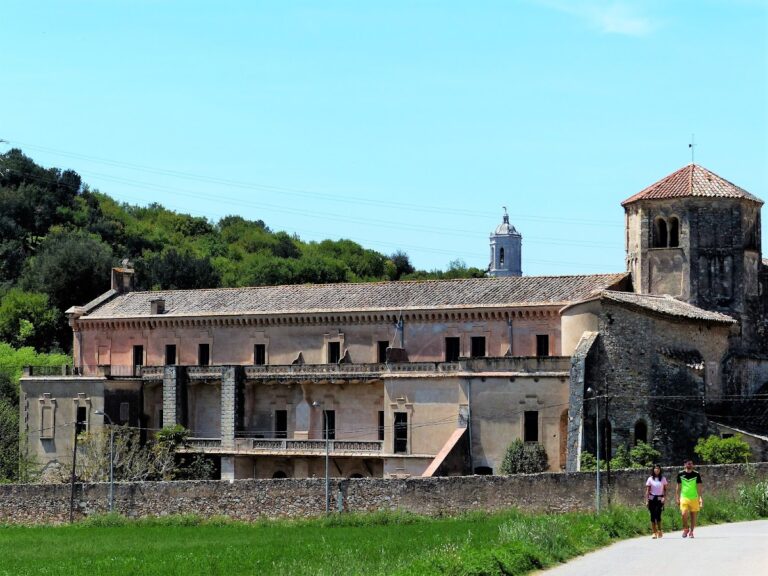
Sant Pere de Galligants is a former Benedictine abbey in Girona, Spain, whose present church was built in 1130 in the Romanesque style. Its documented development began outside Girona’s walls in 992, when Ramon Borrell, Count of Barcelona, granted the monks rights over the Sant Pere quarter beside the Galligants River. He strengthened that connection with an important bequest to the monastery in his testament a few years later.
Monastic development and union with Lagrasse
In 1117, Ramon Berenguer III united Sant Pere with Sainte-Marie of Lagrasse in the Languedoc. Sant Pere retained its own abbot and substantial autonomy, although the union continued. By the following century, it was largely formal. The abbey remained a small Benedictine community consisting of an abbot, six monks, and six other clerical members.
The monastery was associated with the parish of the Sant Pere quarter, but most parish services took place at the nearby church of Sant Nicolau. Baptisms were conducted at Sant Pere, giving the abbey a continuing religious role within the quarter.
Encasement within Girona and later decline
The monks controlled the Sant Pere quarter until 1339, when Peter IV of Aragon recovered the Crown of Aragon’s rights over it. The expansion of Girona’s walls in 1362 brought the monastery within the fortified city. At that time, the bell tower was remodelled for a more defensive purpose.
Sant Pere began to decline during the fifteenth century. In 1592, it was united with the declining monasteries of Sant Miquel de Cruilles and Sant Miquel de Fluvia, but the arrangement did not revive monastic activity. When the abbey closed and underwent exclaustration in 1835, its community consisted of an abbot and four monks.
From monastery to museum
Since 1857, the former monastery has housed the Girona venue of the Archaeology Museum of Catalonia. The complex was declared a national monument and designated an Asset of Cultural Interest in Spain’s historic heritage in 1931.
Remains
Church layout and Romanesque sculpture
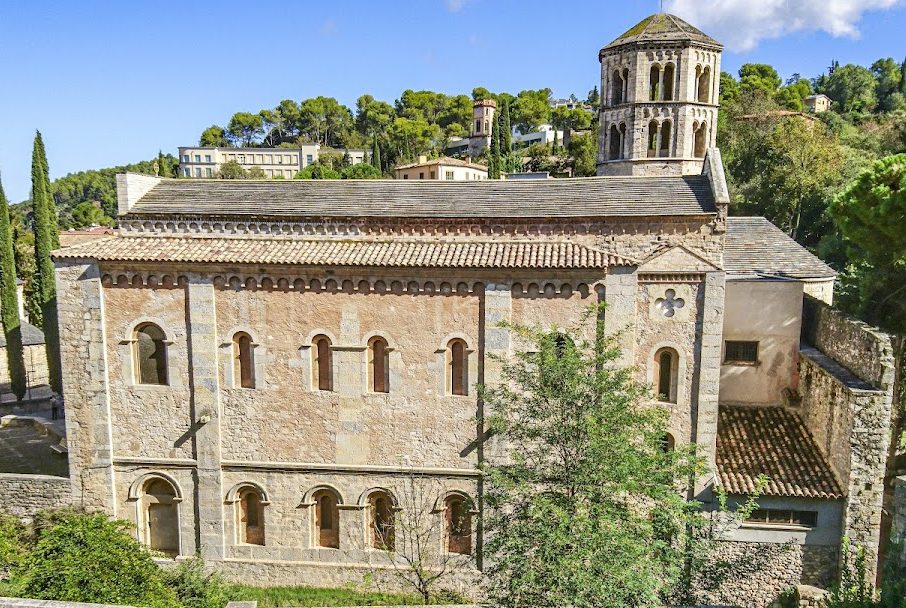
The surviving church follows a Romanesque plan with three naves, a transept, and four apses. One apse aligns with the central nave, two stand on the epistle side, and another lies beneath the bell tower. The main portal may belong to the earlier building beneath the present church. Its plain arches rest on fluted columns with capitals carrying geometric and zoomorphic designs. Above it, a rose window approximately 3.5 metres across dominates the facade through its elaborately carved stonework.
Attached columns run along the central nave, and their capitals bear vegetal motifs. The columns support the transverse arches that reinforce the central vault. The capitals of the triumphal arch before the central apse are considerably more elaborate, indicating the participation of different artists. Some of this sculpture is attributed to the Master of Cabestany, the conventional name for an unidentified twelfth-century sculptor or workshop associated with distinctive Romanesque stone carving in Catalonia and neighboring regions.
Bell tower and apses
The octagonal bell tower is divided into two principal levels or sectors. Its upper part contains paired windows separated by columns and is decorated with Lombard-style lesenes, arcaded friezes, and bands. The tower’s remodelling in 1362 adapted it to the monastery’s new position inside Girona’s walls. The exterior apses are plain apart from a central window opening.
Cloister
A small cloister is attached to the south side of the church and is regarded as an important example of Catalan Romanesque architecture. Its north gallery dates from 1154, while the other galleries date from 1190. The capitals use themes similar to those at the cloisters of Sant Cugat del Valles and Girona Cathedral. Some show scenes from the life of Jesus, while others feature Romanesque motifs including lions and sirens.