St. Barbara Church in Ortrand: A Late Gothic Hall Church in Germany
Site at a Glance
- Rating
- 4.4
- Popularity
- Very Low
- Country
- Germany
- Primary era
- Early Modern
- External website
- Open
- Eras represented
- Early Modern, Modern
- Civilizations
- German, Holy Roman Empire
- Site type
- Religious
- Remains
- Church
On this page9 sections
History
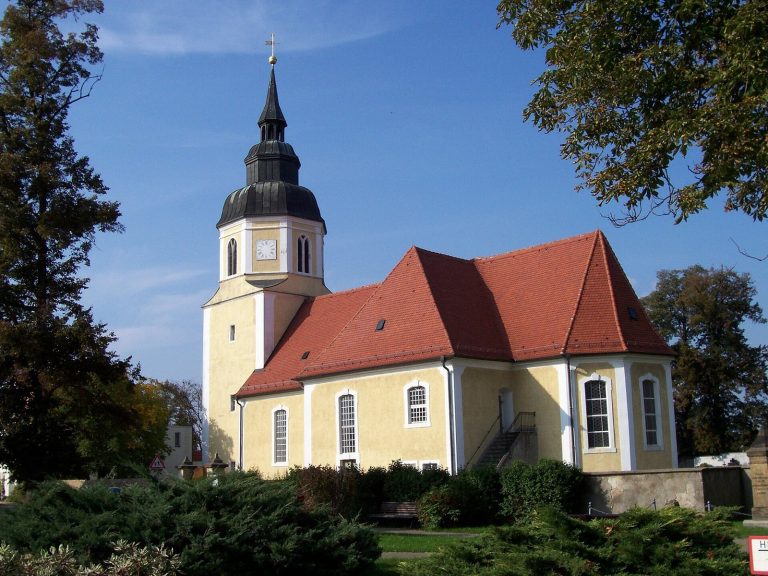
St. Barbara Church in Ortrand, Germany, is a protected historic church developed by the Christian community of Ortrand from an earlier chapel in the late Gothic period. Its construction began in 1563 after the Jakobuskirche required major repairs, and the building was rededicated in 1627 after destruction and reconstruction.
Medieval chapel and sixteenth-century rebuilding
The church grew from an earlier Barbara chapel, recorded in 1346 as Capella Barbarae in the register of the Meissen diocese. Saint Barbara is a Christian martyr traditionally associated with protection against sudden death, storms, and explosions. In 1563, the chapel was converted into a larger church because the Jakobuskirche was in need of extensive repair.
Benjamin Schimmer of Königsbrück directed the work between 1563 and 1565. A foundation inscription on the eastern side gives 18 May 1563 as the beginning of construction and identifies Schimmer as the builder. This phase established the church as a late Gothic, three-nave hall church.
Fire, reconstruction, and Baroque remodelling
A town fire destroyed the church completely in 1612. Reconstruction lasted until 1627 and was delayed when the Thirty Years’ War began. This major European conflict, fought from 1618 to 1648, interrupted the rebuilding period, and the Jakobuskirche served as the place of worship while work continued. St. Barbara Church was rededicated on 12 August 1627.
Another town fire, on 19 April 1707, damaged the church while leaving it standing. The surrounding buildings were destroyed. Repairs and remodelling followed between 1728 and 1732 under the main direction of George Bähr, a German architect associated with major Baroque churches including Dresden’s Frauenkirche. During this work, the damaged tower above the sacristy was demolished. Further repairs took place in 1772, 1821, 1872, 1895, and 1928.
Twentieth-century changes and conservation
The church’s bronze bells were melted down during the First World War. Three steel bells replaced them in 1920. In 1934, the council gallery was demolished, special pews were removed, and the side galleries were rebuilt. During the 1960s, the altar wall was dismantled and a new pulpit was installed.
The tower and exterior plaster were repaired in 1983 and 1984. On 17 November 1984, a gilded tower knob with a star was installed during a commemorative ceremony. Friedrich Press, a German sculptor and church artist known for individually conceived ecclesiastical interiors, redesigned the interior between 1986 and 1988 around the theme “Through Suffering to Resurrection.”
The organ’s changing history
Johann Friedrich Turley built the existing organ in 1847. Arno Voigt’s organ-building workshop converted it in 1918, and Reinhard Schmeisser rebuilt it between 1952 and 1955, causing further loss of its original substance. After the instrument deteriorated, restoration and reconstruction began in 2022 with donations and grants. In 2024, four registers not preserved in any other Turley instrument were added to its original specification.
St. Barbara Church is listed in Brandenburg’s register of monuments under number 09120216.
Remains
Church structure and exterior
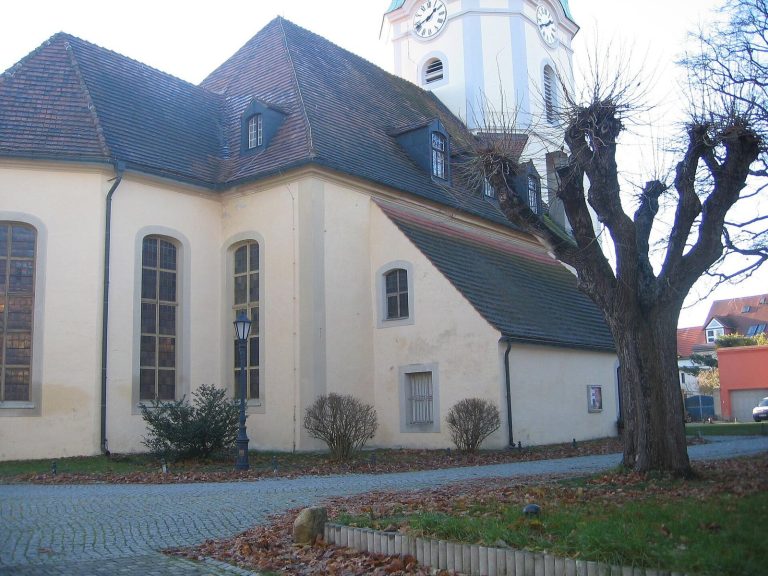
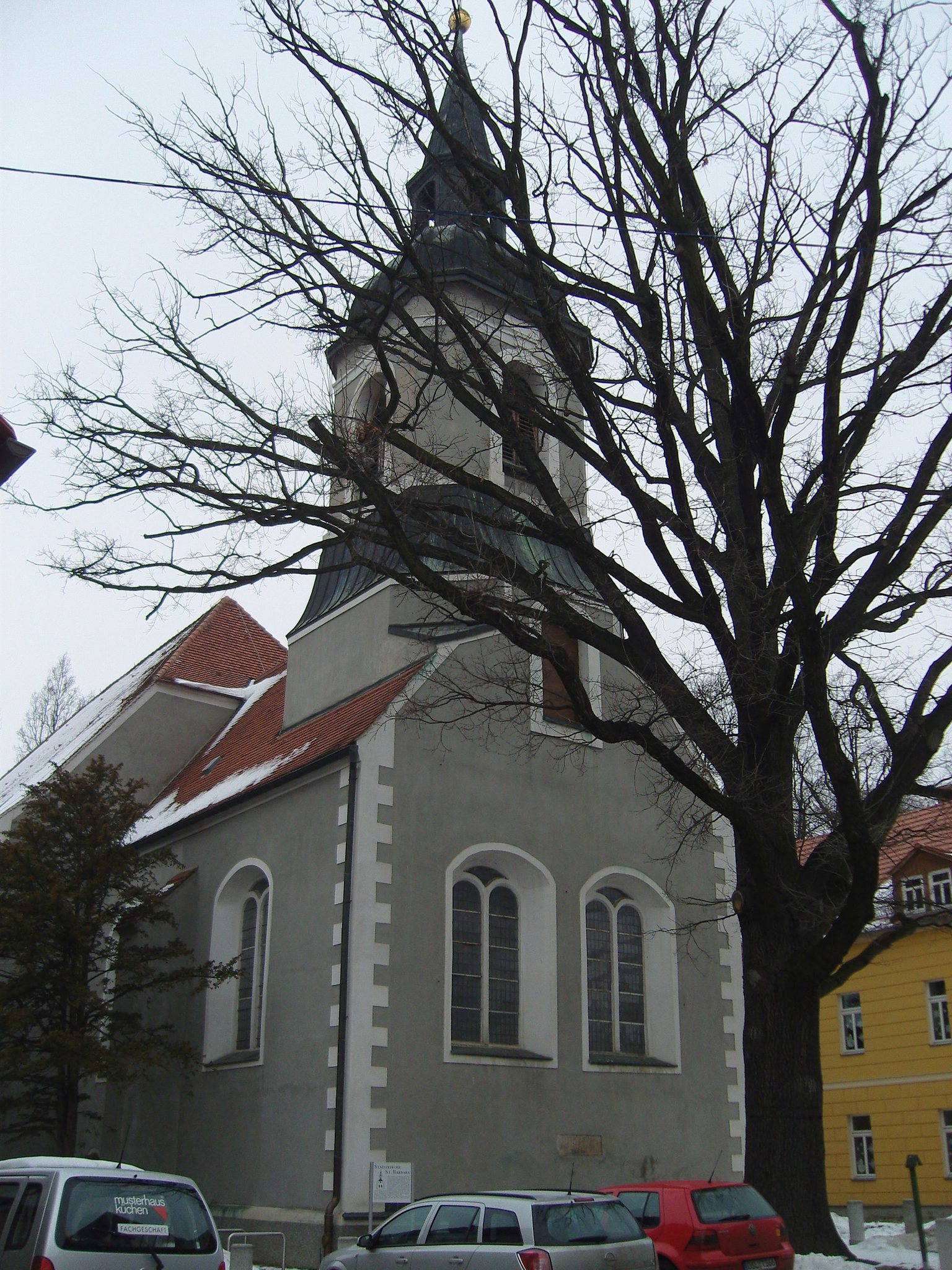
St. Barbara Church survives as a late Gothic hall church with three naves. The roof above the altar area carries a roof turret, a small tower rising from the roof rather than from the ground. It has a cap, lantern, and tower knob. The earlier tower on the north side had been built over the former sacristy before it was removed during the remodelling of 1728 to 1732.
The eastern exterior preserves the foundation inscription associated with the sixteenth-century rebuilding. Its abbreviated wording is interpreted as stating that the church was founded by Benjamin Schimmer on 18 May 1563. The southern portal in the choir dates from 1627, while the northern portal in the nave dates from 1629. Both have fittings decorated with flat-cut ornament, a technique in which designs are incised into a relatively shallow, flat surface.
Altar area and furnishings
The altar area is dominated by a large cross that widens toward its upper part and represents the Resurrection. Its widening cleft refers to Matthew 27:51, while a trail of blood recalls the crucifixion. Christ is not shown on the cross.
Figures representing the disciples stand beneath the cross, with one pointing toward the mother of Jesus. The altar also brings together an indicated six-pointed Star of David and a sacrificial lamb, whose head appears at the lower right. This arrangement expresses the end of sacrifice through Jesus’s death and recalls the historical persecution of Jews by Christians, including the Holocaust.
Baptismal water is supplied from a large basin at ground level that is continuously filled with fresh water. A stained-glass window depicts Jesus in the Garden of Gethsemane.
Organ and bells
Turley’s organ originally contained 18 registers distributed across two manuals and a pedal. A register is a selectable set of organ pipes with a particular tone, while a manual is a keyboard and the pedal is the foot-operated keyboard. Voigt’s 1918 technical rebuilding created an instrument with 23 registers, 19 of them speaking, and pneumatic action for both playing and registration while retaining most of Turley’s registers. It is the largest preserved and only two-manual Turley organ.
The three steel bells installed in 1920 weigh 14, 23, and 42 Zentner respectively. In modern German usage, a Zentner corresponds to 50 kilograms.