St. Adalbert: A Historic Collegiate and Parish Church in Aachen


Site at a Glance
- Rating
- 4.4
- Popularity
- Low
- Country
- Germany
- Primary era
- Modern
- External website
- Open
- Eras represented
- Medieval, Modern
- Civilizations
- German, Holy Roman Empire
- Site type
- Religious
- Remains
- Church
On this page15 sections
History
St. Adalbert is a church in Aachen, Germany, founded as a medieval Romanesque collegiate church and consecrated in 1005. Its creation was promoted by Emperor Otto III in honour of Adalbert of Prague, a bishop and missionary canonized in 999, and Hermes of Rome. It became the second-oldest church in Aachen after Aachen Cathedral and developed into an imperial foundation with an important chapter, parish, and relic treasury.
Imperial foundation
Otto III had been a friend and admirer of Adalbert of Prague. After Adalbert’s death in 997 and canonization two years later, the emperor arranged for his relics to be distributed among selected churches and ordered a church at Aachen dedicated to Adalbert and Hermes. Otto died before the project was complete. His successor, Henry II, finished the church and its associated buildings, which were consecrated in 1005. Among the relics given to the new foundation were the skull relics of both patron saints.
The clergy installed under imperial authority formed a collegiate chapter, a community of canons serving a church rather than monks living in a monastery. The chapter initially had about 20 canons under a provost. St. Adalbert was established as a legally free imperial collegiate church and, like the imperial city of Aachen, belonged to the Diocese of Liège. From 1018, the church also held parish rights, including the right to baptize. The crypt served parish Masses, while the main church was intended for the canons.
Chapter lands and medieval expansion
The collegiate chapter acquired extensive agricultural estates. Its holdings in 1005 included Soiron, Olne, and Lendersdorf. Other properties followed, including part of Mook in 1018, part of Vaals in 1041, Baesweiler in 1130, and Eilendorf in 1238. Between 1005 and 1059, the newly built Church of St. Salvator on Salvatorberg was also assigned to the chapter before an imperial decree transferred it to the Münster collegiate foundation.
At the end of the thirteenth century, the construction of Aachen’s outer city wall brought the church within the territory of the imperial city. The Adalbert Tower and Adalbert Gate were built beside the church property during related works in the early fourteenth century. The church’s association with the city’s religious and civic structures continued through the later Middle Ages. A bell named for Mary Magdalene was installed in 1410, and a Laurence bell cast in 1523 by the Aachen founder Johannes of Trier was added later. Neither bell survives.
Relics and the end of the collegiate foundation
The relic treasury grew through donations to as many as 22 individual relics. Some fragments were later transferred elsewhere. In 1608, Ernst of Bavaria, archbishop of Cologne, received relics of Saint Stephen, Quirinus of Neuss, and Mary Magdalene. In 1698, the Adalbert Church in Liège received particles from Adalbert’s head. A relic of Emperor Henry II came from Bamberg in 1932.
French occupation began in 1794. Napoleon Bonaparte dissolved the free imperial collegiate foundation by decree on 9 June 1802, ending its former institutional status. The church remained a parish church within the Diocese of Aachen. In 1809 it underwent its first major reorganization, and parish Masses were transferred from the crypt into the main church.
Rebuilding and wartime destruction
Population growth, the expansion of the surrounding districts, and the deteriorating condition of the medieval structure led to a substantial rebuilding in 1875 and 1876. The work followed plans by the Cologne architect Heinrich Wiethase. The church was reconsecrated in 1898. In 1903, five years after that ceremony, the sculptors Carl Esser and Wilhelm Pohll installed a monumental seated figure of Henry II on the retaining wall below the church, facing Adalbertstraße.
Because of its history as a former collegiate church, St. Adalbert was elevated to a provost church on 12 December 1935. This granted its parish priests the right to use the title provost. The building suffered catastrophic damage during the heavy bombing of Aachen on 14 July 1943. Incendiary phosphorus canisters struck the music room, and the church burned almost completely within seven hours. Shelling also damaged the exterior masonry.
After the war, Günther Döring and cathedral master builder Joseph Buchkremer directed the rebuilding. The church returned to use during a solemn pontifical Mass on 23 October 1949. Its later history included adaptation to the reforms of the Second Vatican Council, the Catholic council held from 1962 to 1965 whose decisions changed worship and church interiors. This adaptation took place in 1970. Further restoration and renovation followed under the architect Gerd Gerards between 1985 and 1998.
Recent religious life
Between 2005 and 2008, Herbert Cürvers comprehensively restored the reliquaries. A new ambo, or reading stand, by Titus Reinarz was installed in 2007, followed by a large icon cross by the Russian painter Andrey Davydov of Suzdal in 2009 and 2010. Since 1 January 2010, St. Adalbert has belonged to the Catholic parish of Franziska von Aachen in central Aachen, named after Franziska Schervier and supported by the Sisters of St. Francis of the Poor. The church accommodates its own parish, the Korean Mission, and a Spanish-speaking parish community. Its rooms are also used for services by the Queer Community of Aachen, an association of gay and lesbian Christians. Its historical importance is reflected in its protection as a monument.
Remains
Setting and medieval plan
St. Adalbert stands beside present-day Kaiserplatz on the Adalbert Rock, about one kilometre east of the Aachen palace and along the former Roman road to Trier. The rock rises roughly seven metres above a marshy valley and consists of Condroz sandstone deposited during the Upper Devonian. This elevated geological setting supported the church above the surrounding low ground.
The medieval building faced east and had three aisles divided by stone pillars, forming a Romanesque basilica. Its general plan already resembled that of the later church, although the earlier structure was smaller. A crypt lay beneath the choir. The crypt was a partly underground church chamber used for worship and the veneration of relics, and it served parish Masses until those services were moved into the main church in 1809.
Neo-Romanesque rebuilding
The nineteenth-century reconstruction gave the church its principal present form. Built in red sandstone in the Neo-Romanesque style, a nineteenth-century revival based on Romanesque architectural forms, it was expanded into a five-aisled church with a transept and a western tower. The exterior walls and tower were dismantled, the crypt was levelled, and the building was largely reconstructed using older models. The work also included a new peal of five bells and extensive interior furnishing.
A new group of six bronze bells was cast in 1896 and 1897 by the Otto bell foundry of Bremen-Hemelingen, supplementing a smaller existing bell. Their stated diameters were 1,750, 1,480, 1,300, 1,200, 798, and 500 millimetres, with stated weights of 3,264, 1,932, 1,380, 982, 798, and 66 kilograms. They were tuned to B, D-flat, E-flat, F, G-flat, and B. The four middle bells survive, while the largest and smallest were lost during the two world wars.
Postwar structure and interior
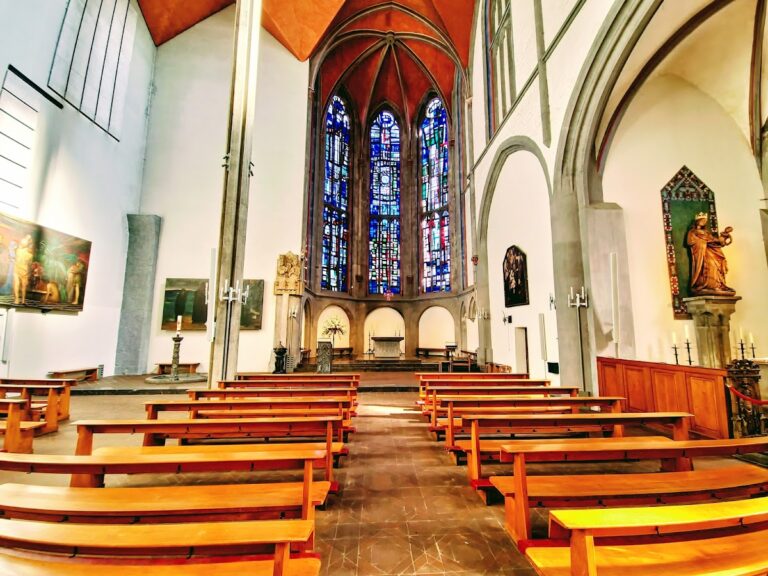
The postwar rebuilding introduced a steel roof frame from which the wooden ceiling of the nave was suspended. The vault of the southern transept arm was repaired, and a plastered wire-mesh vaulting system was installed in the northern arm. Repairs to the nave pillars exposed their Romanesque cores, after which the interior was refurnished.
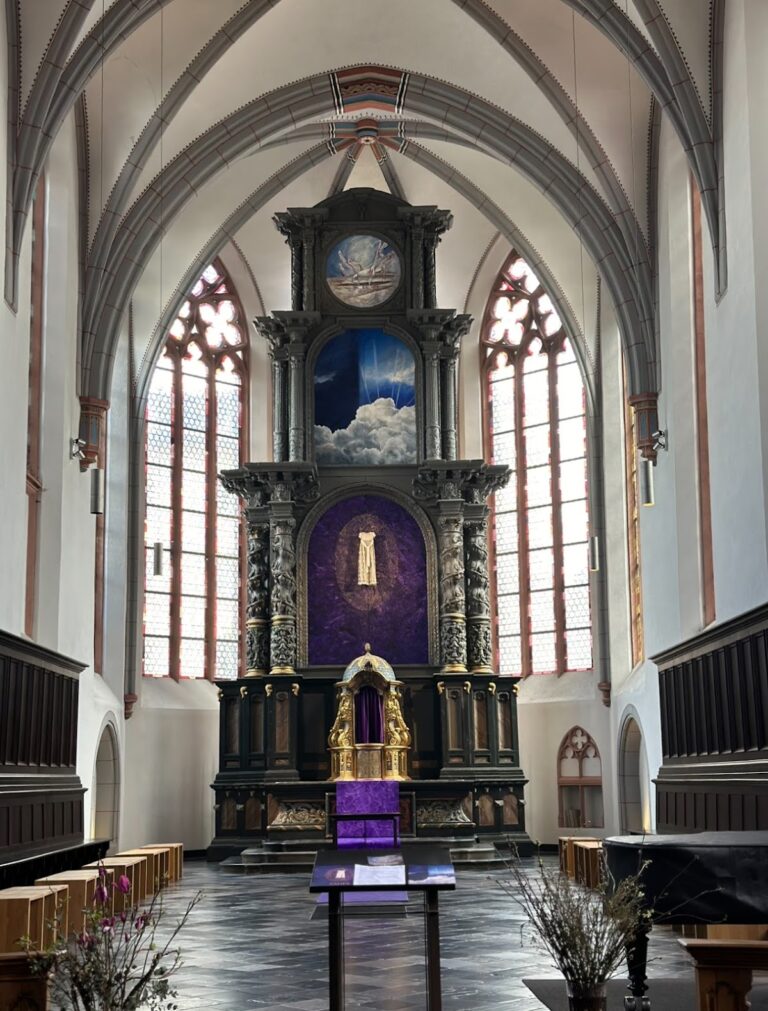
The renovations carried out between 1985 and 1998 changed several interior arrangements. The reliquary of Saint Adalbert was placed in a side aisle, and a new altar and tabernacle were installed in the sanctuary. The interior was repainted, a redesigned baptistery was created beneath the tower, and new flooring was introduced to symbolize the Christian’s path through life.
The church contains a principal organ built by Rieger of Schwarzach in Vorarlberg in 1965 and a choir organ made by Wilbrand Orgelbau in 1972. Several icons form part of the interior furnishings. Two panels by the Aachen calligrapher Shahid Alam display a quotation from the Book of Revelation in Arabic script.
Relic busts and treasury
Adalbert reliquary bust
The reliquary bust of Saint Adalbert is made of repoussé copper, with partial silvering and gilding. Including its oval wooden base, it measures 75 centimetres high, 47.5 centimetres wide, and 38 centimetres deep. It dates from after 1475. Johann Schreyer repaired it in 1901, renewing the mitre cross, the clasp bearing Adalbert’s figure, all stones and settings, and most of the rosettes.
Hermes reliquary bust
The reliquary bust of Saint Hermes dates from the fourteenth century and contains the saint’s skullcap. Including its wooden base, it is 51 centimetres high, 39 centimetres wide, and 21 centimetres deep. Schreyer restored it in 1902, renewing part of the beard, the halo, stones, settings, enamelled rosettes, the breast rosette, and the painted finish. A further comprehensive restoration took place in 2005.
Other relic objects
Other explicitly identified objects include arm reliquaries of Saints Sebastian and Christopher and an ostensory from around 1400. An ostensory is a vessel designed to display a relic publicly. The treasury also contains a thorn from Christ’s Crown of Thorns, a fragment of the True Cross, a piece of the manger associated with the infant Jesus, a shoulder blade of Laurence of Rome, parts of the skulls of Lucy of Syracuse and Pope Stephen I, arm bones of Sebastian and Christopher, bones of Agnes of Rome, Catherine of Alexandria, and Agatha of Catania, Henry II’s hunting knife, and cloth fragments from the garments of Gertrude of Nivelles and Walburga.
Commemorative evidence
A plaque from the Paths Against Forgetting project is fixed to the exterior wall beneath the niche containing the figure of Henry II. It recalls Joseph Buchkremer’s work as a youth chaplain at the church, his opposition to Nazism, his arrest in 1942 for remarks about the SS, his imprisonment in Dachau concentration camp, and his liberation in 1945. The plaque connects the surviving postwar building with the history of one of the people who directed its reconstruction.