Kloster Lambrecht (Pfalz): A Former Benedictine and Dominican Monastery in Germany


Site at a Glance
- Rating
- 4.9
- Popularity
- Very Low
- Country
- Germany
- Primary era
- Medieval
- External website
- Open
- Eras represented
- Medieval
- Civilizations
- Holy Roman Empire
- Site type
- Religious
- Remains
- Church
On this page12 sections
History
Kloster Lambrecht (Pfalz) is a former monastery in Germany, founded in 977, although some historians place its foundation in 987. Count Otto of Worms, a Salian count, established it at Grevenhausen, the original settlement of present-day Lambrecht, in honor of Saint Lambert of Liège. The foundation stood above the Spira River in the wooded region then known as the Wasigenwald and Speyergau. It was organized according to the Rule of Saint Benedict, a Western Christian monastic rule emphasizing communal worship, disciplined daily life, and work.
Benedictine foundation and Salian support
Otto founded the monastery for the salvation of his own soul and those of his parents. His wife Judith advised the foundation, while their sons Heinrich, Bruno, and Cuno gave their consent, and Emperor Otto encouraged the undertaking. The charter granted the monastery lasting freedom from secular obligations and appointed the eldest member of Otto’s family as its protector. This secular protector, known as a schirmvogt, was responsible for defending a monastery and its rights against injustice or outside interference.
Kloster Lambrecht began as a richly endowed Benedictine house and received firm support from the Salian dynasty. Its monks helped develop the remote wooded valley, and a settlement grew around the monastery. In 1237, this community was named villa St. Lamberti in an inheritance agreement involving Bishop Conrad of Eberstein. It later grew together with the older settlement of Grevenhausen, forming the basis of Lambrecht. The monastery also maintained commercial connections over a wide area, with relationships reaching the Rhineland and Westphalia by 1172.
The monastery became connected to the Salian dynasty’s foundation at Speyer. In 1027, Otto’s grandson Conrad II became ruler of the medieval Roman Empire and founded Speyer Cathedral as a dynastic burial church. In 1065, Conrad’s grandson Henry IV transferred St. Lambrecht, together with its revenues, to the cathedral church of Speyer. Much of the monastery’s income thereafter supported the cathedral’s expansion, while the Benedictine community initially continued under the authority of the Bishop of Speyer.
Decline and Dominican reform
At the beginning of the twelfth century, the Benedictine convent declined in importance. Poor financial management led to the pledging or sale of many properties. To rescue the institution, Bishop Conrad of Eberstein removed the Benedictines and installed Dominican women, including penitents who followed the Dominican rule associated with San Sisto in Rome. Here, “penitents” means women living a strict religious life within the Dominican tradition. Pope Innocent IV confirmed the change on 15 April 1244.
Donations and endowments improved the monastery’s finances after the change. St. Lambrecht became the wealthiest Dominican women’s monastery in the Palatinate and Rhenish Hesse, and its community developed substantial religious and economic activity. Countess Agnes of Orlamünde, widow of Count Otto III of Orlamünde, entered the monastery as a Dominican in 1292. Munio of Zamora, master of the Dominicans, sent her a personal letter of congratulation and approved a relaxation of the order’s strict rules for her. Agnes became a major benefactor and probably died around 1300; the convent’s necrology gives 25 November as the day of her death without specifying the year.
Under Prioress Kunigunde of Fleckenstein, the church was decorated shortly after its completion. Kunigunde died on 10 August 1353. In the mid-fifteenth century, the Bishop of Speyer ordered a reform of the convent in accordance with papal instructions. Under Prioress Agnes Sendeln, the monastery entered a final period of prosperity.
Plunder, dissolution, and later use
Troops of Duke Alexander of Zweibrücken plundered the monastery in 1505. Further damage followed during the German Peasants’ War in 1525, a widespread uprising in the German lands driven by social, economic, and religious grievances. The convent never fully recovered, and the Reformation reduced the number of women entering the community.
Elector Palatine Frederick II, who inclined toward the Reformation, sought to dissolve twelve monasteries in his territory and transfer their temporal possessions to the University of Heidelberg. Pope Julius III commissioned the nuncio Sebastian Pighi to inspect the communities. Pighi found some partly deserted and others close to decline, and in 1551 the pope issued a bull permitting the dissolution of St. Lambrecht. The decision required lifelong maintenance for the nuns and the continued celebration and teaching of the Catholic faith at the church.
On 2 September 1553, representatives of the Electoral Palatinate took possession of the monastery, its temporal possessions, revenues, and rights. The remaining community consisted of Prioress Ursula Jochin of Kandel, sacristan Elisabetha of Buchen, and the sisters Elisabetha of Neidenfels, Apollonia Nussdorfer, and Odilia Königstein. The convent’s steward, Hanns Werner Altenbas, handed over the keys. This formal act ended approximately six centuries of monastic tradition at Lambrecht.
Around 1568, Elector Frederick III transferred the church and monastery complex to Reformed religious refugees from the Netherlands, who settled there. The former monastery church is now the Protestant parish church of the municipality. The medieval necrology book of the Dominican convent survives in the University Library of Heidelberg and remains an important source for the local history of Kloster Lambrecht.
Remains
The surviving complex preserves a Gothic convent church and archaeological evidence of the earlier Benedictine foundation. The later church was built in a restrained form of Gothic architecture known as Reduction Gothic, characterized by simplified forms and comparatively limited ornament. Excavations in 1979 and 1980 located the foundations of the Benedictines’ earlier cruciform basilica, revealing an earlier phase beneath the later religious complex.
Church and archaeological foundations
Earlier basilica
The Benedictine monks built a cruciform basilica at the monastery above the bank of the Spira River. Its foundations were identified during the excavations of 1979 and 1980. These remains establish the physical presence of the first church and distinguish its plan from the later convent church commissioned by the Dominican community.
Gothic convent church
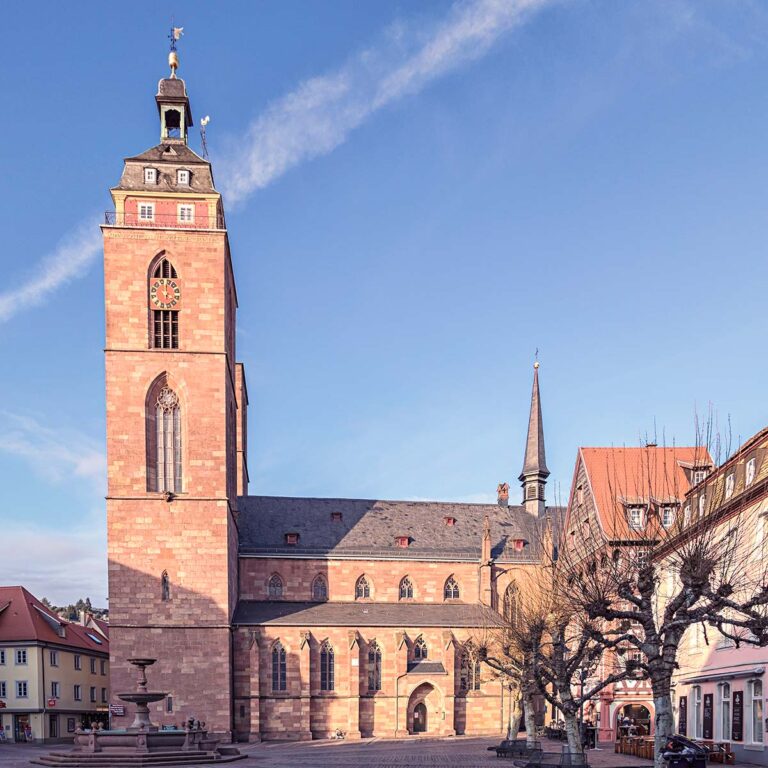
The Dominican community later commissioned a new and imposing convent church. It was constructed in Reduction Gothic and remains largely preserved. The church forms the principal surviving architectural element of the former monastery and continues in use as a Protestant parish church.
Medieval wall paintings
Choir paintings
The church contains medieval wall paintings made in secco, a technique in which pigments are applied to dry plaster rather than wet plaster. Five large painted wall surfaces survive in the choir. They were uncovered and restored during the second half of the twentieth century after being covered with whitewash during the iconoclastic phase of the Reformation.
Saint Quirinus and Saint Lambert
The central end wall of the choir presents the life of Saint Quirinus, who was venerated as a protector against plague, in numerous individual scenes. The medieval paintings also include an image of Saint Lambert, the Christian bishop and martyr associated with Liège, described as one of the oldest known depictions of him.
Prioress Kunigunde
Another painted scene shows the Virgin Mary with two nuns. A scroll inscription identifies one of them as Prioress Kunigunde of Fleckenstein, who led the Dominican community during the period when the church was decorated. The painting therefore connects a surviving religious image with a named leader of the medieval convent.