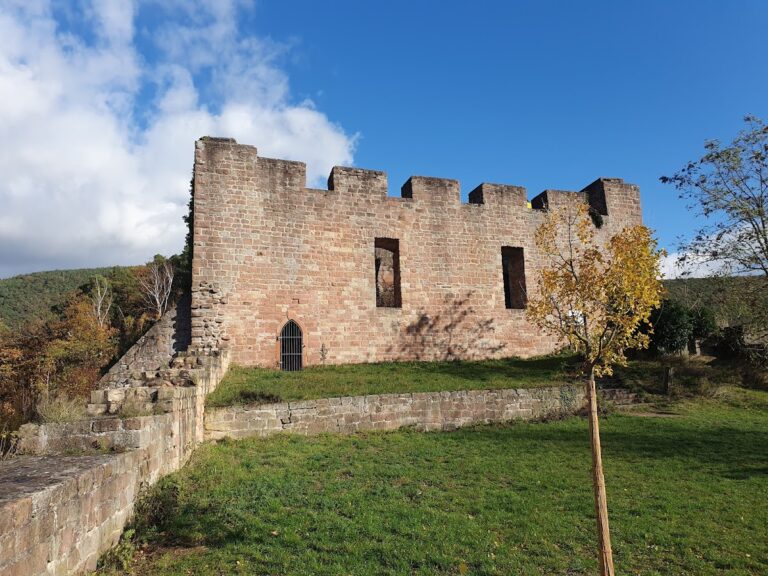
Erfenstein Castle: A Medieval Hill Castle in Germany


Site at a Glance
- Rating
- 4.5
- Popularity
- Very Low
- Country
- Germany
- Primary era
- Medieval
- External website
- Open
- Eras represented
- Medieval
- Civilizations
- Holy Roman Empire
- Site type
- Military
- Remains
- Castle
On this page8 sections
History
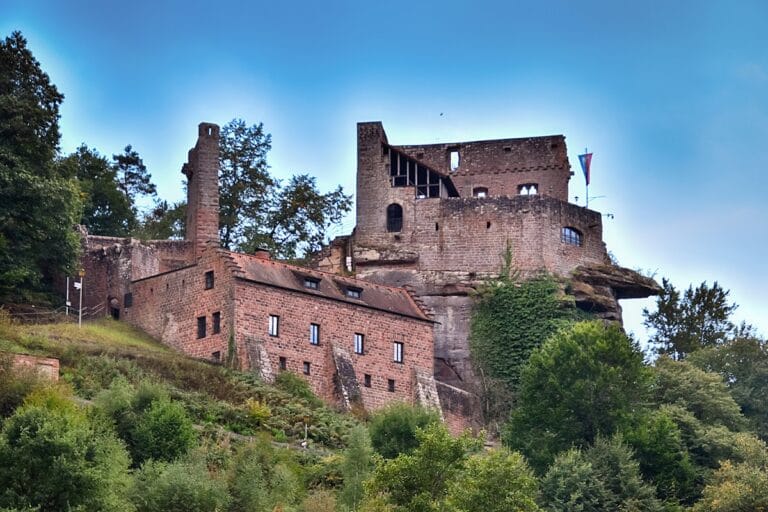
Erfenstein Castle is a medieval hill castle in Germany, situated above the Elmstein Valley in the Palatine Forest near Esthal. Its foundation date and builder are uncertain, but it is generally attributed to the Counts of Leiningen, who may have established it to protect their extensive forest lands. The castle is traditionally connected with nearby Spangenberg Castle through the legend of the Leather Bridge.
Foundation and Early Lords
The earliest secure association with Erfenstein dates to 1272, when Bock of Erfenstein, a ministerialis or medieval service noble, lived there with his family. The years 1189 and 1193 have also been proposed for an earlier mention. In 1439, a deed granted Siegfried Bock of Erfenstein specific rights in the parish of Dirmstein. He was evidently descended from the earlier Bock family associated with the castle.
Ownership changed through inheritance and division within the House of Leiningen, a German noble dynasty with regional territories and forest holdings. The Leiningen-Rixingen branch held Erfenstein together with the village of Esthal until 1345. The castle then became jointly inherited, creating divided rights among several co-owners. After disputes between them, it passed to the Counts of Sponheim in 1415. When the Sponheim family died out, ownership returned to the Leiningen-Hardenburg branch.
Destruction in 1470
Erfenstein and Spangenberg were held by different lords and consequently competed with one another. During the Weißenburg Feud in 1470, a conflict between Elector Frederick I of the Palatinate and his cousin, Duke Louis I of Palatinate-Zweibrücken, opposing forces destroyed the two castles. Erfenstein was destroyed first, followed by Spangenberg, and Erfenstein has remained a ruin since that event.
Remains
Erfenstein occupies a spur above the Speyerbach, at approximately 256 metres above sea level on the eastern spur of the southeastern summit of the 392.7-metre Wassersteinberg. The settlement of Erfenstein lies about 150 metres to the east. The castle developed in two distinct parts, with the higher and older Alt-Erfenstein positioned about 30 metres west of the lower Neu-Erfenstein. Both parts use rusticated ashlar masonry.
Upper and Lower Castle Areas
Alt-Erfenstein
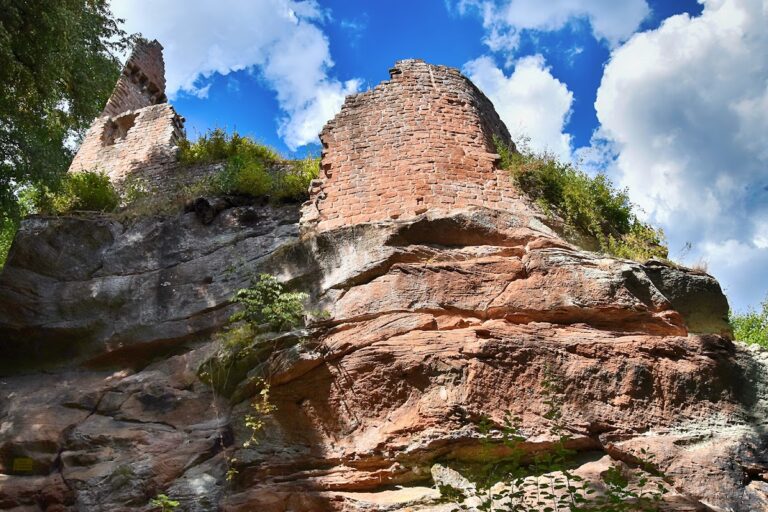
Alt-Erfenstein stands at approximately 268 metres above sea level. Its defensive position is marked by a neck ditch that is nearly filled with rubble or earth. Several rusticated ashlar blocks from a former square bergfried, the principal defensive tower of a medieval German castle, survive on an approximately eight-metre-high sandstone rock. A further neck ditch separates this upper castle from Neu-Erfenstein.
Neu-Erfenstein
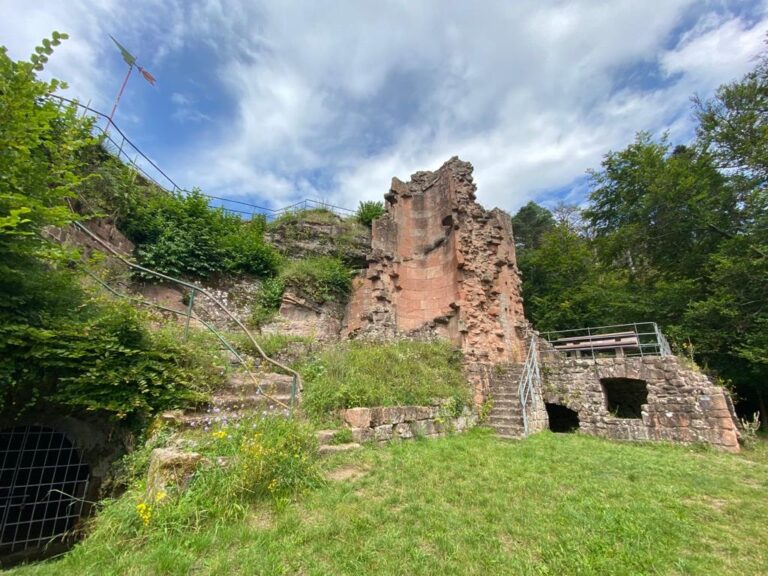
Neu-Erfenstein is dominated by a well-preserved bergfried with an entrance high on its eastern side. Sections of a curtain wall remain beside the tower. Rectangular sockets in the masonry received the ends of wooden beams, indicating that the tower’s interior was divided into several storeys. The surviving masonry and tower form preserve the main defensive character of this lower, later part of the castle.
Lower Ward
A lower ward stood at the foot of the sandstone rock carrying Neu-Erfenstein. A few remains survive there, forming part of the castle’s lower defensive area. The exposed ruin is in poor condition. Vegetation and climbing on the rocks and ruins, especially the tower stump of the upper ward, are contributing to further deterioration. The upper-ward remains and both neck ditches require urgent safeguarding.
Nearby sites