Sonargaon: A Historic River Port and Literary Center in Bangladesh
Site at a Glance
- Rating
- 4.4
- Popularity
- Low
- Country
- Bangladesh
- Primary era
- Modern
- External website
- Open
- Eras represented
- Medieval, Early Modern, Modern
- Civilizations
- Bengal Sultanate, British, Mughal
- Site type
- City
On this page20 sections
History
Sonargaon is a historic city in central Bangladesh, in modern Sonargaon Upazila of Narayanganj District. Its name derives from Suvarnagrama, commonly translated as “Golden Hamlet.” Near an old course of the Brahmaputra River, it developed over many centuries as a capital, river port, textile center, and seat of political and literary activity.
Early capitals and river commerce
The area was associated in antiquity with the Vanga and Samatata kingdoms and later served as a base for the Sena dynasty. In the mid-thirteenth century, Deva ruler Dasharathadeva moved his capital from Bikrampur to Suvarnagrama. Sonargaon is also one of the proposed locations of the legendary land of Suvarnabhumi. The nearby Wari-Bateshwar ruins have been identified by archaeologists with Sounagoura, an emporium, or major trading settlement, mentioned in ancient Greek and Roman accounts. This identification concerns the wider hinterland and does not establish that Wari-Bateshwar and Sonargaon were the same settlement.
Sonargaon stood near the Brahmaputra system and had access through the Bengal delta to the Bay of Bengal. Its fertile hinterland produced rice for export, while large communities of weavers and artisans manufactured muslin and other textiles. River traffic connected the city with parts of Southeast and Southwest Asia, giving Sonargaon an economic role that combined agricultural production, textile manufacture, and maritime trade.
Muslim rule and intellectual life
Muslim settlers arrived around 1281. About a decade earlier, Maulana Sharfuddin Abu Tawwama of Bukhara had established a Sufi khanqah, or religious lodge, and a madrasa, an institution of Islamic learning. These establishments taught religious and secular subjects and became known across the Indian subcontinent. Persian and Persianate Turkic immigrants settled in the city, which developed into a center of Muslim learning and Persian literature from the late thirteenth century.
In the early fourteenth century, Shamsuddin Firoz Shah, the Delhi governor in Gauda, conquered central Bengal and incorporated Sonargaon into the Delhi Sultanate, the medieval Muslim empire ruled from Delhi. He established a mint there, and the city issued a large number of coins. After Firoz Shah died in 1322, his son Ghiyasuddin Bahadur Shah succeeded him. The Delhi sultan Ghiyasuddin Tughlaq defeated and captured Bahadur Shah in 1324, then released him that year and appointed him governor of Sonargaon. Rebel governors of Bengal repeatedly chose the city as their capital.
Sonargaon’s institutions also supported the production of Persian works. During the administration of Roknuddin Kaikaus between 1291 and 1301, Nam-i-Haq, a ten-volume work of Islamic jurisprudence containing 180 poems, was written there. Its introduction indicates that the work was composed by a disciple of Abu Tawwama from his teachings, although authorship had been attributed to Abu Tawwama. At the initiative of Tatar Khan, the Tughluq governor of Sonargaon, scholars compiled Fatwa-i-Tatarkhani.
Fakhruddin and the Bengal Sultanate
After Bahram Khan died in 1338, his armour-bearer Fakhruddin Mubarak Shah declared himself independent Sultan of Sonargaon. He sponsored a trunk road, raised embankments, and built mosques and tombs. His authority expanded toward territories held by Arakan and Tripura, and his forces captured Chittagong in 1340. Sonargaon competed with Lakhnauti and Satgaon for military supremacy in Bengal. Its naval forces were stronger during the monsoon, while Lakhnauti held an advantage in land campaigns during the dry season.
Fakhruddin died in 1349 and was succeeded by his son, Ikhtiyaruddin Ghazi Shah. In 1352, Shamsuddin Ilyas Shah of Satgaon defeated Sonargaon and established the Bengal Sultanate, an independent Muslim state that had separated politically from Delhi. Sonargaon then became one of eastern Bengal’s principal towns and an important river port near the Brahmaputra Valley and the Bay of Bengal.
Sultan Ghiyasuddin Azam Shah established a royal court at Sonargaon, which flourished as a center for writers, jurists, and Persian literature. The city hosted a mint and served as the main administrative center of eastern Bengal, especially the riverine Bhati region. Turkic, Arab, Habesha, Persian, and Pashtun settlers joined the local population, while many weavers and artisans remained Hindu. A fifteenth-century Chinese expedition associated with Admiral Zheng He visited the city. In 1451, the expedition participant Ma Huan described a fortified walled city with a royal court, bazaars, busy streets, water reservoirs, and a port.
Hussain Shahi campaigns and wider trade
Under the Hussain Shahi dynasty, a Muslim ruling house of late fifteenth- and early sixteenth-century Bengal, Sonargaon served as a base for campaigns against Assam, Tripura, and Arakan. Its river port supported naval operations in the Bengal Sultanate’s wars with the Kamata Kingdom and the Kingdom of Mrauk U between 1512 and 1516.
In the sixteenth century, Sonargaon became the eastern terminus of the Grand Trunk Road, associated with the Afghan ruler Sher Shah Suri. The road linked Bengal with Central Asia and reinforced the city’s commercial connections. European travellers including Ludovico di Varthema, Duarte Barbosa, and Tome Pires described Sonargaon as a major trading center. Its textile economy produced fine cotton cloth, including the high-quality fabric known as Khasa.
Isa Khan and Mughal incorporation
After the Bengal Sultanate disintegrated in the late sixteenth century, Sonargaon remained a center of Bengali independence for several decades. Under Sultan Taj Khan Karrani, the nobleman Isa Khan acquired an estate covering the Sonargaon area. Isa Khan became the principal leader of the Baro-Bhuyan, a confederation of regional landholding chiefs who resisted Mughal expansion in Bengal. The confederation included Muslim and Hindu zamindars, or major landholders with revenue and local authority, including leaders of Turkic and Rajput ancestry.
Isa Khan gradually became ruler of the Bhati region under the title Mansad-e-Ala and used Jangalbari Fort. In 1578, the Twelve Bhuiyans defeated the Mughal viceroy Khan Jahan I under the leadership of Majlis Pratap and Majlis Dilawar, after Isa Khan had withdrawn during a battle on the Meghna River. In 1584, Isa Khan and Masum Khan Kabuli repelled a Mughal invasion at Egarosindur through a combined land and naval counterattack. In 1597, Isa Khan’s fleet defeated the Mughal navy on the Padma River, where Mughal viceroy Man Singh I lost his son.
Isa Khan died in September 1599, and his son Musa Khan took control of the Bhati region. During Musa Khan’s rule, the court poet Nathuresh compiled the dictionary Shabda-Ratnakari. Musa Khan was defeated by the Mughal general Islam Khan on 10 July 1610. Sonargaon then became a district, or sarkar, of Bengal Subah, the Mughal provincial administration established after conquest. The regional capital later developed at the new Mughal metropolis of Dhaka.
Mughal, British, and modern periods
Under Mughal rule, riverside defenses near Sonargaon helped protect Dhaka against Arakanese and Portuguese pirates, and several bridges were built in the area. During the nineteenth century, Panam developed as a wealthy textile-business district whose merchants included Bengali Hindus, Marwaris, and Bengali Muslims. The nearby Port of Narayanganj, established in 1862, eventually eclipsed Sonargaon’s commercial importance.
The Bangladesh Folk Arts and Crafts Foundation was established at Sonargaon by the painter Zainul Abedin on 12 March 1975. The former Baidyabazar subdistrict was renamed Sonargaon, and on 15 February 1984 Narayanganj subdivision became a district. Flooding and vandalism led to Sonargaon’s inclusion in the World Monuments Fund’s 2008 Watch List of 100 Most Endangered Sites. Present-day Sonargaon is a municipality in Narayanganj District.
Remains
Surviving features reflect Sonargaon’s development as a river-port city with administrative buildings, commercial districts, textile workshops, religious institutions, fortifications, bridges, and water installations. The historic environment includes mosques, tombs, Sufi establishments, Hindu temples, palaces, museums, and other structures associated with the city’s long political and commercial history.
Panam’s commercial buildings
Panam Nagar
Panam Nagar is a historic commercial neighborhood containing approximately 52 old brick mansions. Its buildings combine Bengali, Mughal, and colonial influences. During the nineteenth century, the neighborhood included townhouses, offices, temples, and mosques, with European architectural influence in the design of its buildings. Panam preserves the physical setting of the textile-business district that developed under British rule.
Bara Sardar Bari
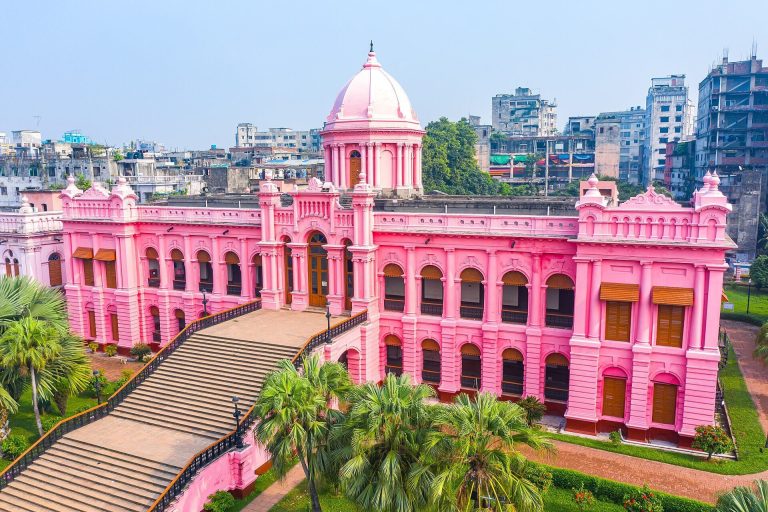
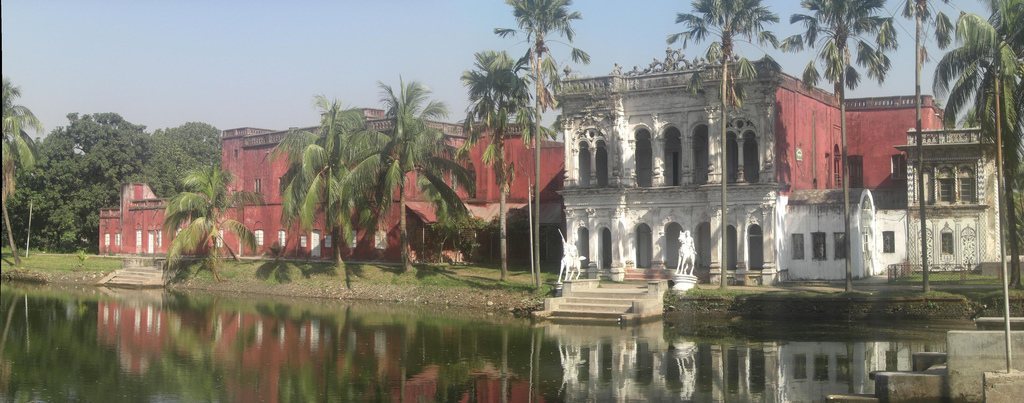
Bara Sardar Bari was built in 1901 by the zamindar Ishan Chandra Saha. The palace displays Mughal architectural features and now forms part of the Sonargaon Folk Art and Craft Museum. The museum preserves and displays traditional Bangladeshi textiles, pottery, woodwork, and metalwork, with the former palace serving as one of its principal buildings.
Bridges and canals
Panam Bridge, Dalalpur Bridge, and Panamnagar Bridge belong to the historic bridge network associated with the area. These bridges remain in use, while a seventeenth-century Mughal bridge crosses a deteriorated canal nearby. Together they represent the infrastructure that connected the settlement’s commercial and riverine landscape.
Religious and institutional remains
Goaldi Mosque
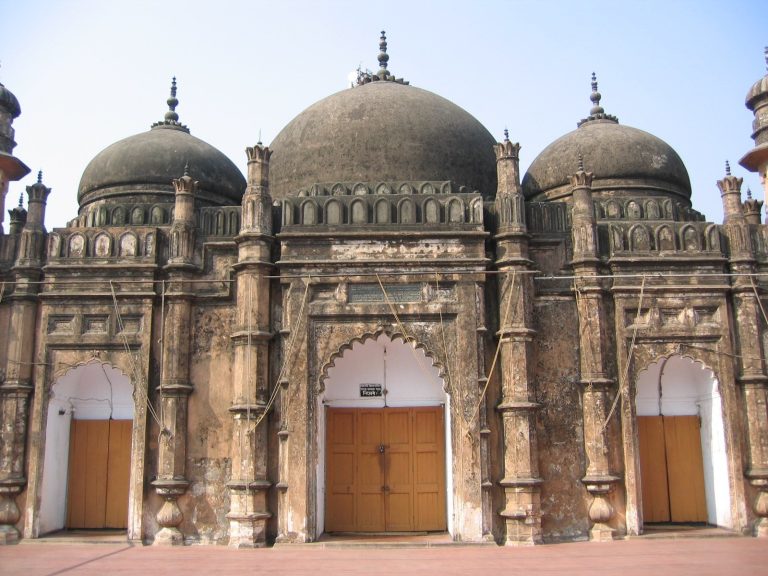
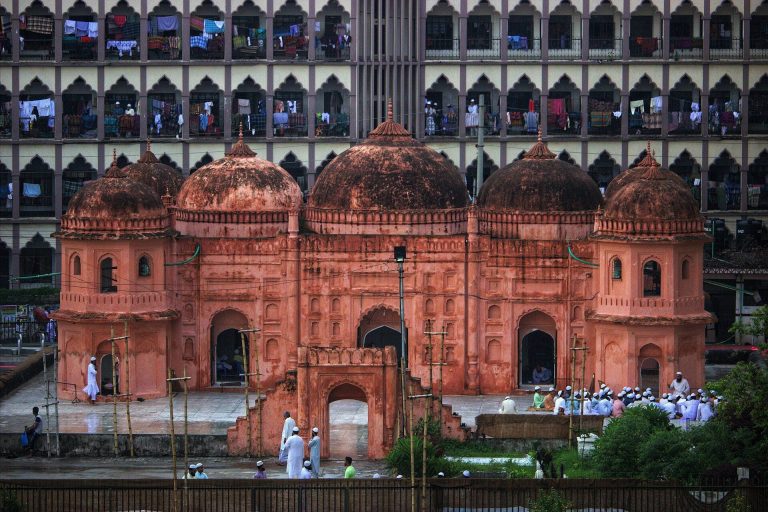
Goaldi Mosque is a fifteenth-century mosque known for intricate carvings and described as an example of Mughal architecture. It belongs to the group of historic religious buildings that preserve Sonargaon’s role as a center of Islamic worship and learning.
Abu Tawwama’s institutions
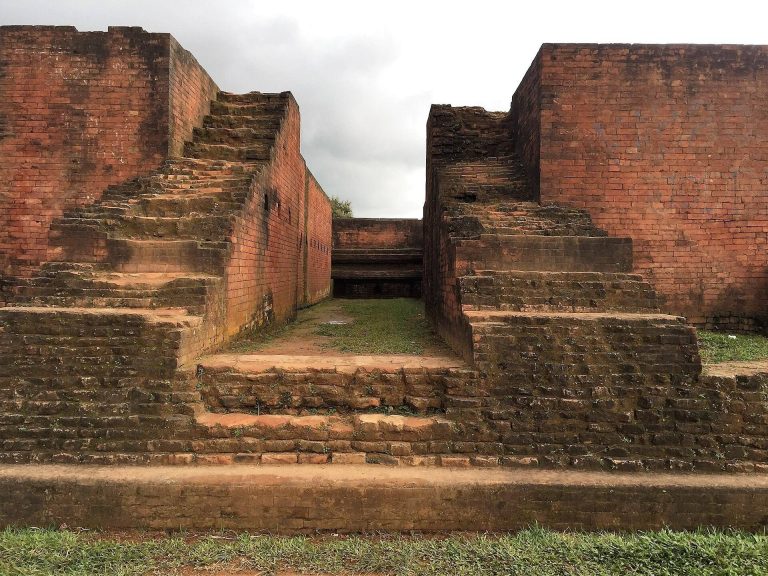
Abu Tawwama’s complex included a Sufi khanqah and a madrasa. The lodge provided a setting for Sufi religious activity, while the school supported religious and secular education. The complex reflects the institutional foundations of Sonargaon’s medieval intellectual life.
Other religious sites
Kadam Rasul Dargah is a religious site believed to preserve a footprint associated with the Islamic Prophet Muhammad and is noted for its architectural character. Panch Pirer Mazar in Bhagalpur village is used for prayer and pilgrimage. Baradi contains Sonali Mosque and the ashram of Loknath Brahmachari, as well as the palace associated with Isa Khan.
Fortifications, memorials, and later structures
Riverside defenses
Hajiganj Fort and Sonakanda Fort are associated with the Mughal riverside defenses near Sonargaon. Jangalbari Fort is linked with Isa Khan’s military activity. These fortified sites belong to the defensive landscape formed around the river routes leading toward Dhaka and eastern Bengal.
Memorial museums
The Sonargaon Folk Art and Craft Museum presents traditional Bangladeshi craft production, including textiles, pottery, woodwork, and metalwork. The Joynul Abedin Smriti Jadughar is a memorial museum dedicated to the artist Joynul Abedin. It contains his paintings, sketches, writings, and personal belongings.
Bangladesh’s Taj Mahal
A monument known as Bangladesh’s Taj Mahal was built in 2003 by Ahsanullah Moni as a tribute to his wife. It is described as a smaller replica of the Taj Mahal in Agra. The Sonargaon area also includes Neel Kuthi, Sufi shrines, Hindu temples, historic mosques, tombs, and other historic structures.