Cornštejn Castle: A Gothic Fortress Defending Bítov


Site at a Glance
- Rating
- 4.6
- Popularity
- Medium
- Country
- Czechia
- Primary era
- Medieval
- External website
- Open
- Eras represented
- Medieval, Early Modern
- Civilizations
- Holy Roman Empire, Kingdom of Bohemia, Margraviate of Moravia
- Site type
- Military
- Remains
- Castle
On this page9 sections
History
Foundation and Lichtenburg rule
Cornštejn Castle is a ruined and partially reconstructed Gothic castle in Czechia, built in the 1320s by Raimund of Lichtenburg on royal demesne land subordinated to Bítov Castle. Raimund, a Moravian governor and nobleman favored by King Wenceslaus II, received approval from King John of Luxembourg to establish the castle. Cornštejn was intended to strengthen Bítov’s defenses, secure the road to Vranov Castle, and provide residences for Raimund’s sons.
The surrounding estate had been pawned and was granted as a fief to the Lichtenburg family in 1308. Cornštejn first appears in a written record dated 31 May 1343, when Margrave Charles of Moravia authorized Raimund’s sons Smil and Čeňek, together with their nephew Jan, to divide the hereditary fiefs of Cornštejn and Bítov. Henry of Lichtenburg held the castle and its estate in 1348. A dispute with the Lords of Neuhaus followed, but the Lichtenburgs were again recorded as owners in 1363.
Hussite capture and expansion
Hussite forces, followers of the Bohemian religious reformer Jan Hus, captured Cornštejn in 1422 during the wars that followed his religious movement. After the Hussite Wars, the Lichtenburgs strengthened the castle and built a new palace along its northern side. In the first third of the fifteenth century, Albrecht and Jan of Lichtenburg also created a lower fortified area with a second palace, barracks, and other buildings.
A dispute over Cornštejn between Emperor Frederick III and Jan of Lichtenburg in the early 1440s was settled in 1445. From 1460, the castle belonged to Hynek Bitovský of Lichtenburg, who supported the Catholic opposition to King George of Bohemia and Pope Pius II. George declared Hynek a traitor, and the Moravian Diet ordered an attack. His forces besieged Cornštejn for eleven months in 1463 and 1464 before capturing it.
Post-siege fortification
George confiscated Cornštejn and its associated possessions and granted them as a fief to Heinrich Kraiger of Kraigk. Wolfgang Kraiger repaired the damage caused by the siege and modernized the castle’s two palaces. His sons Lipolt and Henry added an advanced fortification designed for contemporary artillery warfare.
After 1526, Cornštejn returned to the Lichtenburgs of Bítov and was incorporated again into the Bítov domain. In 1542, the Moravian Estates ordered repairs and improvements because of a possible Ottoman advance, a military threat from the expanding Ottoman Empire. The expected advance did not reach southern Moravia, and Cornštejn was not attacked.
Abandonment and preservation
Use of the medieval castle declined by the late sixteenth century. When the Lichtenburg line died out in 1576, the new owners, the Streuns of Schwarzenau, abandoned Cornštejn and may have removed its roofs to avoid taxation. The castle then deteriorated. Later owners included the Jankovský family of Vlašim from 1617, the Counts von Daun from 1788, the Haugwitz family, Jan Ladislav Zamoyský, Prince Franz Radziwill, and the industrialist Georg Haas von Hasenfels, who acquired the property in 1912.
Georg Haas von Hasenfels’s son was dispossessed in 1945 under a decree issued by Czechoslovak President Edvard Beneš, and the castle was nationalized. The Monument Preservation Institute in Brno undertook stabilization and reconstruction in the early 1970s, rebuilding approximately two-thirds of the castle. Since 1987, the South Moravian Museum in Znojmo has administered and maintained the ruins.
The castle is also associated with the historical names Zornstein, Cornštýn, Corštejn, and Corštýn. The German form Zornstein has been connected with words meaning “anger” and “stone,” although the derivation remains uncertain.
Remains
Setting and original fortress
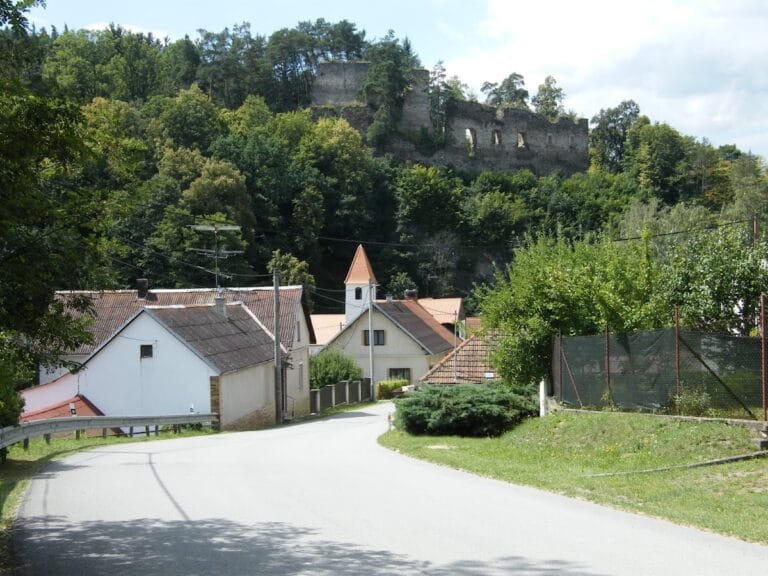
Cornštejn stands on a high rocky site at approximately 402 metres above sea level, about one kilometre from Bítov Castle and above the valley of the Dyje, or Thaya, River. The river, now impounded by Vranov Dam, curves around the castle in a broad meander. The site occupies a strategic position near an Eneolithic fortified settlement, a Copper Age settlement enclosed by defenses.
The original castle was a small Gothic noble residence built of stone. It consisted of a courtyard, a high enclosing wall, and a palace protected on its vulnerable side by a shield wall, a particularly high defensive wall. During the second half of the fourteenth century, Henry of Lichtenburg added a defensive wall around the entire castle, creating the Upper Bailey, an enclosed section of the castle complex.
Lower Ward and artillery defenses
In the first third of the fifteenth century, Albrecht and Jan of Lichtenburg built a second palace on the opposite side of the courtyard. They established the Lower Ward with barracks and other buildings, enclosing it with a new ring of curtain walls, defensive walls linking strongpoints. The enclosure included two gates and two bastions.
After the Hussite attack of 1422, a detached outwork, or defensive structure outside the main fortifications, was built on the strategically vulnerable hill south of the castle. A later advanced fortification on a rocky platform south of Cornštejn was adapted to artillery warfare. Further defensive work in 1542 included a tower on a hill southwest of the castle.
Surviving fabric
The complex survives in a ruined but partially reconstructed condition. Several gates, cellar rooms, and two wells remain, while other parts of the medieval fortress survive as ruins or reconstructed sections. The surviving stone fabric reflects the castle’s successive medieval expansions, post-siege repairs, and later defensive adaptations.