Skederid Church: A Medieval Church in Rimbo, Sweden
Site at a Glance
- Popularity
- Low
- Country
- Sweden
- Primary era
- Medieval
- Eras represented
- Medieval, Early Modern, Modern
- Civilizations
- Swedish
- Site type
- Religious
- Remains
- Church
On this page20 sections
History
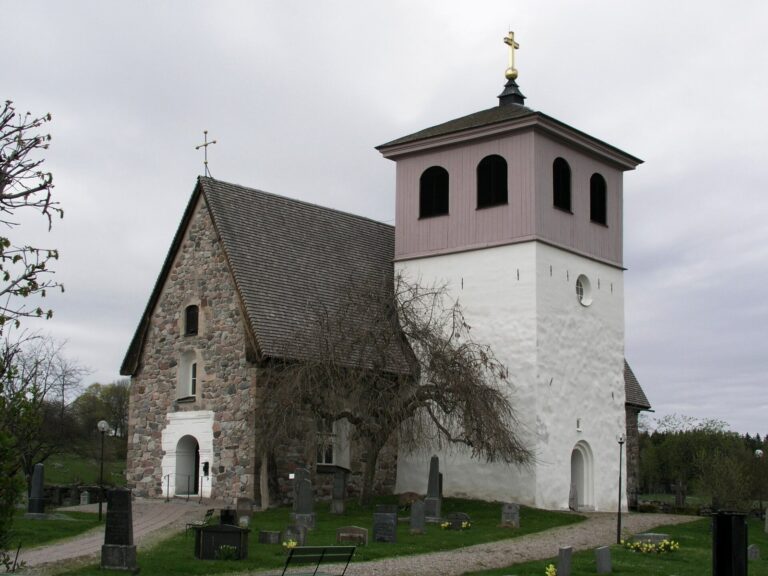
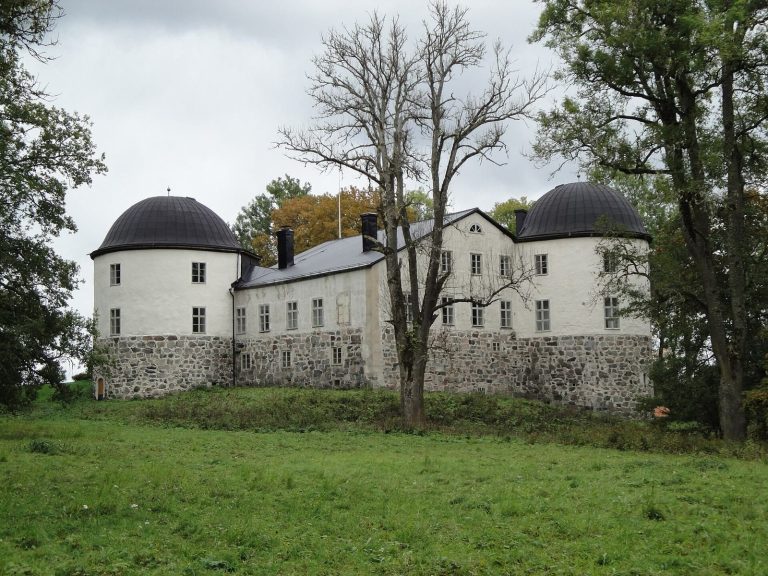
Skederid Church stands in Rimbo, Sweden, and its oldest parts date to the late thirteenth century. Birger Persson, a senior regional legal official and the father of Bridget of Sweden, probably built it as a private church connected with Finsta manor. Bridget, a fourteenth-century religious visionary later canonized as a saint, may have been baptized there; the church is also associated with some of her earliest visions.
Medieval origins and expansion
The surrounding area has been inhabited continuously since at least the Bronze Age. A fire in the fourteenth century destroyed the church’s roof. After Bridget’s canonization in 1391, the church became a destination for religious pilgrims. The resulting need for a larger building led to an expansion, and by the middle of the fifteenth century the church had acquired much of the size and form it retains today.
Rebuilding and later changes
By the eighteenth century, the church was in serious disrepair. Pastor Tegman of neighboring Rimbo organized repairs, and a diocesan collection began in 1746. Major rebuilding started in 1748–49 and was completed in 1767. The entrance between the porch and the main church was blocked from the eighteenth century until 1971. During that time, the porch served as a place to store firewood and other goods. The old sacristy on the north side of the choir was demolished in 1880, and the church’s windows were enlarged during the eighteenth and nineteenth centuries.
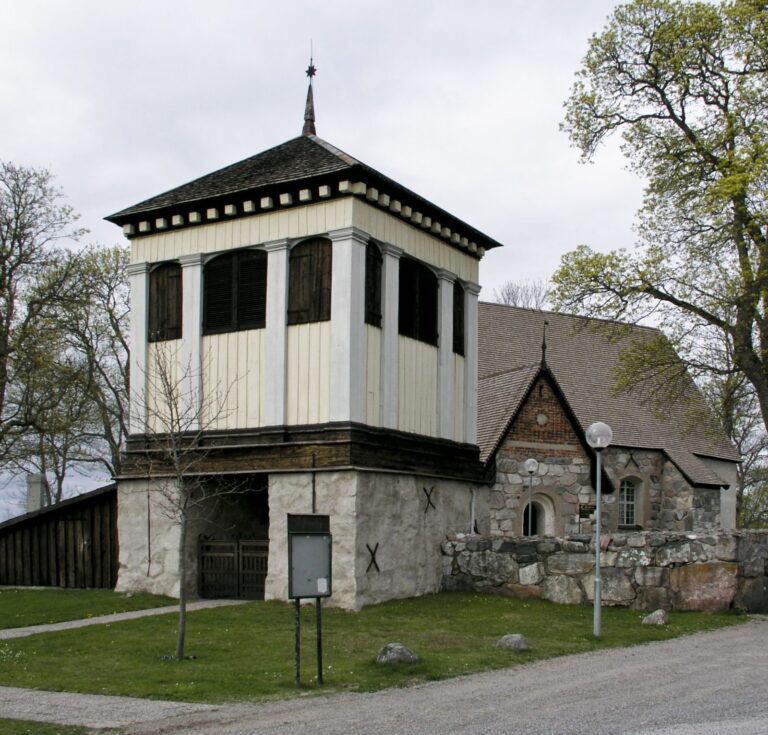
In 1775–76, the medieval cemetery entrance was adapted to support a wooden bell tower, replacing a freestanding tower built in 1692; timber from the earlier tower was reused. A restoration in 1923 added heating, while repairs in 1950 restored the eastern window group in the sacristy. The blocked doorway was reopened in 1971. Church silver, including a box for communion bread and a jug, was stolen in 1839, and new communion silver was acquired in 1924.
Church affiliation
Skederid Church was formerly Catholic and is now Lutheran within the Church of Sweden’s Diocese of Uppsala. It belongs to the parish of Husby, Skederid and Rö. Until 1 January 2018, it was part of Rimbo pastorate, an administrative grouping of parishes; it is now within the western Roslagen pastorate.
Remains
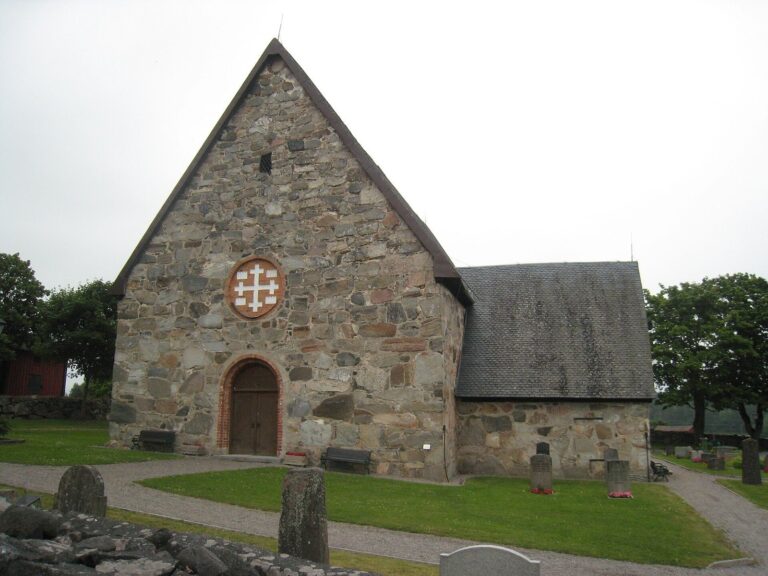
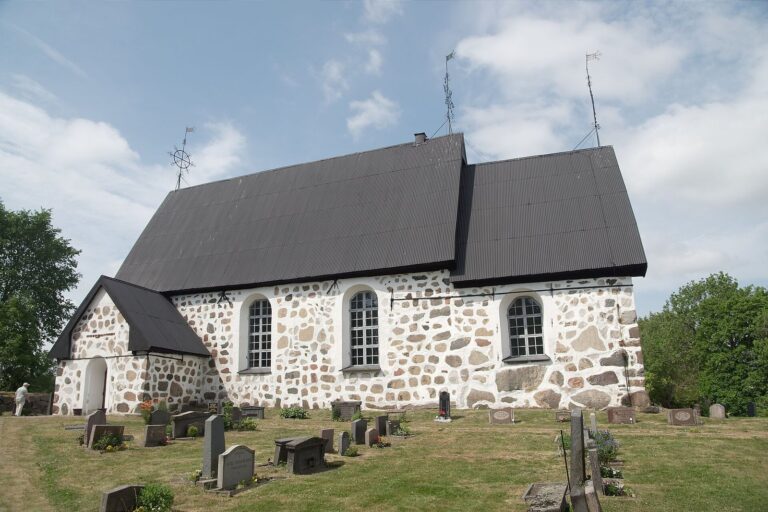
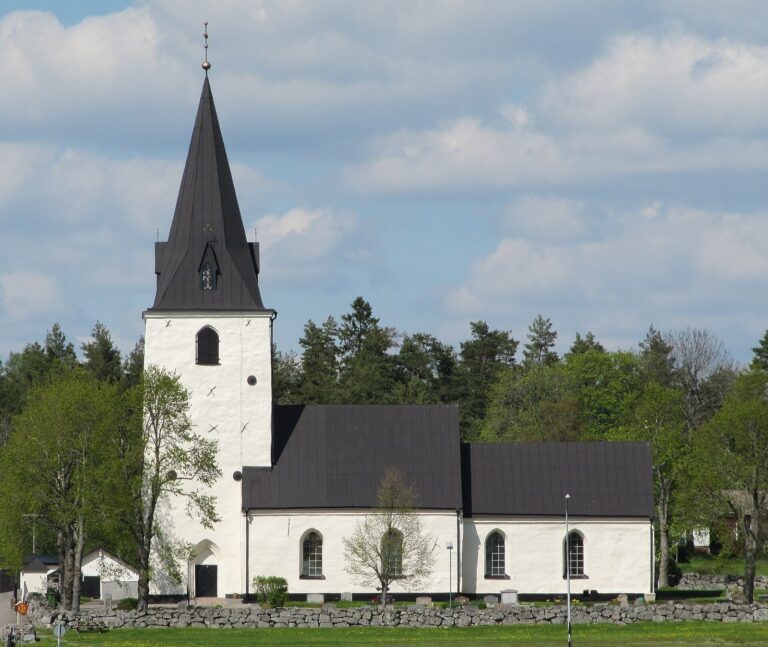
The present church combines medieval stonework with later brick details and changes made during rebuilding. Its long interior is organized around a rectangular nave, the main area for the congregation, a narrower choir near the altar, and a smaller sacristy, a room used by clergy to prepare for services and keep sacred objects. The church lies about halfway between Norrtälje and Rimbo. Husby-Sjuhundra Church is about two kilometres away and within sight.
Plan and fabric
Changing plan
The oldest part of the church was approximately the size of the present choir. In the earliest arrangement, the space now used as the sacristy served as the choir, while the present choir was the nave; another sacristy stood north of that early choir. The later nave was added to the west, and the medieval choir continued in use, creating an unusually long interior. The arrangement changed again during the eighteenth-century rebuilding: an opening between the choir and the earlier nave was blocked, the old choir became a sacristy, and the old nave became the choir.
Construction and interior
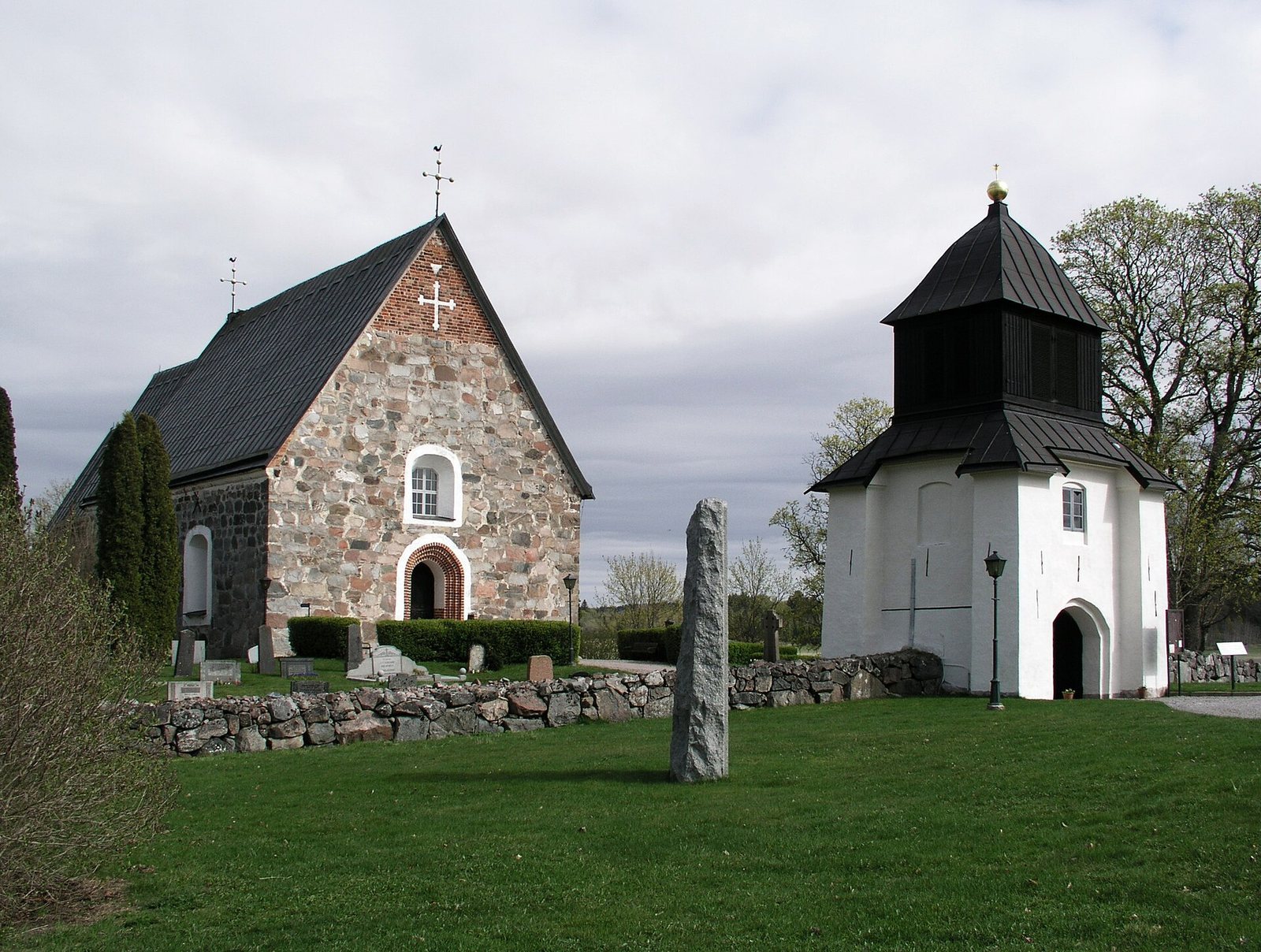
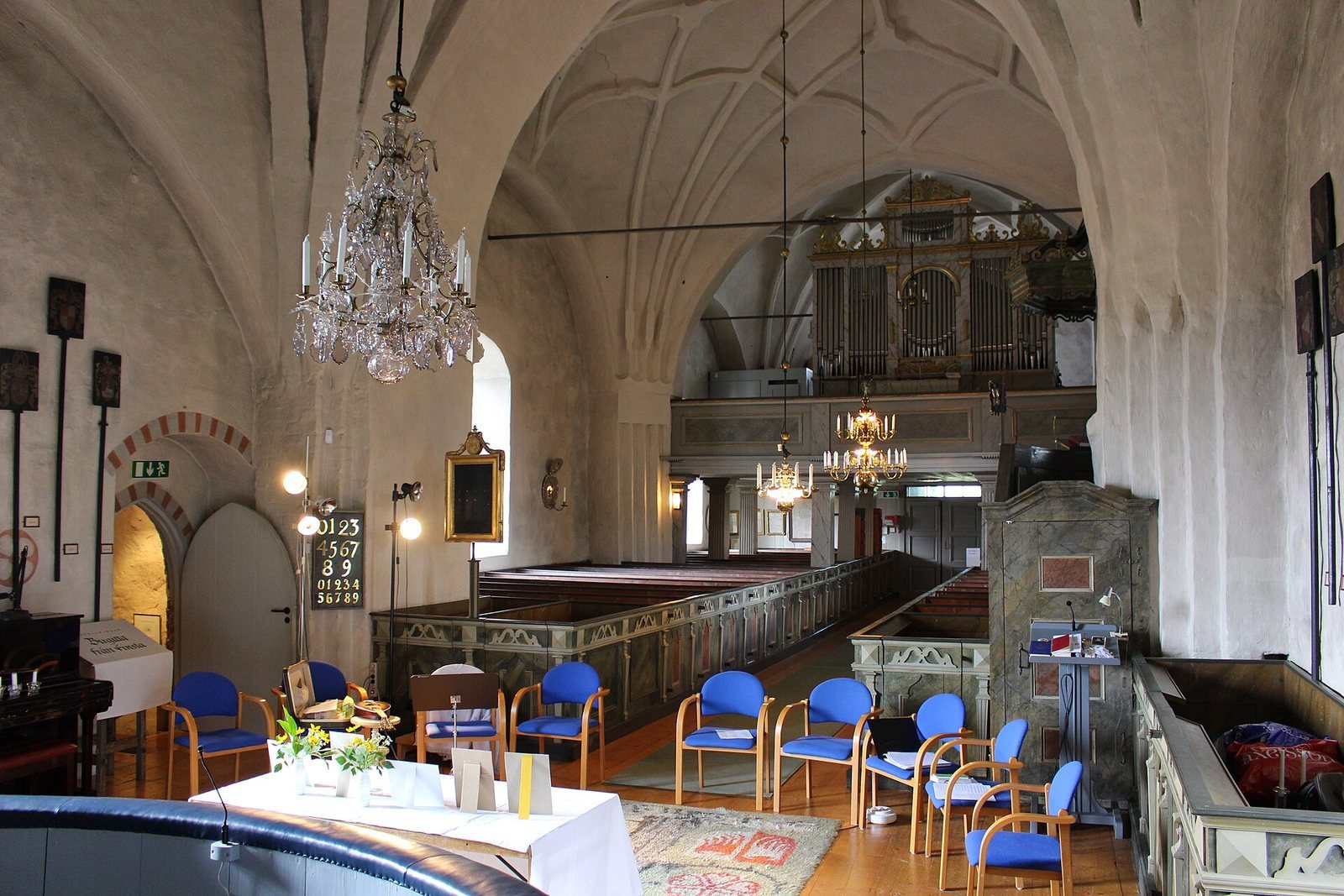
The exterior walls are faced with exposed natural stone, with brickwork around openings and in the gables. Dressed sandstone blocks reinforce the corners of the choir and sacristy. A pointed-arch brick portal forms the main entrance in the west end wall, and a sheet-metal covering protects the gabled roof. Inside, brick arches span the church; after the medieval fire, a wooden barrel-shaped ceiling was built beneath the new roof. Two iron bars cross the building to draw the nave’s side walls together. The walls are plastered and whitewashed, and the roof framing above the eastern part was rebuilt. The present pews date from the eighteenth-century rebuilding.
Porch and churchyard
South porch
The south porch stands at the junction of the nave and choir, an unusual position for this feature. A doorway connects it to the choir, and a recess in its eastern wall indicates that the porch also served as a chapel. A burial chamber beneath the floor was used by the owners of Finsta. In 1923, the chamber was converted into a boiler room.
Cemetery entrance and bell tower
At the cemetery entrance west of the church, a medieval masonry gate carries a wooden bell tower. The church’s two bells differ in age: the larger is thought to date from the fourteenth century, while the smaller was cast in 1790.
Hill and surrounding features
A memorial stone to Bridget of Sweden stands outside the church and dates to 1930. A well associated with her is also near the building. On the south side of the church hill is a mortuary built around 1960.
Paintings and carved memorials
Fragments of medieval wall painting survive inside the church, including a vine pattern on the arch above the altar. Crosses marking places associated with the church’s consecration remain in the choir and sacristy. A runestone fragment is set into the porch, and carved wooden memorials associated with several aristocratic families hang on the church walls.
Furnishings and works of art
Medieval altarpiece
An altarpiece believed to have been made in Lübeck in the 1470s includes a sculpture of Mary holding the dead Christ. It was sold to the Swedish History Museum in 1897. The museum also holds a thirteenth-century triumphal crucifix, traditionally displayed between a church’s nave and choir, and a fourteenth-century image of an apostle.
Other medieval sculptures and crosses
A wooden sculpture of Bridget dates to the first third of the fifteenth century. An early-fourteenth-century figure of Christ, once part of a cross carried in religious processions, is now fixed to a newer cross. A medieval processional cross is also associated with the church’s furnishings.
Present altarpiece
The current altarpiece was assembled in 1761–62 from parts of different origins. Its painting of Jesus on the cross, by Anders Eklund, shows the two Marys in the foreground. A painting of Jesus in Gethsemane was placed at the center in 1831, when the altar table and rail were also made. Below the paintings is a carved, gilded relief of the Last Supper. Draped female figures flank the central image, and a wooden relief of a radiant sun representing Jehovah, a traditional English name for God in the Bible, crowns the work.
Pulpit and baptismal furnishings
The pulpit was made in the seventeenth century and altered between 1748 and 1753. Its hourglass was purchased in 1745, and a wooden stand for the baptismal bowl was acquired in 1753.
Communion vessels and candlesticks
A gilded silver communion vessel bears the date 1584 and is associated with a small plate used during communion. Tall pewter candlesticks made by Heinrich Gottfried Pschorn in 1718 were donated in 1722. A silver bridal crown was given to the pastorate in 1945. For the church’s 700th anniversary in 1997, a donation provided six silver candlesticks and two silver vases.
Lighting, organ and bells
A metal chandelier on the gallery dates to the seventeenth century. Other chandeliers were made in 1758 and 1935; a crystal chandelier in the choir, already old when acquired, was obtained in 1817. A wooden chandelier in the sacristy was purchased in Norrtälje in 1736 and renovated in 1950. The organ’s façade dates to 1857, while its mechanism has been rebuilt several times.