Sirotčí hrádek: A Gothic Castle Ruin in Czechia


Site at a Glance
- Rating
- 4.8
- Popularity
- Medium
- Country
- Czechia
- Primary era
- Medieval
- External website
- Open
- Eras represented
- Medieval
- Civilizations
- Holy Roman Empire, Kingdom of Bohemia
- Site type
- Military
- Remains
- Castle
On this page10 sections
History
Sirotčí hrádek is a Gothic castle ruin above Klentnice in Czechia, built in the mid-13th century by the Swabian Wehingen family. Its name is linked to an offshoot of that family founded by the knight Siegfried Sirotek. The castle occupied a difficult limestone site in the Pavlov Hills and later became part of the Mikulov domain.
Wehingen and Liechtenstein lordship
After the Wehingen family died out, the castle came into the possession of King Wenceslas III in 1305. Wenceslas III was the last Přemyslid ruler of Bohemia and was assassinated in 1306. The Liechtenstein family later acquired Sirotčí hrádek and incorporated it into their Mikulov estates.
Decline and protection
By the 16th century, the castle had fallen into ruin. A land register from 1560 does not mention it, while a record from 1590 describes it as desolate. The Dietrichstein family acquired the site in 1575, when it was probably already deserted and seriously deteriorated. A chapel still survived there in the 18th century.
Sirotčí hrádek has been protected as a cultural monument since the mid-20th century. The ruin lies within the Pálava Protected Landscape Area and a protected nature reserve.
Legends of the castle
Local tradition connects the castle with the knight Čičos, who was supposedly a member of the Knights Templar and the castle’s castellan, the official responsible for administering and defending a castle. The legend says that Čičos refused a summons from the order because his son was being born. The commander who arrived became the child’s godfather, named him Orphanus, meaning “orphan,” and ordered Čičos’s execution for betraying the order. Nearly all the castle’s inhabitants were said to have been killed. Čičos’s widow Růžena died of grief, while the commander took Orphanus away. After learning the truth from an elderly survivor, Orphanus went mad and began riding at night from the castle toward Turold Castle.
Another local legend tells of nocturnal apparitions of a fiery dog and a Templar who had broken his vow of celibacy.
Remains
Rocks, approach, and defenses
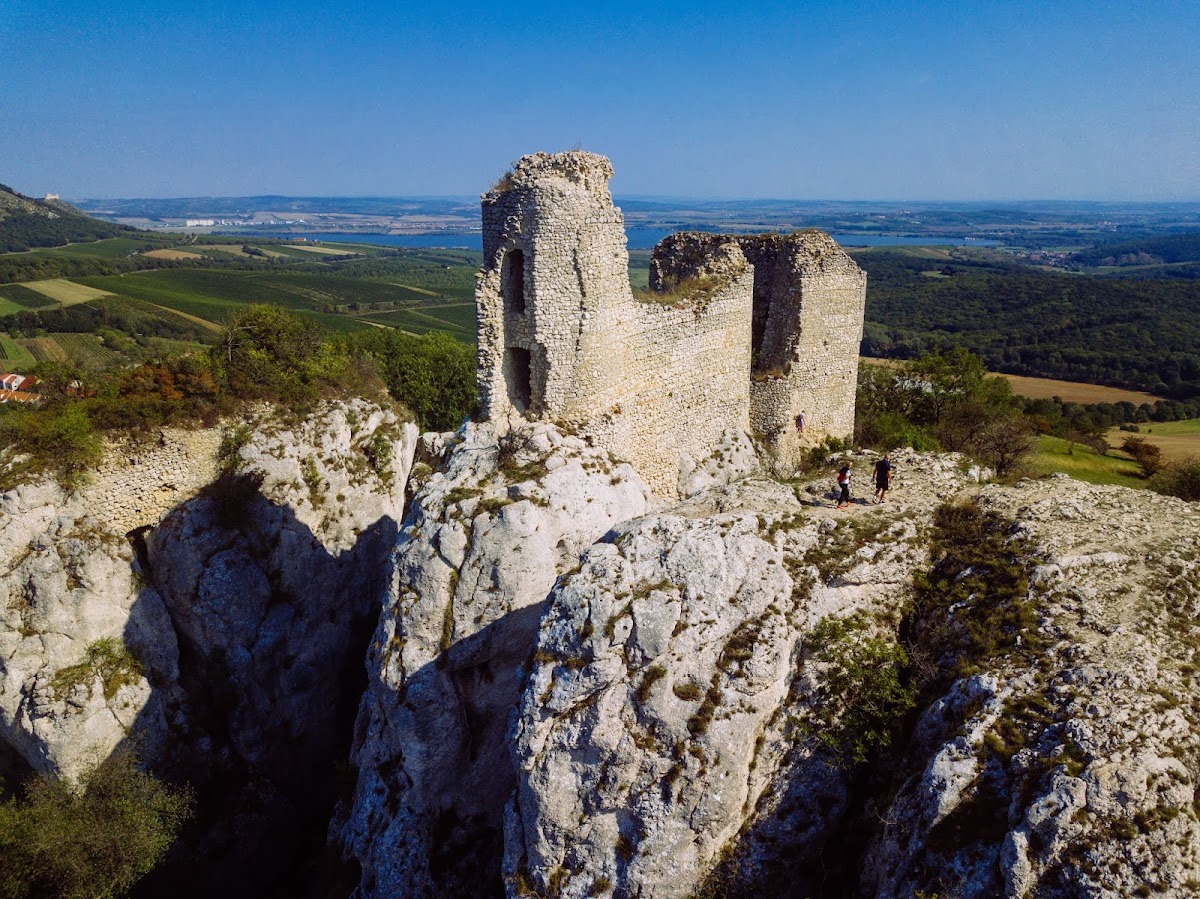
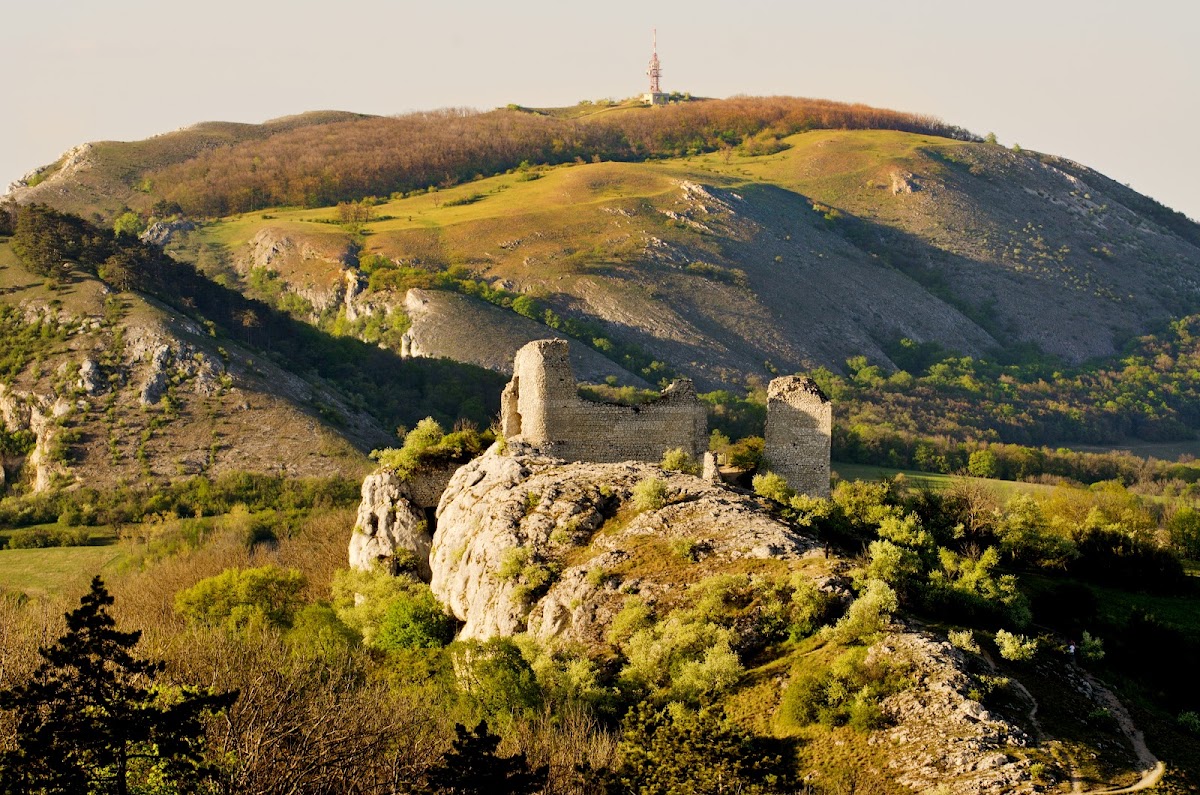
The ruin stands at an altitude of 458 metres on the northern edge of Stolová hora, one of the Pavlov Hills in the Mikulov Highlands, immediately above Klentnice. The castle was built on two hard-to-reach limestone rocks divided by a deep gorge. The main part occupied the southern rock, while a bridge probably connected it across the gorge to the northern rock. The bailey was enclosed by an earth rampart and a palisade.
Southern rock
Palace and surviving walls
A three-storey palace stood on a smaller plateau of the southern rock. A section of castle wall about 8 metres high survives, with a window opening at its centre. On the opposite side, the palace remains rise several metres above the rock. They contain three window openings, including two topped by pointed arches, a characteristic Gothic form made from two curved sides meeting at an apex.
Rock-cut cistern
Immediately beside the surviving wall is a cistern cut into the limestone. It supplied the castle with water and remains physically connected to the principal surviving wall.
Northern rock
The northern rock is now inaccessible. A prismatic watchtower stood there, and relatively small masonry remains survive, including fragments associated with another tower.
The site is also known by the names Sirotčí hrad, Sirotčí hrady, Růžový hrad, Waisenstein, Rosenstein, Rasenstein, and Rosenburg.