Roman Fort Pasohlávky: A Roman Military Base in Czechia



Site at a Glance
- Rating
- 4.3
- Popularity
- Very Low
- Country
- Czechia
- Primary era
- Classical
- External website
- Open
- Eras represented
- Classical
- Civilizations
- Roman
- Site type
- Military
- Remains
- Fort
On this page13 sections
History
Roman Fort Pasohlávky is a Roman military site in Czechia, built on Hradisko in Moravia during the Marcomannic Wars between AD 172 and 180. Located in the former cadastral area of Mušov, now part of Pasohlávky, the fortress stood about 80 to 86 kilometres north of ancient Vindobona, near present-day Vienna. It became the central Roman base for operations in Marcomannic territory and was probably intended to become the capital, or one of the principal centres, of a planned province called Marcomannia.
Early Roman operations
Roman forces may have used Hradisko as early as AD 6, when Tiberius planned a campaign against Maroboduus, the ruler of the Marcomanni. The route was associated with troops commanded by Tiberius from Carnuntum and by his legate Gnaeus Sentius Saturninus from Marktbreit. The original Roman name of the site is unknown.
The permanent fortress belonged to a later phase of Roman expansion beyond the Danube. Pottery, brooches, and coins place the main Roman presence at Hradisko more specifically around AD 175 to 180, during the reign of Marcus Aurelius, Roman emperor from AD 161 to 180. The Marcomannic Wars were a series of conflicts between Rome and the Marcomanni, Quadi, and other groups along and beyond the Danube frontier, conventionally dated to approximately AD 166 to 180.
The fortress during the Marcomannic Wars
After Roman forces pushed invading armies back across the Danube in AD 171, Marcus Aurelius established his headquarters at Carnuntum and began offensive operations in AD 172. Campaigns north of the river continued in several phases, including a major invasion of Marcomannic and Quadian territory in AD 178. Roman forces used the Morava, Dyje, Jihlava, Nitra, Váh, and Hron rivers to move troops and supplies. The Morava and Dyje probably carried especially large quantities of provisions for soldiers and animals.
Hradisko served as the main military centre in this northern theatre. It coordinated Roman forces, supported the occupation army, and connected the fortress with temporary camps that controlled approaches and communications. Its functions included storing supplies, maintaining equipment, and caring for wounded soldiers. Senior military personnel may have lived there, and Marcus Aurelius may have stayed at the fortress briefly during the Second Marcomannic War.
The military concentration around Hradisko was the largest known grouping of Roman military units between the Rhine and Danube. More than twelve, and possibly several dozen, temporary marching camps were identified across the wider region. They ranged from installations for small tactical detachments to camps capable of holding forces exceeding 10,000 men. Estimates place more than 50,000 legionaries in the surrounding area in AD 179, while another estimate suggests about 20,000 soldiers during winter and as many as 100,000 during summer campaigning.
Abandonment and later use
Roman occupation ended after the change in imperial policy that followed the accession of Commodus, the son and successor of Marcus Aurelius, in AD 180. The fortress was probably abandoned at the end of that year or soon afterward. The planned province of Marcomannia was never established, and Commodus relied more heavily on agreements and payments to Germanic leaders. Hradisko consequently lost its military importance.
After the Roman withdrawal, the site was reused as a cemetery and as a source of building material for later construction. Over time, decaying plant material covered the remaining traces of the fortress.
Excavation and interpretation
Roman objects had long been recovered from the area by local farmers. Josef Lieber began excavations in 1925 and found the first Roman brick after three days. He stopped after recovering about 30 bricks, ten of which were sent to the Moravian Museum. The State Archaeological Institute carried out trial excavations in 1926, followed by systematic work in 1927 and 1928 under Anton Gnirs, with substantial support from President T. G. Masaryk.
Further investigations took place under G. Hejzlar in 1949, followed by renewed research under Jaroslav Tejral in 1976 and 1977 and again in 1979. Excavations intensified from 1984, with campaigns in 1985 to 1995, 1988 to 1993, 1993 to 1994, and 1994 to 1996. Later work was conducted under Balázs Komoróczy. The results indicate that Hradisko was more than a temporary camp. It was a permanent forward position containing military and civilian facilities, and its role as a central fortress for a planned Roman province is supported by other Roman camps in Moravia.
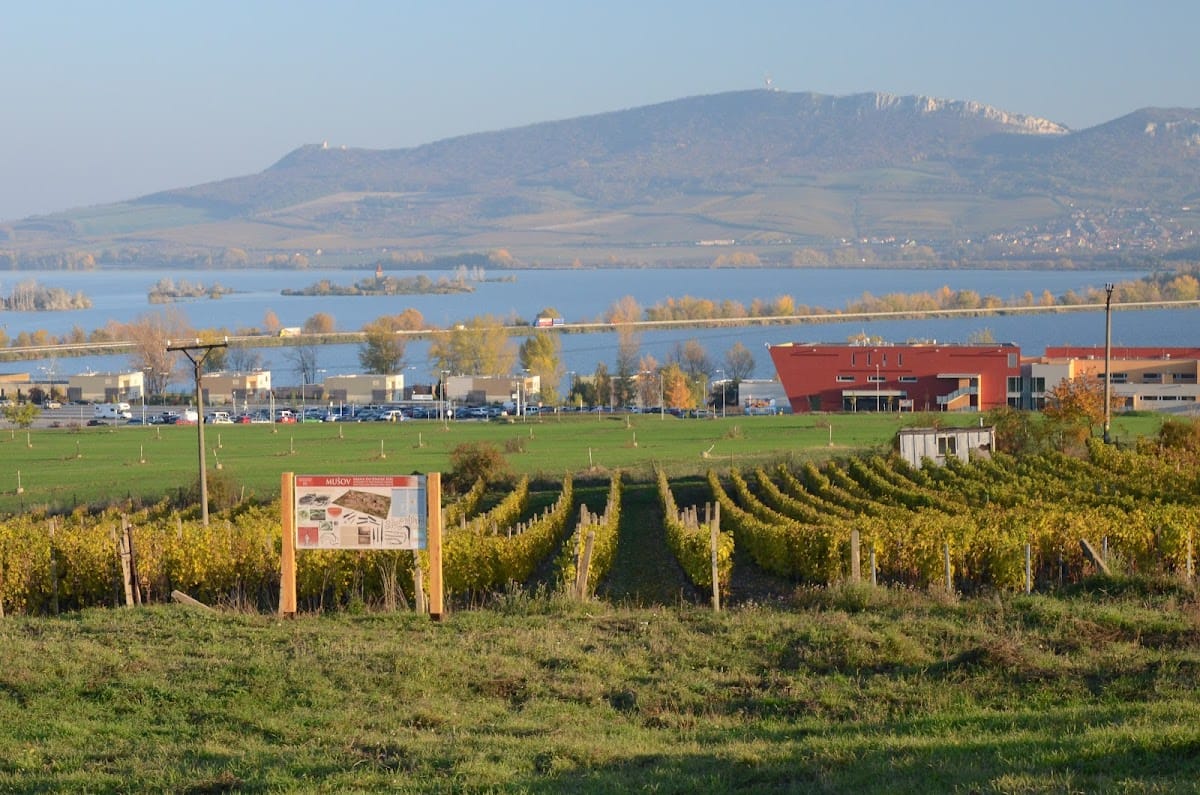
The fortress and its archaeological traces are protected as a cultural monument. In June 2020, a visitor centre with the interactive exhibition “Gateway to the Roman Empire” opened at the foot of Hradisko, together with an educational trail leading towards the hilltop.
Remains
Fortress summit and high-status buildings
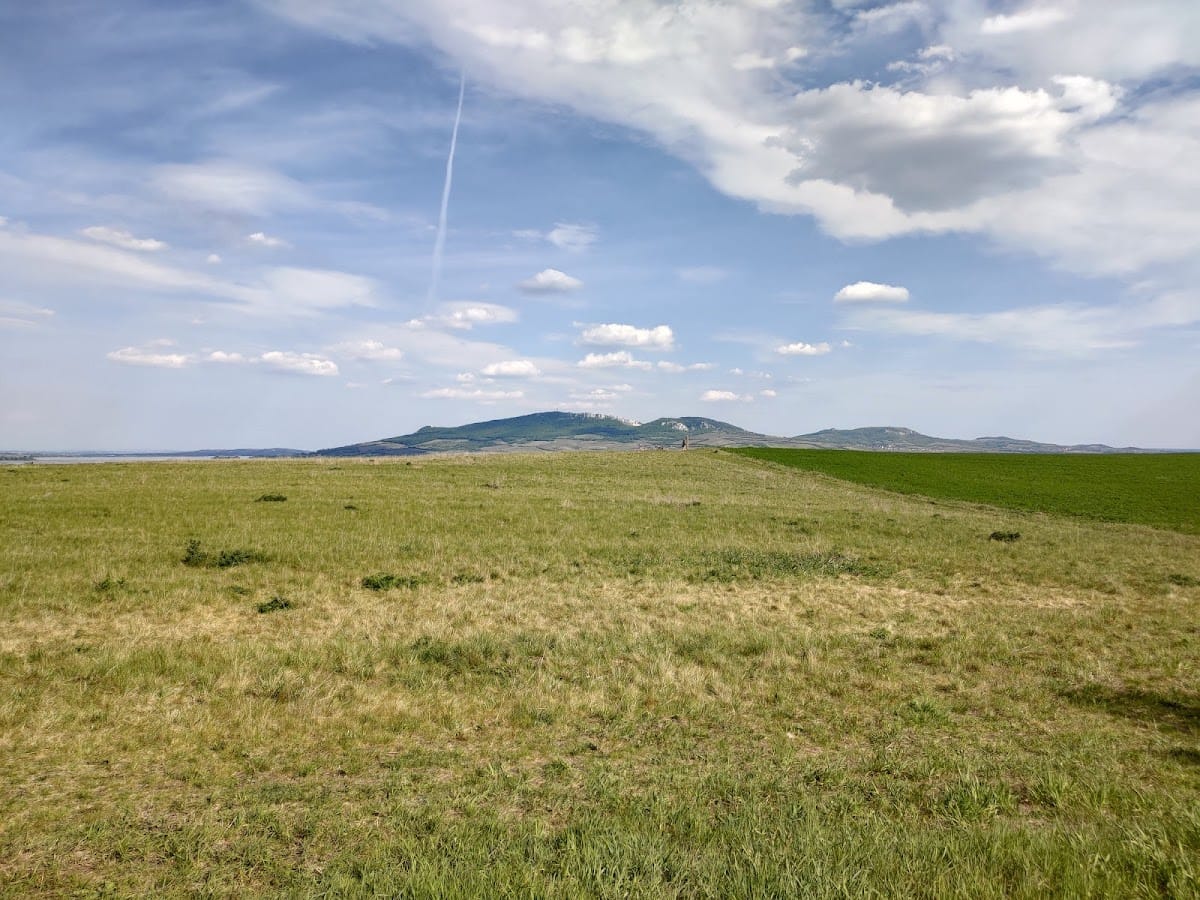
The fortress occupied the summit and the gentle southern and eastern slopes of Hradisko, a moderate hill on the left bank of the Dyje. The hill rises about 50 metres above the surrounding landscape and stands near the confluence of the Dyje, Svratka, and Jihlava. This position gave Roman forces a broad view over the terrain and allowed them to control river crossings, fords, anchorages, overland routes, and the settled river terraces inhabited by the Marcomanni.
The fortified area covered approximately 10 hectares. Its defences included substantial earthworks and a wooden palisade, forming a large fortified position on the hill. Only part of the internal plan has been reconstructed archaeologically. Excavation exposed an area of about 100 by 100 metres containing a rectangular residential building and a bath complex.
Residential building
The rectangular residence contained four rooms and formed part of a high-status complex with the bath. Its position and character have led to its interpretation as accommodation for senior military authorities. The wider fortress also contained administrative or residential buildings connected with command, logistics, and the occupation army.
Bath complex
The bath, or balneum, had a semicircular end, rooms supplied with cold and hot water, and underfloor heating. Its walls were covered with coloured plaster. The warm and hot rooms used a hypocaust, a Roman heating system in which hot air circulated beneath the floor and could also pass through hollow wall spaces. A water-supply installation served the complex. These features place the bath among the facilities associated with the fortress’s senior occupants.
Eastern slope workshops and military facilities
Barracks and work areas occupied the eastern slope. Workshops contained simple round kilns and a large waste pit, remains that point to the repair and possibly the manufacture of military equipment and weapons. Civilian personnel may have worked in this district under Roman military protection. Together with storage areas, barracks, and command facilities, these installations formed a permanent military centre rather than an isolated field camp.
Finds from Hradisko and its excavation area include terra sigillata, other ceramics, coins, brooches, weapons, military equipment, helmet fittings, tools for planing, chisels, hammers, plates, chains, nails, rings, jewellery, and construction materials. Roman bricks and roof tiles bear stamps of Legio X Gemina, the Tenth Twin Legion based at Vindobona. Detachments of this legion were active in Marcomannia during the reign of Marcus Aurelius, and some stamped bricks carry the mark “LEGXGPF.”
A bronze coin showing Marcus Aurelius was found at Hradisko. Another notable object is a uniquely decorated fastening plate from the scale armour, or lorica squamata, of a cavalryman of the Tenth Legion. This armour consisted of overlapping metal scales attached to a garment. The fastening plate probably belonged to a high-ranking officer, possibly a member of the emperor’s immediate entourage.
Temporary camps and river installations
The military landscape around the fortress included at least four camps at Mušov-Na Pískách. Their sizes ranged from about 1.5 to 38 hectares. Ditches surrounding the camps were approximately 1.8 to 3 metres wide, and earthen ramparts helped protect the temporary installations. Some camps served as garrisons controlling roads leading towards Hradisko, while others accommodated large contingents at the beginning of campaigns or functioned as protected river anchorages.
The largest camp covered about 38 hectares before the area was artificially flooded. Its recorded dimensions were approximately 670 by 560 by 630 by 620 metres. These camps were temporary military installations, with internal buildings probably consisting mainly of tents and other short-lived shelters.
Masonry building at Mušov-Na Pískách
A masonry building at Mušov-Na Pískách measured approximately 21 by 7 metres. It may have been a commander’s residence. An underfloor heating system comparable to the calidarium, the hot room of a Roman bath, was found within it. The building demonstrates that some facilities in the surrounding military landscape were more substantial than the tents and temporary shelters used by most of the camps.
Civilian settlement
The wider area above and around the fortress also contained a civilian settlement. Its inhabited zone covered more than 11 square kilometres and was lightly fortified. The settlement was bounded by the Dyje, the Jihlava, and a rectangular enclosure with a V-shaped ditch. It may have existed before the Roman fortress and was densely occupied by Marcomanni or Quadi who traded with the Romans.
The surviving evidence from Hradisko and its surroundings combines fortifications, barracks, workshops, storage areas, residences, baths, and civilian installations. Objects such as stamped building materials, military equipment, coins, and ceramics connect these physical remains with the Roman occupation of Moravia during the final campaigns of Marcus Aurelius.