Sint-Maartenskerk: A Gothic and Neo-Gothic Church in Kortrijk, Belgium


Site at a Glance
- Rating
- 4.5
- Popularity
- Low
- Country
- Belgium
- Primary era
- Medieval
- External website
- Open
- Eras represented
- Medieval, Early Modern, Modern
- Civilizations
- Belgian, County of Flanders, Spanish
- Site type
- Religious
- Remains
- Church
On this page14 sections
History
Sint-Maartenskerk is a Roman Catholic church in Kortrijk, Belgium, dedicated to Saint Martin of Tours. The present church is chiefly a Gothic building reconstructed from 1390 onward and later restored in Neo-Gothic form. Saint Martin was a fourth-century Christian bishop associated with charitable acts and the spread of Christianity in Gaul, and his liturgical feast is observed on 11 November.
Early worship and medieval patronage
A place of worship associated with Saint Eligius stood near Kortrijk’s central market square around 650. Saint Eligius was a seventh-century bishop and metalworker whom medieval tradition connected with the foundation of churches. The early building was later replaced on the same site by a Romanesque church, probably a three-aisled basilica, which remained until about 1270.
The earliest documented reference to the church dates from 1027. In that year, Hardewijn, the bishop administering the Diocese of Tournai-Noyon, transferred its patronage to the House of Oudenaarde, a medieval noble lineage from the Oudenaarde region. Arnulf III van Oudenaarde returned the church to the bishops of Tournai in 1149 or 1150. The Diocese of Tournai-Noyon was a regional Catholic jurisdiction headed by a bishop.
Gothic rebuilding
The Romanesque church gave way to a Gothic building. Much of it was destroyed in 1382 during the aftermath of the Battle of Roosebeke, a late-fourteenth-century conflict whose consequences affected the church directly. Reconstruction began in 1390. The choir was completed and returned to worship in 1414, while the facade was repaired and enlarged in 1414 and 1415. Nave vaults followed between 1416 and 1449, and the tower was completed in 1439.
Expansion continued with a transept and side chapels from 1454. Building work extended into the early sixteenth century, although the principal rebuilding is dated to 1390 to 1466. These works established the large Gothic church whose three aisles, cross-arm, choir, and tower continue to define the building.
Reformation-era damage and later changes
Sint-Maartenskerk survived the iconoclast revolt of 1566, a wave of attacks on religious images and furnishings in the Low Countries. Calvinists, followers of the Reformed Christian tradition associated with John Calvin, looted the church on 30 August 1578. Repairs continued until the middle of the seventeenth century. A clock was installed in the tower in 1603.
The fifteenth-century rood screen, which had separated the nave from the choir, was dismantled in 1757. Material recovered from it was used to build a sacristy in 1761. Anne van Liedekerke, the wife of General Giorgio Basta, has been buried in the church since 1619. The Holy Sacrament Chapel of ’t Putje at Sint-Denijs-Westrem was established in 1687 at a place where consecrated vessels stolen from Sint-Maartenskerk were reportedly found.
Fire, reconstruction, and protection
Lightning struck the tower on 7 August 1862. The wooden spire, which dated from 1601, burned down, destroying the carillon and causing part of the vaulting to collapse. The choir, most of the roofs, and major sections of the tower were seriously damaged. The Jacquemart figures known as Manten and Kalle were also lost. Jacquemarts are animated figures traditionally connected with clock mechanisms and the striking or marking of the hours. The remaining tower ruins were dismantled.
Reconstruction began with the choir in 1866, and the restored space reopened on 5 June 1870. The tower was rebuilt in 1875 and 1876 to a design by Leopold De Geyne. The interior was renovated and a new main portal was erected between 1884 and 1886. The carillon was restored in 1974, the interior underwent another restoration between 1978 and 1981, and the tower was restored in 1987. A Neo-Baroque side chapel was added to the east side of the north transept in 1958. The church entered the protected-monument register in 1937 and is protected heritage in Flanders. It belongs to the Diocese of Bruges, the Catholic jurisdiction serving the region.
Remains
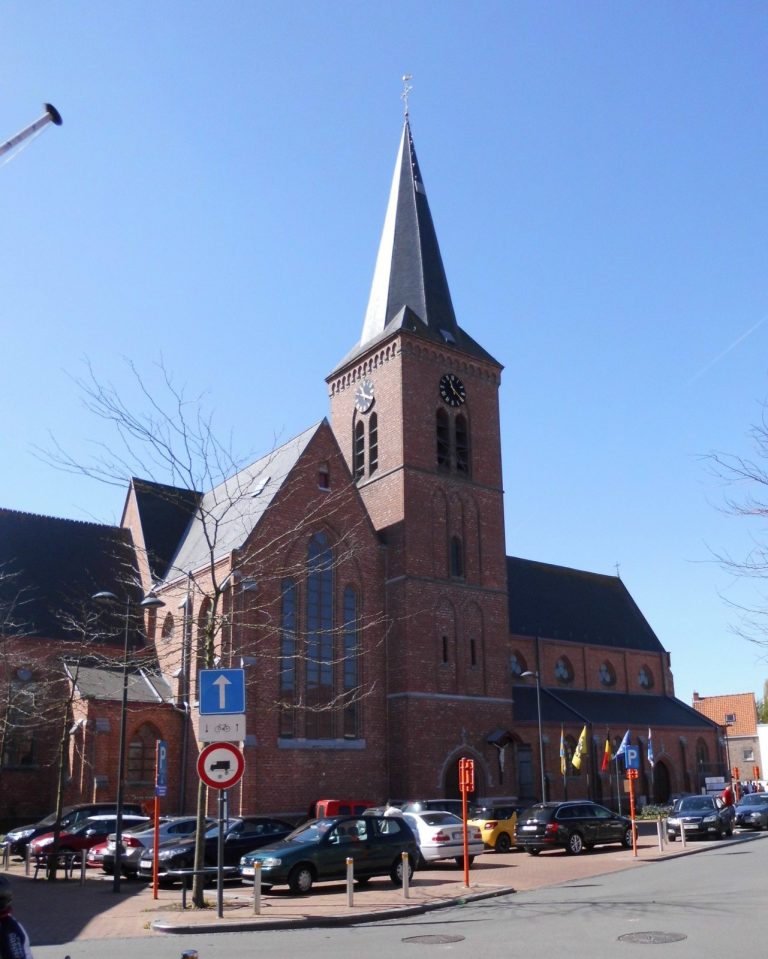
Sint-Maartenskerk is a Gothic and Neo-Gothic hall church with three aisles and a transept. In a hall church, the aisle spaces are approximately equal in height to the central nave, rather than being lower as in a basilica. The nave and transept are built mainly from limestone described as white Brabant limestone, while the choir is constructed of red brick. The building combines the medieval Gothic fabric with nineteenth-century Neo-Gothic rebuilding and later additions.
Exterior and principal spaces
West tower
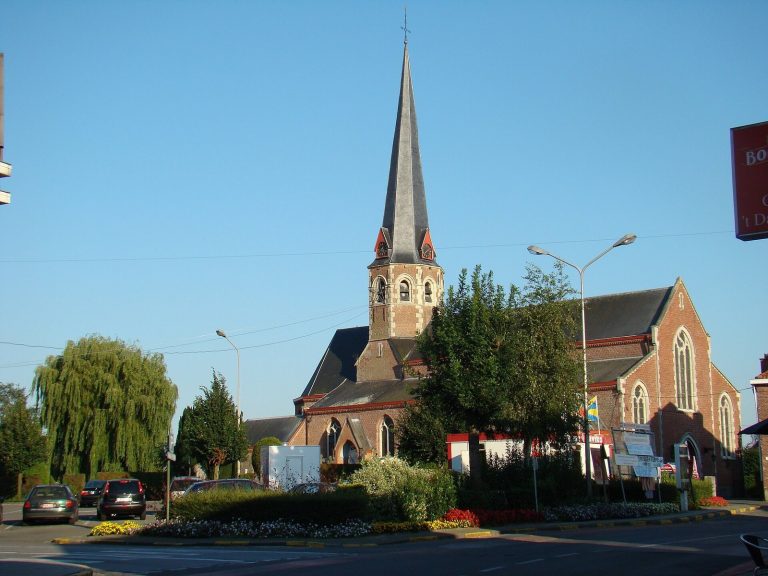
The monumental west tower is in Brabant Gothic style, a regional form of Gothic architecture associated with the historic Duchy of Brabant. It rises 83 metres and carries a wooden spire containing a 49-bell carillon. The bells were cast in 1880. The present tower belongs to the reconstruction of 1875 and 1876, following the destruction caused by the 1862 lightning strike.
Choir and chapels
The central high choir, two side choirs, and Saint Anne’s Chapel were rebuilt in Neo-Gothic form after the fire. A Neo-Baroque side chapel stands on the east side of the north transept, where it was added in 1958. The Bosseniers Chapel contains a small stone sculpture of Our Lady of the Hazel Tree, dated 1485. A cannonball that struck the chapel in 1646 is located beneath the statue.
Interior artworks and furnishings
Sacrament tower
A 6.5-metre-high sacrament tower stands in the choir. A sacrament tower is a tall architectural container used to display and reserve the consecrated Eucharist. Hendrik Mauris, an Antwerp artist, created it in 1585 and 1586. Made from originally polychromed Avesnes stone, it combines the form of a Late Gothic tower with Renaissance sculpture.
Paintings and sculptures
The church contains The Martyrdom of Saint Catherine, painted by Karel van Mander in 1582, and the Triptych of the Holy Spirit by Bernaert de Rijckere, dated 1587. The triptych presents Pentecost in the centre, the baptism of Jesus on the right, and the creation of Adam on the left. Other works include The Adoration of the Magi by Gaspar de Crayer, dated 1630, and Saint Francis Contemplating the Holy Cross by Jan Erasmus Quellinus, dated 1688.
An oak statue known as Our Lady of the Grapes dates from about 1450. Beside the columns of the central nave stand limewood statues of the Apostles, made around 1770 by Nicolas Lecreux of Tournai. Their arrangement symbolically represents the pillars of the Church. Filip Serrus created a depiction of the life of Saint Martin near the right side of the portal. The church also contains a polychromed statue of Saint Martin as a bishop by Jozef Lelan.
Portal, pulpit, and baptismal font
A portal dating from 1595 was restored in 1832. Between 1899 and 1939, an oak statue of the Virgin Mary stood between the two main portal entrances. It was replaced by a white-stone statue of Saint Martin made by Jozef Lelan. The early Baroque pulpit dates from 1665, while the baptismal font is made of red gilded marble and dates from about 1760.
Organs and later additions
Pierre Schyven made the principal organ in 1888. It has 43 stops, three manuals, and a pedal, and was repaired in 1954. A smaller organ from the Loncke workshop was installed before the high altar in 1968. The Stations of the Cross were made in 1996 using the lost-wax technique, a casting process in which a wax model is replaced by molten metal within a prepared mold. They were designed by Heinrich Bartoldus, a German priest from Westphalia.