Gaverkasteel, Deerlijk: A Late-Nineteenth-Century Country Residence
Site at a Glance
- Rating
- 4.3
- Popularity
- Low
- Country
- Belgium
- Primary era
- Modern
- External website
- Open
- Eras represented
- Early Modern, Modern
- Civilizations
- Belgian, Habsburg
- Site type
- Domestic
- Remains
- Castle
On this page10 sections
History
From manor farm to country residence
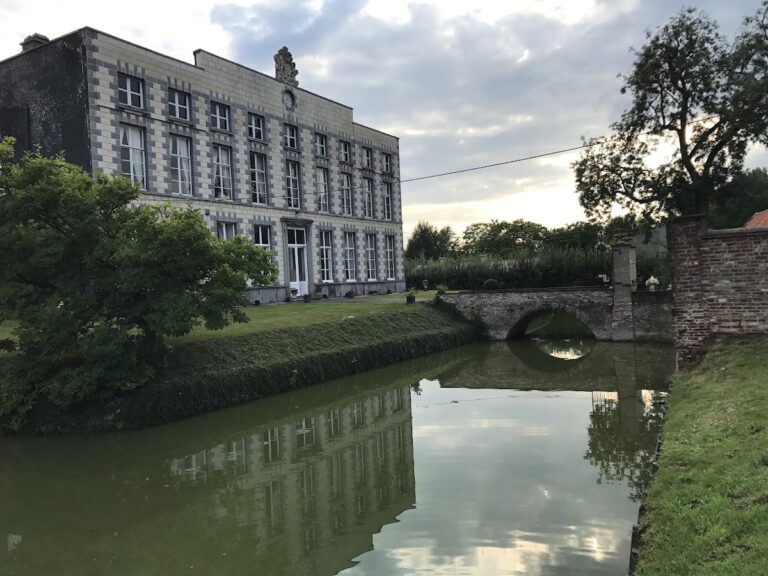
Gaverkasteel is a castle in Belgium that developed from the manor farm known as ‘t Goed ter Plancken. The site was already occupied during the first half of the eighteenth century, and it served as a sheep farm at the beginning of the nineteenth century. The name Gaverkasteel comes from the Gavers, an area of wet meadows several kilometres west of the estate that is now the De Gavers nature reserve.
In the early nineteenth century, the property passed to the wealthy Vercruysse family. At the end of that century, Jonkheer Astère Vercruysse de Solart, a hereditary title holder from the untitled nobility, had the farm transformed into a late-nineteenth-century castle and country residence for use by himself and his family as a summer home.
War, restoration, and changing ownership
During the First World War, German officers requisitioned the castle and transferred much of its valuable furniture to Germany. Astère Vercruysse died in 1921. The following year, his heirs commissioned the Kortrijk firm Kunstwerkstede Gebroeders De Coene N.V. to restore the interior, an intervention associated with the copper coat of arms dated 1922 that remains inside the building.
The castle was sold around 1930. In 1932, its new owner and several associates were arrested after secretly distilling and smuggling alcohol at the property. The estate later changed hands again, before the municipality of Deerlijk bought the castle and adjoining land in 1956.
Creation of the recreation domain
The municipal authorities established the recreation area Het Gaverkasteel in the castle gardens in 1957 and expanded it in 1962. Tennis courts formed part of the facilities. A sports hall was added in 1971, followed by an indoor swimming pool in 1974 and a second sports hall at a later date. Additional land purchased in 1991 enlarged the grounds, which are now officially known as Gaverdomein.
The domain is bounded by Vercruysse de Solartstraat, Schragenstraat, Stationsstraat, and the Ring road, designated N36. For decades, tall trees and the estate’s secluded position kept the castle largely hidden from the road. Since September 2025, its exterior has been undergoing complete restoration. The first phase repaired the crenellations, with further work planned for the facade and loggia, a covered architectural gallery or open-sided extension, before the interior is renovated.
The former carriage house and stable have served for decades as a restaurant and brasserie. The castle itself now accommodates the Social House and the Public Centre for Social Welfare, a Belgian municipal institution providing social assistance and related services.
Remains
Castle interior and decorative features
Entrance hall
A stained-glass window in the entrance hall bears the coat of arms of Vercruysse de Solart. It shows an azure shield with a silver cogwheel and 21 gold crosses. The motto, Sub Cruce Labor, means “labour under the cross.” Bas-relief figures drawn from Greek and Roman antiquity decorate the walls.
Dining room
The dining room contains a wooden mantelpiece made from old church furnishings taken from the church of Ruien. A copper cross hangs above it, with the noble coat of arms rendered in copper beneath. The coat of arms carries the date 1922. Beneath the fireplace, a Gospel scene depicts Jesus at Jacob’s Well with the Samaritan woman.
Heraldic and symbolic windows
Other windows display the coats of arms of Deerlijk, West Flanders, East Flanders, and Hainaut. These places were associated with the family, while Hainaut also refers to the family’s ownership of Château Méaulne in Celles. Another window shows a woman holding a cogwheel in one hand and a bowl in the other, surrounded by birds and fruit.
Former farm buildings and estate grounds
The former carriage house and stable have been extensively altered, but the stable walls retain iron numerals forming the date 1772. The buildings stand within Gaverdomein, whose wider grounds include the castle gardens, tennis courts, sports halls, and indoor swimming pool.