Virga Jesse Basilica: A Marian Pilgrimage Church in Hasselt, Belgium
Site at a Glance
- Rating
- 4.6
- Popularity
- Very Low
- Country
- Belgium
- Primary era
- Early Modern
- External website
- Open
- Eras represented
- Early Modern
- Civilizations
- Holy Roman Empire
- Site type
- Religious
- Remains
- Basilica
On this page17 sections
History
Virga Jesse Basilica is an eighteenth-century Marian pilgrimage church in Hasselt, Belgium, built in a late-Baroque and early-Classical style between 1727 and 1731. It developed from a medieval sanctuary dedicated to the Virgin Mary and continues to serve as the focus of Hasselt’s Seven-Yearly Festivities.
Medieval sanctuary
Marian devotion in Hasselt is recorded from the thirteenth century. A document from 1308 mentions a confraternity dedicated to Our Lady, while tradition places an early chapel in a hazel grove. In 1334, a wealthy member of the Brotherhood of Our Lady built the Clerken Chapel on the site of the earlier sanctuary. The chapel was consecrated by the bishop of Liège in 1357.
The chapel stood beside the busy commercial route between Bruges and Cologne, a position that helped encourage pilgrimage. Ecclesiastical authorities granted indulgences, and stories of miraculous cures increased the sanctuary’s reputation. During the fifteenth century, Marian processions took place one week after the Feast of the Assumption and on the anniversary of the chapel’s consecration.
Religious upheaval and renewed devotion
Religious wars in the second half of the sixteenth century brought the pilgrimages and processions to an end. They resumed in 1645, and the sanctuary became particularly active during the second half of the seventeenth century. Pope Alexander VII granted indulgences, the confraternity became highly active, and the Marian statue acquired the name Virga Jesse, meaning “Branch of Jesse.” The expression refers to the Christian image of Christ’s descent from Jesse, the father of King David, and is especially associated with the Virgin Mary and Christ Child.
From 1682, the processions held every seven years were conducted with greater solemnity. They included prayers seeking Mary’s protection from natural and other calamities. Four priests carried the statue, while nine altars in different parts of Hasselt served as special places of veneration along the route.
The present church
The present church replaced the earlier chapel on the same site. Construction began in 1727 and was completed in 1731. It was formerly known as the Church of Our Lady, before the name Virga Jesse became associated with the basilica and its pilgrimage tradition.
The French Revolution interrupted pilgrimage and Marian devotion once more. In 1798, a member of the confraternity hid the statue in his home. It emerged from hiding five years later, after which pilgrimages and the annual and seven-year processions resumed.
Nineteenth- and twentieth-century changes
From 1846 to 1899, Franciscan friars, members of the religious order founded by Saint Francis of Assisi, were responsible for the church and its pilgrims. Among them was Blessed Valentinus Paquay, a Belgian Franciscan priest and confessor. On 15 August 1867, François-Xavier de Mérode, a Belgian churchman and papal official, solemnly crowned the statue as the representative of Pope Pius IX.
In November 1944, a German V-1 flying bomb heavily damaged the church and neighboring houses, killing sixteen people. The church was rebuilt and reopened for worship in 1951. On 6 May 1998, Pope John Paul II raised it to the status of a minor basilica, a papal title granted to churches with particular religious, historical, or pilgrimage importance.
The church has been a protected monument since 1980. A major renovation carried out for the 2017 Seven-Yearly Festivities moved the Marian statue to a new chapel at the front right, relocated the tombs, and installed new lighting. In 2023, serious structural problems required the removal of the upper part of the bell tower, including its carillon. A bent vertical beam, rotten wood, and other defects had weakened the spire. Plans exist for the tower’s restoration.
Remains
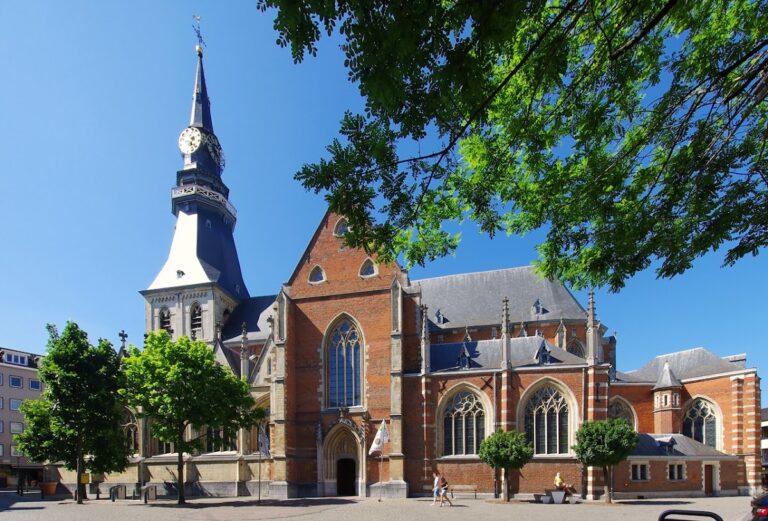
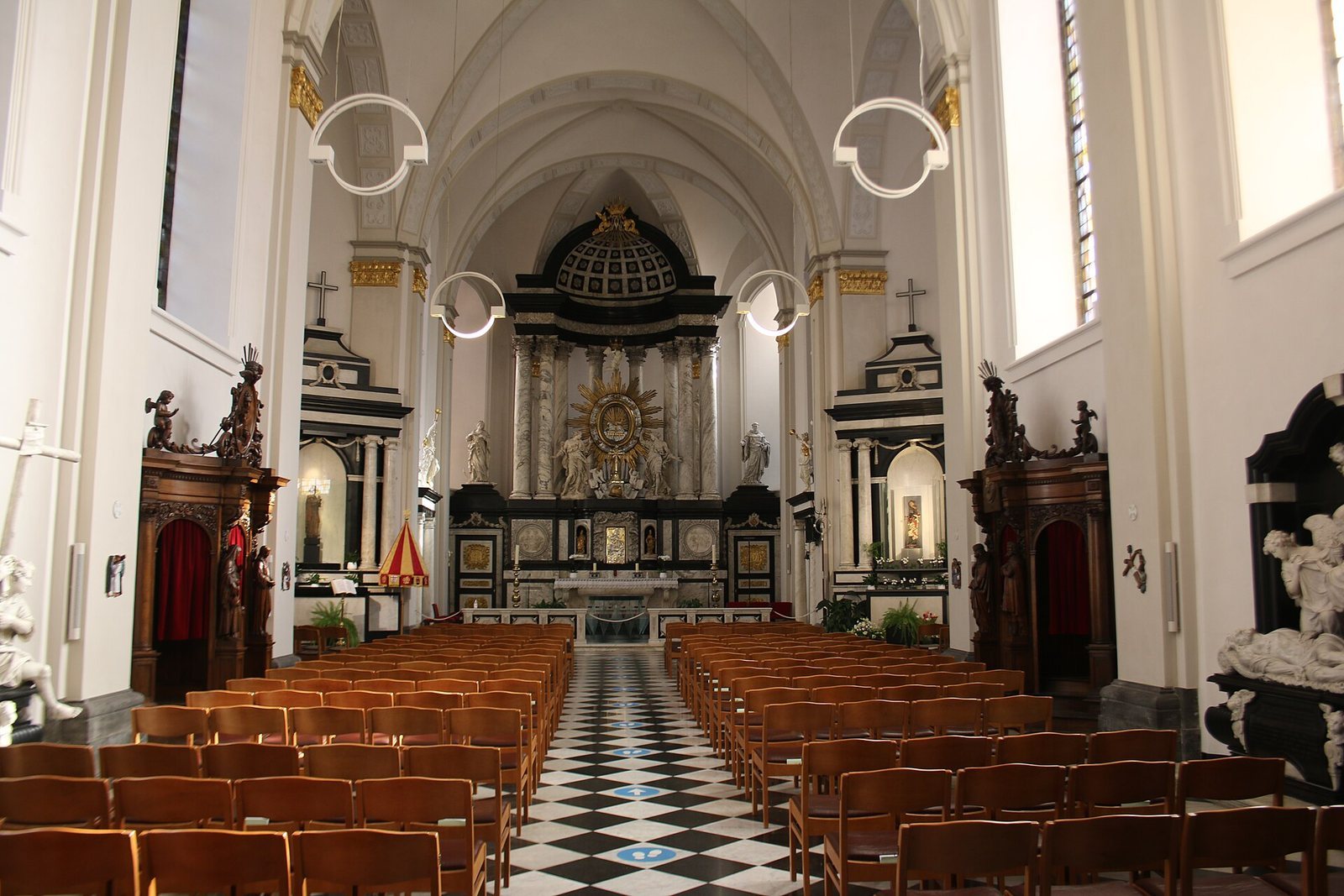
Virga Jesse Basilica is a stone-built church on Kapelstraat in Hasselt. Its single nave, late-Baroque and early-Classical design, devotional furnishings, funerary monuments, and surviving religious objects reflect the long development of the sanctuary. The church’s historic fittings include works transferred from Herkenrode Abbey and an organ that has been in the basilica since the postwar rebuilding.
Marian statue and devotional setting
Virga Jesse statue
The Virga Jesse is a Gothic oak carving approximately one metre high, made from a single block of wood. The crowned Virgin Mary carries the Christ Child on her left arm. Its posture and facial expression place it in the early fourteenth century. The statue survived the sixteenth-century Iconoclasm, a period of religious upheaval in which Protestant forces damaged or destroyed religious images in the Low Countries. It also survived the bombing of 4 November 1944 and was recovered almost intact beneath the rubble.
The statue was formerly displayed in the middle of the church. Following the 2017 renovation, it was placed in a new chapel at the front right, creating its present devotional setting within the basilica.
Altars and funerary monuments
High altar
The high altar is a Baroque work by Jean Del Cour, a sculptor from Liège. It originally came from the abbey church of Herkenrode before being installed in the basilica.
Herkenrode tombs
Two marble funerary monuments in the transept also came from Herkenrode Abbey. One is the tomb of Anna Catharina de Lamboy, abbess of Herkenrode from 1609 to 1675, made by Artus Quellinus the Younger. The other commemorates Barbara de Rivière d’Arschot, an abbess who lived from 1666 to 1744, and was made by the Ghent sculptor Laurent Delvaux.
Later furnishings
Confessionals and organ
The confessionals were made by Janssens of Sint-Truiden between 1858 and 1867. One carries a copper plaque recalling that Valentinus Paquay heard confessions there while living in Hasselt.
The organ was built around 1860 by the Belgian organ builder Arnold Clerinx. It was first installed in the Saint Elisabeth Hall in Antwerp and has stood in the basilica since 1952. Restoration took place in 2003.
Stained glass and basilica insignia
The church contains stained-glass windows, including one representing the Tree of Jesse. Its basilica insignia are displayed in the choir: a conopeum, or ceremonial papal canopy, and a tintinnabulum, a bell mounted in a ceremonial holder.
Treasure and bell tower
Church treasure
Part of the church treasure is displayed at Het Stadsmus museum. It includes mantles and jewels made for the Virga Jesse statue, among them the silver “Morin dress,” recognized as a Flemish heritage masterpiece. The collection also includes a cross-shaped reliquary made in 1703 and containing a relic of the Holy Cross, a distinctive set of pomanders, and a Baroque sun monstrance made by Nicolaas Sigers and Steven Van der Locht in 1669.
Bell tower
The upper section of the bell tower, including its carillon, was removed in 2023 because of structural instability. The tower therefore remains incomplete while possible restoration is considered.