Groeningeabdij Kortrijk: A Cistercian Nunnery and Museum in Belgium
Site at a Glance
- Rating
- 4.2
- Popularity
- Very Low
- Country
- Belgium
- Primary era
- Early Modern
- External website
- Open
- Eras represented
- Early Modern, Modern
- Civilizations
- County of Flanders, Spanish
- Site type
- Religious
- Remains
- Fortified Monastery
On this page8 sections
History
Groeningeabdij Kortrijk is a former Cistercian nunnery in Kortrijk, Belgium, founded in the mid-1230s in the medieval period and dedicated to Our Lady. Its mainly French-speaking community followed the Rule of Cîteaux, a Western Christian monastic tradition centred on disciplined communal life, prayer, and relative simplicity. The nunnery received formal affiliation with the Cistercian Order in 1236.
Foundation and move to Groeninge
The first monastery stood at the Rodenburg estate in Marke under the name Speculum beatae Mariae Virginis. Financial problems and a nighttime raid in 1259 forced the closure of the Rodenburg house. Beatrix of Kortrijk, a noblewoman connected to both the Brabant and Flemish aristocracy, initiated the community’s transfer to Groeninge, outside Kortrijk’s walls. Construction began in 1260, the nuns had moved by 1265, and the new abbey buildings were complete by 1286. Beatrix financed part of the work and later acted several times as the abbey’s protector.
When Beatrix died in 1288, her heart and entrails were placed in a monumental tomb in the abbey church. Her heart was later transferred to St Michael’s Church. The abbey also became connected with the Battle of the Golden Spurs in 1302, fought nearby along the Groeninge stream. Flemish and Namur forces defeated the French army. The abbot of Ten Duinen Abbey, who exercised authority over Groeningeabdij and supported the French-aligned Leliaard faction, fled to France after the battle. French and Hainaut knights who fell in the fighting were buried at the abbey for a limited period or permanently.
Prosperity and medieval decline
Effective administration brought a period of prosperity during the fourteenth century. The abbey received increasing donations of property, although it never became wealthy. After a dike breach, it could not pay for the necessary repairs and had to sell adjoining land. During the abbacy of Margareta Mols, who died in 1384, a wall was built around the abbey. The Count of Flanders also granted an exemption from tolls on the abbey’s monastic livestock when it was sold at market.
From the fifteenth century, Groeningeabdij entered a long decline as established Western European monasteries weakened and newer religious orders gained influence. The community became underpopulated and the buildings gradually fell into ruin. Only a small group of approximately eight to twelve sisters remained. A papal bull, a formal decree issued by the pope, brought the abbey within the ruler’s sphere of influence in 1515 and allowed the ruler to determine the appointment of the abbess, the female superior of the nuns.
The nuns responded to their changing circumstances by providing education as a source of income and caring for distressed people, the poor, and the sick. They also established a hospital for men. These activities continued as the abbey faced the political and military upheavals of the sixteenth century.
Destruction and the urban abbey
During the revolt against Spanish rule, the Ghent Republic, an insurgent polity that controlled Ghent and surrounding areas, held Kortrijk. In 1578, the abbey outside the city walls was almost entirely destroyed under the Prince of Orange, and the nuns took refuge in Kortrijk. In 1581, the abbess bought several houses at the Houtmarkt for a refuge house inside the city. The community settled there permanently in 1583. The new abbey was complete by about 1600, and a substantial surrounding wall was added in 1627.
The urban monastery soon experienced serious financial and disciplinary difficulties. Around fifty nuns lived there, while the community faced disorder, repeated breaches of its rules, poor relations among the sisters, and violations of the celibacy obligation. Victoire Gillon was elected the last abbess in 1784. Heavy taxation under French rule preceded the expulsion of the nuns in 1796–97, and the abbey was suppressed during the French Revolution.
Later use and museum redevelopment
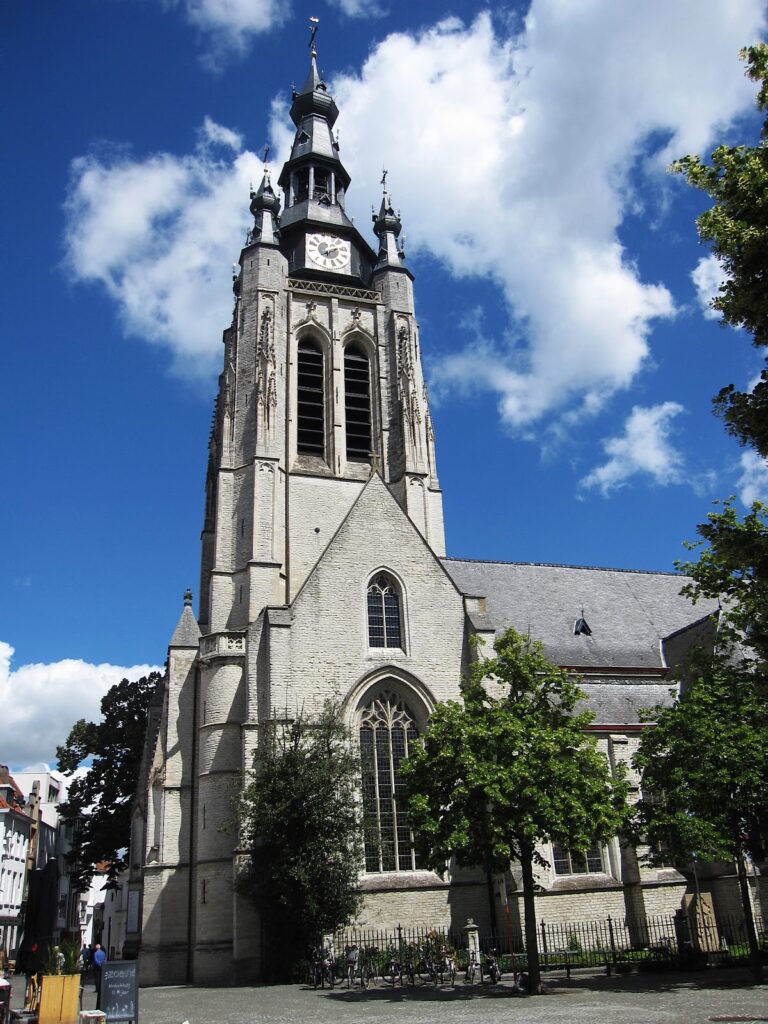
The surviving buildings were occupied by the Poor Clares, a Catholic order of contemplative nuns founded in the thirteenth century, from 1845 to 1978. Proposals to demolish the site were prevented, and it was repurposed during the 1980s. The former abbey remained a closed ruin until it reopened in the late twentieth century. In 2004, the restored dormitory and nineteenth-century chapel were given museum functions. The complex first housed the Museum of the History of Kortrijk and then, from 2007 to 2021, Kortrijk 1302, a multimedia museum devoted to the Battle of the Golden Spurs. That museum later moved to the Church of Our Lady of Kortrijk.
Groeningeabdij is protected heritage in Flanders under monument number 59636. The former abbey buildings were renovated for the Abby museum, which opened in March 2025 as an exhibition venue for visual art centred on identity. The redevelopment included the demolition of the former regional visitor centre, a park pavilion, and 600 square metres of underground exhibition space.
Remains
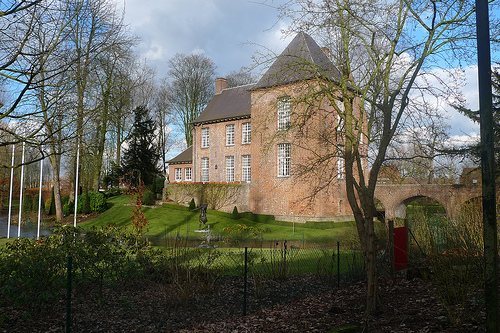
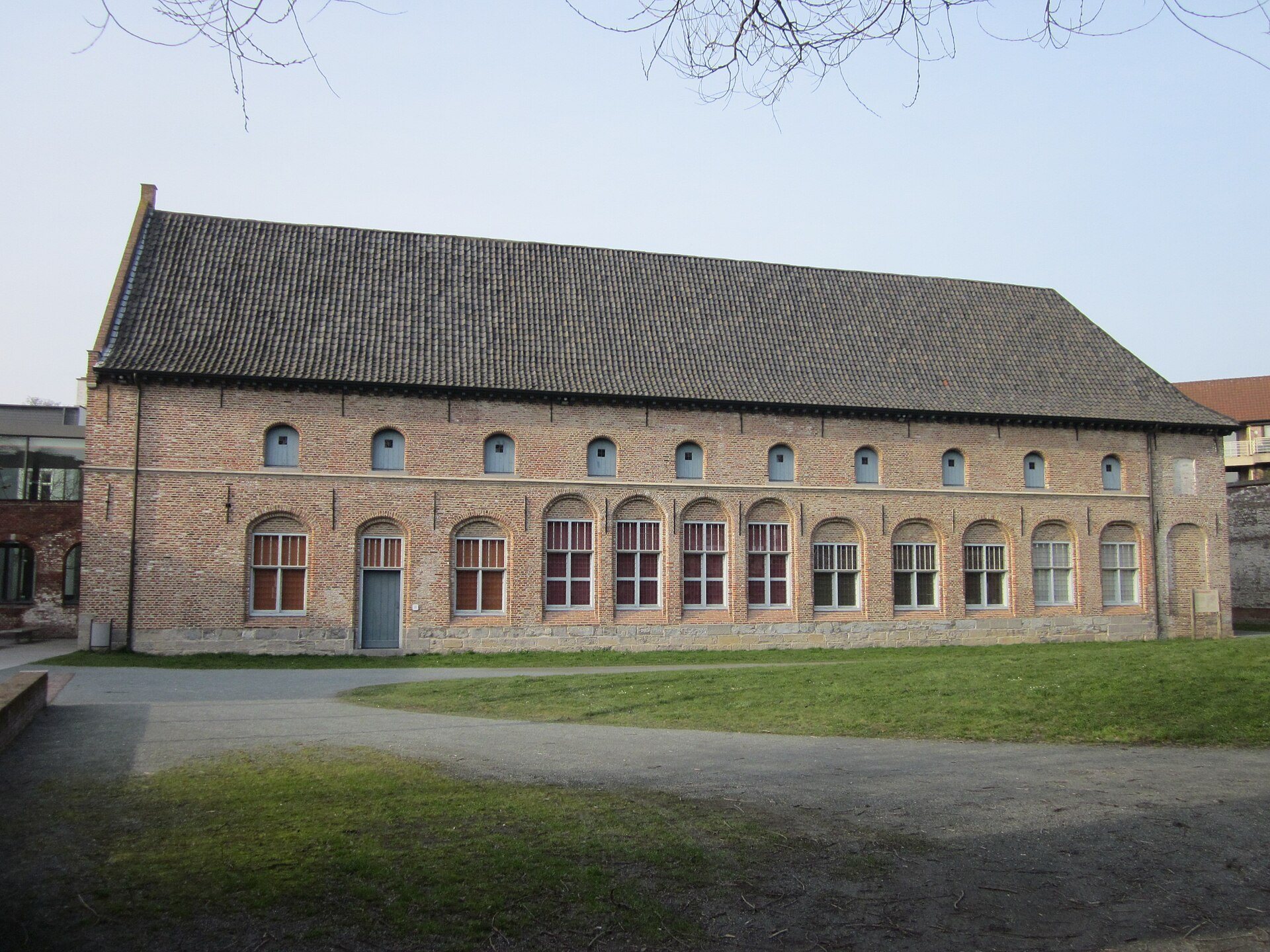
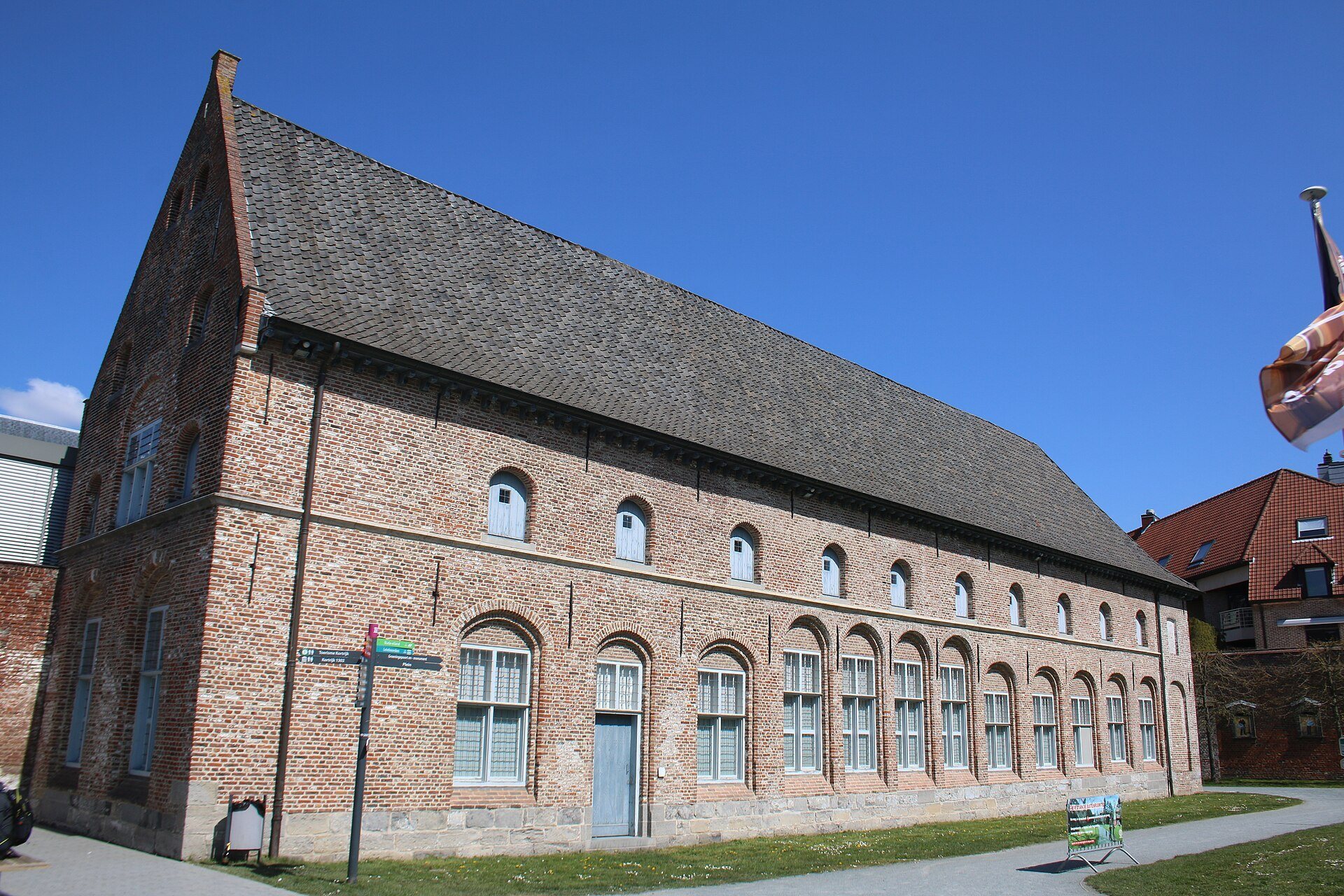
The site’s surviving fabric reflects its three successive locations: the original monastery at Rodenburg in Marke, the thirteenth-century establishment at Groeninge outside Kortrijk, and the urban complex created inside the city from 1581 to 1583. The surviving dormitory stands in the present Begijnhofpark area between Groeningestraat and Begijnenhof. Restored by 1992 and renewed during later museum redevelopment, it forms part of a complex that also includes renovated abbey buildings, an inner courtyard now used as a park, a pavilion, and underground exhibition rooms measuring 600 square metres.
Walls and urban buildings
The outer abbey at Groeninge was enclosed by a wall built during the tenure of Margareta Mols. The later urban monastery received another substantial surrounding wall in 1627. Its buildings included a nineteenth-century chapel and a hospital built for men. The restored dormitory and chapel were adapted for museum use in 2004, while the inner courtyard became part of the present park landscape and the wider museum complex.
Memorials and devotional remains
A tomb monument in the former abbey church held the heart and entrails of Beatrix of Kortrijk before her heart was moved to St Michael’s Church. The museum also displays a gravestone attributed to the legendary King Sigis, who was supposedly buried at the abbey after the Battle of the Golden Spurs. His existence is considered fictitious. The miraculous image of Our Lady of Groeninge, the local devotion to Mary, is venerated in St Michael’s Church rather than at the former abbey.